Monday, November 15, 2021

Movie Music: Hans Zimmer's "The Lone Ranger" (2013)

I love this soundtrack. And this movie. I bought the soundtrack shortly after I saw The Lone Ranger (2013) in the theater for the second time.  For the next two years, I never put the CD on my shelves -- it lived in the kitchen, next to the little CD player I use while I'm cooking. I listen to it at least once a month still, usually on those hard-to-get-moving mornings when I need a blend of oomph and comfort to set me on my feet. It shot quickly to the top tier of my list of favorite soundtracks, and I doubt it will ever drop out of the top ten. 


By now, this music courses through my veins. It's become an integral part of my consciousness. So right now, you're going to hear the music that flows through my brain at some point just about every single day. This is what it sounds like to be inside my head, some of the time anyway. 

I'll start you off with "Silver," a gentle, haunting song. It begins wistfully, then builds to a theme of yearning and desire. 


"Ride" starts off sounding like something from one of Ennio Morricone's spaghetti western soundtracks. That first 45 seconds of it makes me want to jump on a horse and, well, ride. Ride toward something important, some necessary action. Then it twists, becoming quieter, more thoughtful. Later, it opens up into a sweeping theme that makes me think of wide-open spaces, with no boundaries or limitations. 


And as for the "Finale," well, this is my musical happy place. I can't hear it and not smile, not get cheered up, not start to bounce. You know the familiar "William Tell" theme by Rossini, which the old TV show and radio show used for their theme song -- "Finale" takes that theme and runs wild with it. My absolute favorite part kicks in at 7 minutes when the theme returns off-cadence and minor, and then 30 seconds later these trumpets come in with what I think of as a love song to the Old West. That part makes me ache with joy. 


Happy trails!

(The bulk of this review originally appeared here at J and J Productions on August 31, 2015.)

Saturday, November 13, 2021

"Charade" (1963)


Some people call Charade (1963) "the best Alfred Hitchcock movie that Hitchcock never made."  I can see why -- it's got so many of the same ingredients of classic Hitchcock suspense films.  Exotic European locales? Check.  Confused, innocent person pursued by hitherto unknown Bad Guys?  Check.  Beautiful woman in danger?  Check.  Chic costumes?  Wry humor?  Cary Grant?  Check, check, checkity check.

But I love Charade far more than any of Hitchcock's movies.  In fact, there are no Hitch films on my top 100 list, but Charade is firmly there.  I think that's because there's one key difference between Charade and even my favorite Hitchcock films:  I believe the happiness of its ending.  With all of Hitch's films, with the possible exception of The Trouble with Harry (1955), there's always this lingering... off feeling at the end.  Will the hero and heroine live in peace and happiness now that they're through whatever harrowing ordeal we've watched them survive?  In Hitchcock's movies, the answer is usually 'maybe.'  But with Charade, at least for me, the answer is a total 'yes.'


Regina Lampert (Audrey Hepburn) is suddenly, violently widowed when her husband falls from a train... or is pushed.  At his funeral, some very weird characters (played by James Coburn, George Kennedy, and Ned Glass) show up and behave fairly weirdly near the coffin.  


Then, they start threatening Regina.  They claim her husband had a lot more money than she knew about, and they insist he stole it from them.  The trouble is, no one can find the money.

A handsome, helpful man called Peter Joshua (Cary Grant) helps her out of a couple of jams, protecting and rescuing her from the three weirdos several times.  Peter and Regina had met before, just before her husband died, and she's all to happy to have him around giving her advice and shielding her from harm.


However, things keep getting stranger and stranger.  It's as if Regina is trapped in a kaleidoscope that a little kid keeps turning.  Names, identities, stories, and situations shift without warning, keeping her constantly off-balance.  Without Peter Joshua there to steady her, she would surely lose her footing completely.


Watching Audrey Hepburn and Cary Grant together is pure magic.  Grant didn't initially want to make the movie because he felt the 25-year age gap between himself and Hepburn made the film's romance too ridiculous.  The screenwriters added a lot of little jokes about it to appease him, and he agreed to make the movie after all.  Thanks to those jokes, what might have been a slightly weird love story turns into a quirky and charming one, all because the characters acknowledge their age difference and accept it, so we do too.  Completely brilliant.

(Oh, and Regina was planning to get a divorce before her husband suddenly died, so that neatly eliminates any weirdness about her falling in love right after her husband's funeral.  For me, anyway.)


I watched this with my best friend a week or so ago.  I love this movie and have seen it many times, but she had only seen it once and didn't like it.  That made her curious to know why I love it.  I decided it mostly boils down to the fabulous dialog that makes me laugh and laugh and laugh, and the fact that I totally love the two main characters.  The lovely costumes and exciting story are fun bonuses, but they're not what draw me to the story.  I am here for Hepburn and Grant trading snappy, snarky, sassy one-liners and falling in love along the way, and that's all there is to it.


While we watched this together, my best friend commented that she really doesn't understand why Regina keeps trusting Cary Grant's character when his story changes every twenty minutes or so.  He's obviously lying to her -- he admits that repeatedly, and tells her new lies.  Why does she continue to trust him for so long?  I had to think about that for a bit, because it's a good question.  


I finally concluded that she trusts him because his words change, but his behavior doesn't.  He is always, always there for her, ready to help, rescue, shield, encourage.  He cheers her up, makes her laugh, feeds her, comforts her.  His truthful actions speak louder than his lying words, and those are what she trusts.  Only when she thinks she can't trust his actions anymore does her trust in him waver.

(Mild spoilage in this paragraph.)  Also, here's something I never picked up on while watching it all these times, but did while screencapping it -- Cary Grant is nearly always shot facing toward the right of the frame.  That codifies him as being a trustworthy good guy heading in the right direction.  Whenever he and Audrey Hepburn share the screen, he's on the left, looking right, as you can see in my screencaps.  That very subtly lets the audience know that yes, he is a good guy doing the right thing.  Pretty cool.  (It also means that whenever they share the screen, Audrey is looking left and thus signals that she's confused, going backward, or not doing things quite the way she ought, which is also super interesting.)  (End spoilage.)

Is this movie family friendly?  Mostly.  There are a couple of instances of taking God's name in vain, and maybe another mild cuss word or two.  There's this weird scene with people on a riverboat playing a game where they have to take an orange from the other person without using their hands that gets a little suggestive.  And there's a very tense and menacing scene where someone is threatened while getting burning matches dropped on them.  There's a gunfight and some hand-to-hand fighting, all sixties-style and non-gory.


This is my contribution to the Distraction Blogathon hosted by Taking Up Room.  The money in Charade is a MacGuffin because no one in the audience actually cares about it, it's just a reason to have a bunch of guys chase Audrey Hepburn while she trades sparkly quips with Cary Grant.  If you like classic cat-and-mouse movies, but you haven't seen Charade (or haven't seen it recently), it's FREE on Amazon Prime right now!  And it's not expensive on DVD either.

Friday, November 12, 2021

My Last Femnista Post


Yes, it's true.  After ten years of "[b]ringing young women together to inspire and create, through art, fiction, history, and literature," Femnista is ending.  The final issue is dedicated to Things We Love, giving contributors a chance to celebrate one last movie, book, or other piece of entertainment or art is dear to our hearts.

My final article is called "Forever My Favorite: The Man from Snowy River" and you can read it here.


Sunday, October 31, 2021

"No Time to Die" (2021) -- Initial Thoughts

No Time to Die
 (2021) gave me something I've never gotten from a James Bond movie: a hero.

Don't get me wrong -- I've thoroughly enjoyed many James Bond movies, and loved several.  I am a fan of the franchise, overall.  But James Bond has never been an actual hero for me.  His movies deliver adrenaline-fueled fun, and that's all I need from them. 

I'm not sure what I think about No Time to Die overall.  I think it was a little longer than necessary, and I still haven't figured out a couple things.  Which means I just need to watch it over again, that's all.  A second viewing will determine whether I quite like it, or just kinda like it.

But I know I loved one thing.  I love that James Bond got to be really, truly my hero for the first time that I can really remember.  Oh, he always gets to play the hero: stop the bad guys, save the day, put himself into harm's way for queen and country.  But that's different than actually being my hero.  

The moment that made him my hero is kinda spoilery, so maybe don't read farther if you're caring about spoilage.  Go see it, come back and read this after, etc.

You see, James Bond gets to do something in this movie that he often fails to do:  he saves the girl.  Yes, I know there have been Bond girls who've survived to the end of the movie before.  They don't all die.  But back in GoldenEye (1995) when Alec Trevelyan taunts Bond about all the dead women he failed to protect... he's onto something.  A lot of Bond girls die in a lot of Bond movies.  And it's usually somehow Bond's fault -- he's usually just a little too late.

So, it was a big and exciting moment for me when James Bond put the woman he loves, another woman, and a little girl into a raft and sent them away to safety.  Because, in that moment, he became the truest, highest, realest kind of man.  A real man who will shield and shelter women and children with his every resource, including his own life.

And that woman he loves?  She does what real women do:  she realizes the gravity of the situation and accepts his protection.  She does not pretend she doesn't need his protection or his help.  She does not scorn it.  She does not protest at all.  He offers to send her to safety, and she goes.

Did I then cry?  I did.  I got tears of pride and joy in my eyes, watching James Bond become, at long last, my hero.  That moment was worth the price of admission, the price of my popcorn and Coke, and the slightly overblown runtime.  I was so thoroughly happy.  Well done.

Friday, October 29, 2021

Movie Music: Bernard Herrmann's "Jane Eyre" (1943)

I have only been a fan of the 1943 Orson Welles/Joan Fontaine version of Jane Eyre for about a year.  Very late to that party, I know.  But like it more and more every time I watch it.  You can read my review of it here, and see how it stacks up against other versions of Jane Eyre that I've seen on my comparisons page.  


In this post, I'm going to focus on Bernard Herrmann's score for this film, a score that fits the moody, atmospheric imagery of this adaptation just perfectly.  I'll focus on my favorite tracks, but you can currently listen to a nice recording of this soundtrack on YouTube here.  I have the original motion picture soundtrack on CD, conducted by Bernard Herrmann, but the version on YouTube is enjoyable too.  And, if you want something kind of dark and intense to listen to over Halloween weekend, it's definitely a nice choice for that!

My first selection, "Jane Alone," has a pensive and gentle beginning.  But it turns darker, more passionate.  This piece really evokes Jane Eyre's unhappy childhood, taunted and tormented by her cousins and always craving peace and quiet.  


"Rochester's Past/The Fire" is actually two tracks put together, but they work nicely that way because they're both filled with sturm und drang, as the Germans would say -- storm and stress.  Those are big parts of the Romantic literary tradition that Charlotte Bronte's novel Jane Eyre belongs to, so this fits really well with the story being told.

This music begins with a kind of glowering sadness that matches Rochester's story of his tragic (at least, in his mind) past.  It's not stormy at first, but it has a definite darkness to it.  Then the tension mounts, and around 2:30 into it, the music turns frantic, leaping and darting around in crazy ways that definitely makes you think of fire.  This fits to the part of the movie where someone sets fire to... well, I won't spoil it, but there's fire, there's a rescue, and it's all pretty thrilling.  

I love the way Herrmann uses anxious strings and mournful wind instruments here to let us know what is happening is both scary and sad.


My last selection to share with you today is "The Garden," which is the music from the pivotal scene where Jane Eyre and Mr. Rochester first declare their love for each other.  (That's not a spoiler, right?  This is a love story, and we all know it, right?)  It starts out a little bit ominous, but layers that with a sweetness and hope that clue us in to the happiness these two characters are about to glimpse.  But the music never turns altogether joyful, always a little wary and dark even in this happy scene.

So, now you've had a taste of what Bernard Herrmann's score for Jane Eyre is like!  I hope you've enjoyed this little tour.  This has been not only part of my ongoing Movie Music series, but also my contribution to the Bernard Herrmann Blogathon hosted by Classic Movie Muse all weekend long.  Check out her post here for links to the other contributions.


Saturday, October 16, 2021

"Imitation General" (1958)


I mostly love Imitation General (1958) because it feels like an extended episode of my favorite TV show, Combat! (1962-67).  I expect the characters from that show to just come marching up over some hill on the horizon and set about helping the people in this one fix their problems.  They never do, but I feel like they might at any moment.  There are just so many similarities between the two!


For one thing, Master Sergeant Murphy (Glenn Ford) carries a Thompson machine gun just like Sergeant Saunders (Vic Morrow) has on Combat!.  The sound effects for it aren't quite the same (not so smooth and purring as Saunders'), but oh well.  It's still a Thompson, my favorite weapon of all time.  (Shh, yes, even over a Winchester repeater or a Colt .45.)


Also, these soldiers are wandering around what's supposed to be the French countryside after D-DAY, but is obviously the rolling hills of southern California outside Culver City, exactly where Combat! filmed quite a few episodes.  


Not only that, but they even have fight off a German soldier played by Paul Busch, who appeared in thirty-five episodes of Combat! -- more than 1/5 of the episodes!  I mean, how can my beloved Second Squad be far away?  I don't think we even find out what outfit these soldiers are with, so I have headcanoned them into the 361st Regiment and figure they'll meet up with King Company sooner or later.

Actually, the Combat! episode "The Prisoner" has a lot of similarities to the plot of this movie, now that I think about it.


Anyway, Imitation General is called a comedy, and it does have a lot of funny parts.  But it's also a good war movie, with lots of action that's deftly executed.  And it's a pretty good character study too, looking at the way that responsibility affects people, how important leadership is, and so on.  The storyline is quite serious, it's just the way characters react to things that makes it funny.  Well, and a few sight gags, plus Red Buttons making a lot of amusing faces.  


Brigadier General Lane (Kent Smith) is touring near the front lines, boosting morale with his presence and getting a more accurate picture of how the war is going.  His driver, Corporal Derby (Red Buttons), worries constantly that they're all going to be killed, and keeps trying to convince the general to go back to headquarters.  His aide, Master Sergeant Murphy, does what he can to keep them all safe, ever vigilant and ready to defend the three of them when needed.


Unfortunately, General Lane chooses to protect his sergeant instead at a critical moment, and takes a bullet in his place.  Right about then, the Krauts make a big push and cut off the American troops in that area from the rest of the Allied forces.  Murphy and Derby hide in a half-ruined farmhouse, where they've dragged the general's body to keep it out of enemy hands.


A worried corporal named Sellers (Dean Jones) wanders into the farmhouse, convinced he's got shell-shock and should be in a hospital.  Really, he's just freaked out at discovering he's scared of getting killed, and once Murphy convinces him of that, he's pretty brave for the rest of the story.  But he thinks that Murphy is a general because he's holding General Lane's helmet, and Murphy uses that mistake to boost Sellers' morale.  And then Murphy realizes that, if everyone thinks he's a general, he can rally the troops and lead them in fighting their way out of the pocket the Krauts have sewn them into.  So he sets about doing exactly that.


The trouble is, there's this private named Hutchmeyer (Tige Andrews) who knows Murphy from earlier in the war and has a grudge against him.  Most of the funniest parts of this movie come from Derby's efforts to convince Hutchmeyer that Murphy is dead, and also keep him from discovering that Murphy is pretending to be General Lane.


Various exciting things unfold, like Murphy and Sellers taking on a bunch of Germans by driving straight at them a Jeep with half a metal water tower tied to the front.  There are also several tanks involved, including one driven by the aforementioned Paul Busch.  


And there's a local French girl, Simone (Taina Elg), that Murphy and Hutchmeyer both take a shine to.  Everything turns out okay in the end, I assure you, just like it would if it was one of the more light-hearted episodes of Combat!.


Is this movie family friendly?  Basically.  Simone takes a bath, so you get to see her bare shoulders and legs, as shown on the lobby card at the top of this post.  Soldiers leer at her, Hutchmeyer obviously wants to seduce her, and there's some dialog about soldiers missing/yearning for women.  At one point, a character pretends to be attacking Simone violently to convince another character to leave the premises, but it's a sham and the audience knows it.  The wartime violence is all non-bloody, like you'd expect from a 1950s movie.  I don't recall any cussing.  I would show this to my kids, and most likely will one of these days.


This has been my second contribution to the Glenn Ford Blogathon, which I'm co-hosting with Coffee, Classics, and Craziness this weekend.  Check out this main post to find all the other contributions!

Friday, October 15, 2021

The Glenn Ford Blogathon is Here!

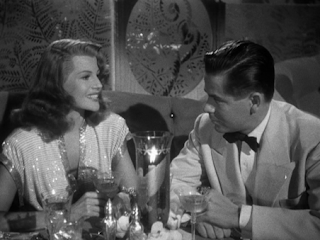
Welcome to the Glenn Ford Blogathon, hosted by yours truly of Hamlette's Soliloquy and Eva of Coffee, Classics, and Craziness!  We are so excited that you could join us in celebrating this delightful actor.


All weekend long, people will be contributing posts about Glenn Ford and his filmography.  As those get shared with us, we'll share them with you, so be sure to check back to either this post or Eva's for the ever-lengthening roster of posts.

The Participants:

at RealWeegieMidget Reviews


at Hamlette's Soliloquy


at Speakeasy


at Taking Up Room


at Coffee, Classics, and Craziness


at Hamlette's Soliloquy


at Poppity Talks Classic Film


at The Classic Movie Muse


at Dubsism