Showing posts with label history. Show all posts

Tuesday, September 30, 2025

Ten Favorite American Civil War Movies

Every week, I watch a movie with my teens over lunch.  During the school year, they take turns picking the movie to watch each week, but during the summer, I get to choose them.  This summer, I chose to have us watch all kinds of movies set during the American Civil War.  I realized while out at the Manassas Battlefield on a field trip last spring that, when I was a kid and teen, I had a really great grasp of the major events of the American Civil War because I had seen quite a few movies set during it, particularly the mini-series The Blue and the Gray (1982), which encompasses the whole war.  And my kids didn't have that because we simply hadn't watched those movies yet.  Sure, we had studied the war repeatedly during school over the years, but it's harder to envision how everything fits together when you are reading about it.


So, we spent the whole summer watching movies set during that war, plus a few that take place shortly after it but are strongly influenced by it.  I eventually added a couple more to the list above as we went, and we didn't manage to watch quite all of them, but my teens now have a good grasp of the basic sequence of events in the American Civil War.  

Inspired by our summer viewing, I decided to share my list of my Top Ten Favorite American Civil War movies.  Here they are!


1. The Blue and the Gray (1982) Yeah, yeah, technically a miniseries.  Anyway!  This is a masterful piece of storytelling that focuses on a young Virginia artist (John Hammond) who has abolitionist leanings and family on both sides of the Mason-Dixon Line.  He and his extended family and friends end up mixed up in just about every major piece of the war, from John Brown's execution to the surrender at Appomattox Courthouse.  It delves thoroughly and entertainingly into the difficulty of a war fought between brothers, cousins, and friends.  I grew up watching it every year or two, and I absolutely credit it with giving me a thorough grasp of the main sequence of events of the war.  Also, nobody but Gregory Peck should ever be allowed to play President Lincoln.

2. Gettysburg (1993)  A talented ensemble cast shows many of the events leading up to and during the battle that is now considered the turning point of the American Civil War. Jeff Daniels turns in a particularly wonderful performance as Col. Joshua Lawrence Chamberlain, one of my personal heroes.

3. Little Women (1994)  Four sisters grow up in New England under their mother's guidance while their father is away with the Union Army.  People don't tend to think of this as a Civil War story, but the war influences everything in their daily lives, sometimes more overtly and sometimes subtly.

4. How the West was Won (1962)  A sprawling saga tracing the lives of two sisters (Debbie Reynolds and Carroll Baker) who move west as young women, and the lives of their husbands and children.  The Civil War is technically only shown onscreen briefly, but its echoes sound out across the rest of the movie as it follows the son of one sister, a veteran who heads west and uses his experiences in the war to inform his decisions from then on.

5. Shenandoah (1965)  A Virginia farmer (James Stewart) insists on his large family never getting involved in the Civil War that rages around them, but there is no way for him to keep them isolated from it forever. 

6. Friendly Persuasion (1956)  A Quaker family tries to remain neutral during the Civil War, but there is no way for them to remain uninvolved forever.  Anthony Perkins is so likeable in this.

7. The Horse Soldiers (1969)  A Union Cavalry colonel (John Wayne) sneaks his troops deep into Confederate territory to destroy the railroads and hasten Union victory, but he has this pesky medical officer (William Holden) along who keeps causing problems.

8. Harriet (2019)  Biopic of Harriet Tubman (Cynthia Erivo) that portrays her escape from slavery and courageous rescue of so many others.  I ended up not watching this one with my teens this summer because it is pretty stern stuff and I think my youngest won't be ready for it for another year or so, but it's an excellent movie.

9. Gone with the Wind (1939)  Eating radishes straight out of the ground after drinking whiskey on an empty stomach convinces a spoiled Southern belle (Vivien Leigh) that she will do anything necessary to avoid repeating that sensation.

10. The Undefeated (1969)  A former Union cavalryman (John Wayne) teams up with a former Confederate officer (Rock Hudson) to get a herd of horses and a wagon train of people safely to Mexico.  Technically takes place just after the war, but the war echoes all through the film, so I say it counts, and it's my list, so there ;-)


Have you seen any of these?  Do you have other favorite Civil War movies?  Are you aghast that I left Gods and Generals (2003) off this list?  Do tell!

Sunday, July 20, 2025

"Back to the Titanic" (2020)

I have been fascinated by the wreck of the RMS Titanic since I was a girl, probably in single digits.  My parents had subscribed to National Geographic for a while in the 1980s, and they had a stack of the magazines on a shelf in our upstairs hallway.  I used to pull them out and look through the photos when I was too young to read the articles properly.  And they had the December 1985 issue with a long article by Dr. Robert Ballard, the man who found the wreck of the Titanic.  It had amazing photos.  It was my favorite of all the issues on the stack, and I used to pore over it pretty often.

Because I couldn't really read the article, I didn't know the tragic story of the ship's sinking until I was older.  I only knew there was a huge ship under the ocean that had been there so long, fish lived on it.  Ever since, I've had a desire to swim around a wrecked ship for myself.  (I also didn't understand that this ship lay more than 3 miles below the surface, where humans can't survive.)  I think my fascination with historic artifacts and archaeology probably stems from that magazine as well.

When I was in middle school, I had to write a research paper on a historic event.  I chose the sinking of RMS Titanic.  I read several books about it, including Walter Lord's A Night to Remember.  I'd seen The Unsinkable Molly Brown (1964) by then, and I remember getting the 1958 movie version of A Night to Remember and the 1953 movie Titanic from the library to watch while writing my paper -- not as research, but for general atmosphere.  (This was in the early 1990s, before the Kate Winslet movie was released.)  Even though I am fascinated by the true story, I've never particularly enjoyed movies about the tragedy.  I think I learned too much about the real horror to find entertainment in seeing it portrayed fictionally.  (I do like Molly Brown, but probably because there is only a smidgen about the Titanic portrayed).

Man, that was a fascinating paper to write.  I did tracings of diagrams of the ship, both before and after the wreck.  I was so incredibly proud of that paper.  My teacher (who was also my mom, since I was homeschooled) thought it was macabre, though.  (The next year, I wrote a research paper about the Lewis and Clark Expedition, which had a happier ending.)  

Through all of that, and through the thirty years beyond, what has really captivated me the most, though, is the wreck itself.  All the history it contains.  The ways that the ocean has both preserved and begun to deteriorate it.  This fascination has extended to making me intrigued by basically all shipwrecks that have been found and explored, especially if the explorers brought things back from them.  One of the great delights of my tween life was visiting the Arabia Steamboat Museum in Kansas City with my family and grandparents.  The Arabia was a steamboat that sank in the Mississippi River in 1856 and was discovered in 1988, still filled with its original cargo preserved in mud.  I want to go back there one day, because I remember it as being mesmerizing.  I've also visited the Mariner's Museum in Newport News twice, where items recovered from the 1862 wreck of the USS Monitor are kept and displayed and studied (and where they have a life vest from Titanic, too!)

ANYWAY.  I'm rambling, and I know it.  I've had a bad cold all weekend.  Sorry.  I will get back on track.

All of this is why I eagerly joined the Titanic in Pop Culture blogathon hosted by Taking Up Room this weekend.  And why I chose not to review a fictional movie about the ship, but the National Geographic Channel documentary Back to the Titanic (2020).  It's all about the wreck, not how it got wrecked.  It traces the events of the first manned expedition to the wreck in fifteen years, and how scientists are studying the way the wreck is slowly changing and deteriorating.

Aside from all the amazing videography of the wreck itself, which I was absolutely delighted by, the coolest thing about this documentary is that they had a descendant of Benjamin Guggenheim along!  Guggenheim was a fabulously wealthy American businessman who was aboard the Titanic.  He was very helpful in loading women and children into the lifeboats after the iceberg collision, then famously took off the life vest he was wearing over his formal evening wear, put a rose in his buttonhole, and declared he was prepared to die like a gentleman.  Which, by all accounts, he did.

Guggenheim had booked a stateroom along the starboard side of Titanic, in a section of the ship that broke off when the the ship sank.  That section was swept away from the rest of the wreck by strong ocean currents, and had not been found by previous expeditions.  One major aim of the 2020 expedition was to see if they could find the staterooms, with Guggenheim's descendant Sindbad Rumney-Guggenheim aboard to witness the finding.  And that was... really poignant. 

You can learn lots more about this documentary, including photos, right here.  And you can watch the whole thing on Disney+, which is how I saw it.


Don't forget to check out the rest of the Titanic in Pop Culture blogathon!

Thursday, July 03, 2025

Respect Me as a Human Being: Jackie Robinson


I spent a lot of years searching for my personal Civil Rights hero. History classes taught me the big names: Martin Luther King, Jr., Rosa Parks, Malcolm X, President John F. Kennedy. None of them connected with me. None had the mixture of goodness, integrity, and grit that makes someone my hero. 

And then, in my mid-twenties, I got Ken Burns’ documentary Baseball (1994) from the library. As I made my way through the series, I became fascinated by Jackie Robinson and how he used his athletic skills and personal courage to show the world that the color of a person’s skin had nothing to do with their worth and abilities. When I subsequently read Robinson’s autobiography, I Never Had it Made, I knew I’d found my Civil Rights hero at last. A kind, stubborn, dignified Christian, Robinson was everything I wanted in a hero. 

Born to Georgia sharecroppers, Jack Roosevelt Robinson grew up poor, but determined. His father left the family when Jack was still a baby, so his mother moved her five children all the way out to California, where she worked whatever jobs she could find and saved up enough money to buy a house in a nice neighborhood. They were the only non-white family on their street. 


Jack Robinson excelled at sports in high school and Pasadena Junior college, playing on various varsity teams. But he also gained a reputation for combativeness, standing up for other African-American students when he thought they were being unfairly treated due to their race. He nearly got suspended at least once over his resistance to inferior treatment. 

After junior college, Jack Robinson — nicknamed Jackie by newspaper reporters — went to UCLA, where he met his future wife, Rachel Isum. Although he did well athletically at UCLA, Robinson was restless. He quit school just a few months short of graduation. About that time, the US entered WWII, and Robinson applied for Officer Candidate School, graduating with a commission as a second lieutenant. He asked Rachel Isum to marry him, and they made plans for the future. 

But in the summer of 1944, Jack Robinson faced a court martial. The Army did not have segregated buses on the Texas base where he was stationed, but one day, a bus driver told Robinson to move to the back of the bus. Robinson refused and got arrested. His court martial acquitted him, but he missed out on seeing combat duty because the rest of his unit shipped overseas while he was awaiting his trial. Later that year, the Army gave him an honorable discharge. 

In 1945, the Kansas City Monarchs signed Jackie Robinson to play baseball in the Negro League. Baseball was entirely segregated — Major League Baseball had been white-only since the 1880s, though there were no formal, legal rules prohibiting athletes of other races from playing. Rather, there was a “gentleman’s agreement” among the team owners and managers that prohibited hiring non-white players. In the mid-1940s, Brooklyn Dodgers manager Branch Rickey set out to challenge that agreement. He scouted the Negro League for someone who not only played excellent baseball, but who could withstand the scrutiny and abuse that would crash down on the first black man to step onto major-league baseball diamonds. 


Robinson had a reputation for not only refusing to back down in the face of racial aggression, but asserting his equality. The incidents in the military and his school days pointed to his being someone who would not stand still and endure racial taunts, threats, and aggression. But Robinson promised not to fight back against whatever abuse came his way, and Rickey signed him to play with the Montreal Royals, the minor league team associated with the Brooklyn Dodgers. 

Jackie and Rachel Robinson got married at last. Robinson played in the minors until April 15, 1947, when he made his major league debut by taking the field with the rest of the Brooklyn Dodgers. He was 28, old by baseball standards, but played so well he wound up being named Rookie of the Year. 

He endured the hatred of millions. Some of his own teammates didn’t want to play with him at first and threatened to sit out any game he played. People in the stands screamed racial slurs at him. One opposing player deliberately gashed Robinson’s leg with his spiked cleats. Others taunted him while on the field. Strangers sent death threats not just to Robinson, but to Rickey and others associated with the Dodgers. 


The American League also signed a black player, Larry Doby, just a few months after Robinson joined the National League. In 1948, both leagues accepted more black athletes, and the pressure on Robinson eased up somewhat. He played better than ever, and by 1949 he was voted Most Valuable Player in the league. A remarkable achievement, considering three years earlier, many in the league actively worked to keep Robinson and other black players out. 

Robinson retired from baseball in 1956, due to his age and ill health. He suffered from diabetes, and a life of constant athletic activity was catching up with him. After leaving baseball, he had a successful business and banking career. He was a devoted husband and father, and a regular churchgoer. And he was active in the emerging Civil Rights Movement, attending marches, giving speeches, and lending moral support to those engaged in sit-ins and freedom rides. He used his fame to gain attention for the movement and worked with leaders like Martin Luther King, Jr., and being active in the NAACP. 

Jack Robinson once said, “I’m not concerned with your liking or disliking me … all I ask is that you respect me as a human being.” I think that’s all any of us can ask from people around us — respect as a human being. Let my actions, my personality, or my words gain your like or dislike, but treat me with the respect you would give any other person because they are created in the image of God.


(This post originally appeared in Femnista magazine on February 15, 2018.)

Tuesday, December 03, 2024

Guest Post for the Brave Authors Blog

I've written a guest post for the Brave Authors blog that's all about how and why historical fiction authors can and should include minorities in their books.


I know most of my posts lately have been about my writing and not about movies and so on.  I've got some fun movie posts planned, I just need to make time to finish them!  Everything is busy for everyone this time of year, so I hope you all understand :-)

Monday, October 07, 2024

He Didn't Expect to Change the World: Martin Luther

Five hundred years ago, a monk and professor at the University of Wittenberg, Germany, wanted to discuss some theological questions with other learned Christians. So he wrote them all down and, since the internet was a few centuries from being invented yet, he posted them to the door of the church instead of to his blog or Facebook wall. He wasn’t trying to cause trouble, he wasn’t trying to start a new church body, and he definitely wasn’t trying to change the world. He just had questions about some church practices that troubled him, like charging money to get souls out of purgatory. 

His name, of course, was Martin Luther. And, whether he meant to or not, he most certainly caused trouble, started a new church body, and eventually changed the world. But what he’d meant to do is reflected in the name we now have for the movement he started: the Protestant Reformation. He was protesting that some of the church’s activities went against what was taught in the Bible, and he wanted to reform the church, to fix things that had gone wrong. Not overthrow it, not replace it, just reform it. 


The trouble was, he attacked the selling of indulgences. Indulgences were like “get out of jail free” cards for purgatory, which the church taught was a sort of limbo world between earth and heaven. They said that if you believed in Jesus as your Savior, but you’d committed more sins than the good works you’d done would atone for, you had to hang out in purgatory for a while until, as the Ghost in Shakespeare’s Hamlet put it, your foul crimes were “burnt and purged away” in “sulfurous and tormenting flames” (I,5). 

If you or someone you loved was probably going to have to stay in purgatory for a while, the church said you could lessen their sentence, or even forgo it entirely, by buying an indulgence. That was a piece of paper that entitled you to some of the extra good works done by various saints who had done so many good things in their lives that not only would they go straight to heaven, but they had leftover goodness you could get credited to yourself or a loved one. Why worry that your mother or father or child who died recently was languishing in torment when you could pay the church to get them released? Or, as a popular rhyme about indulgences went, “As soon as the coin clinks in the chest, the soul flies up to heavenly rest.” 

Selling these indulgences was a really big moneymaker for the church at that time, which made church officials happy. Why? Because they were building a gigantic cathedral in Rome called St. Peter’s Basilica. This was an expensive and lengthy project, and selling indulgences was a super-successful fundraising idea. So when some upstart monk had the audacity to question whether or not selling indulgences was a scriptural practice, the church authorities couldn’t ignore him. 

But wait — what was one unknown professor at some German university going to do against the power of the church, which had the support of the entire Holy Roman Empire? What did it matter if he posted ninety-five discussion questions on the door of some church? How many people were going to attend his little theological debate, anyway? The internet didn’t exist, TV didn’t exist, radio didn’t even exist — nobody except some musty old professors were going to care about this, right? 

A century earlier, that would have been true. But, by 1517, the world had Gutenberg’s printing press, which allowed pamphlets and books to be printed cheaply and quickly. Ideas spread swiftly and accurately now, not passed by word of mouth or by people copying out what someone else had written, but by being printed and distributed in massive quantities. And that’s what happened with Luther’s 95 Theses — someone printed them up and started passing them around. People got excited about this debate. Word spread that some professor in Wittenberg was daring to question the church’s practice of selling indulgences. Shocking! Exciting! News-worthy! 

Suddenly, Dr. Martin Luther was the center of all kinds of attention and controversy. Simply by wanting to discuss church practices and whether or not they were based in Scripture, he’d caused trouble, he was on his way to starting a new church body, and the Reformation he began would end up changing the world.


(This post originally appeared in Femnista magazine on April 27, 2017.)

Friday, January 05, 2024

Quiet Gallantry: General Joshua Lawrence Chamberlain


I was in my early teens when they released the movie Gettysburg (1993). My family rented it as soon as it hit the local video store. We settled down for a deeply moving, relatively accurate depiction of the battle at Gettysburg that turned the tide of the American Civil War in favor of the Union. 

The film more than exceeded my family’s the expectations and mine in particular. It introduced me to a historical figure who became a personal hero: Joshua Lawrence Chamberlain. Sympathetically portrayed by Jeff Daniels, he stole my imagination. I eagerly looked him up in my history books later to learn more about him. 

Only, my history books didn’t say much about him. Chamberlain was not a big, famous Civil War personality by the 1990s. My history curriculum had a lot to say about Lee, Grant, Stuart, and Jackson, but not a soft-spoken college professor whose courage and gallantry earned him the devotion of the men he led and the respect of his opponents. It wasn’t until I got to college and could take a semester-long course in Civil War history that I could really learn more about him. 

Joshua Lawrence Chamberlain was born in Maine in 1828. Drawn to studying languages, possibly because he stuttered as a child, he overcame many personal obstacles to win a position as a professor of languages and rhetoric at Bowdoin College in Brunswick, Maine. When war arrived, thirty-four-year-old Chamberlain volunteered, leaving behind his career and his wife and children to fight for a cause he believed in wholeheartedly: ending slavery. 

Although he had no military experience, Chamberlain’s education gained him the rank of lieutenant colonel in the 20th Maine Infantry Regiment. Chamberlain had studied military history as a boy, and now he read every book on tactics and maneuvers he could find. He drilled his men endlessly and, though they resented the work, they learned to appreciate their new leader. Chamberlain tried to live as much like the enlisted men as he could, even though his status as an officer entitled him to better food and sleeping quarters. 


In late June 1863, the 20th Maine marched toward a little Pennsylvania town called Gettysburg where they had finally stopped the invading Confederate army. His superiors tasked Chamberlain with dealing with 120 mutineers from a different Maine unit. Unless they wanted to be shot, he must convince them to behave. Chamberlain talked to the men. He realized their unit had mistreated and misunderstood them. He promised that if they would fight as part of his regiment, the Union would not punish them for their previous mutiny. In the film Gettysburg, Chamberlain makes a quiet yet impassioned speech that reminds the soldiers why they’re all in this fight. That speech made me sit up and take notice of him. 

Chamberlain and his men saw some of the most intense fighting of the entire battle. Ordered to hold a small hill called Little Round Top at all costs, they faced overwhelming Confederate forces and only maintained their position through Chamberlain’s knowledge of military strategy and bold leadership. Wave after wave of Confederate troops crashed against their line, only to be repelled. 

Wounded in the foot, his men running desperately low on ammunition, and facing another Confederate advance, Chamberlain made a bold decision. He ordered his men to fix bayonets and charge downhill, straight at their enemies. His men were exhausted, but the Confederates had been fighting uphill the entire time, and they could not withstand the downward rush of Chamberlain and his men. Hundreds of them surrendered. They won the day. 

That evening, a limping Chamberlain and his remaining forces crept up nearby Big Round Top and captured it from a much larger force. The Union’s control of these two hills turned the tide of the battle, which began the slow end of the Confederate supremacy on the battlefield. 

Chamberlain received a wound in the leg and abdomen the next summer. General Grant gave him a deathbed promotion to brigadier general, the only battlefield promotion Grant gave during the entire war. Chamberlain did not die. After a slow recovery, he returned to active duty, only to be wounded again in the battle of Petersburg, where he turned a rout into a victory. They promoted him to major general for his gallant leadership. Now leading a division of 10,000 men, he joined the final pursuit of General Lee and his ragged army. 

Finally, the Union army trapped Lee in Virginia, near Appomattox. Messengers from General Lee met with General Chamberlain under a flag of truce and asked him to inform General Grant that Lee was ready to surrender. After they signed the terms of surrender, Grant chose Joshua Lawrence Chamberlain, the soft-spoken college professor from Maine, to accept the Confederate army‘s formal surrender. 


Then Chamberlain made a decision he knew would gain him a lot of criticism from people in the north. A decision that cemented him in my heart as a true hero. When the defeated Confederate soldiers reached the Union troops, Chamberlain gave the order for his men to stand at attention and salute their former enemies. Rather than humiliate his foes or glory in their defeat, he insisted on showing them the respect their courage in battle had earned. This action received harsh criticism from many in the North, but it endeared Chamberlain to people in the South and helped make the surrender a peaceful transition. 

After the war, Chamberlain returned to teaching at Bowdoin College until elected governor of Maine. He served four terms, then returned to private life and served as president of Bowdoin College, dying a beloved hero in 1914.


(This post originally appeared in Femnista magazine on May 22, 2019.)

Friday, December 29, 2023

"The Boys in the Boat" (2023)

Y'all know I am not sporty.  I've never been on a sports team, I've never followed a sports team, and I probably never will.  I enjoy watching live sporting events, and I've enjoyed watching various Olympic events over the years.  But I don't really love sports.  You know what I do love, though?

Movies about sports featuring underdogs.

Man, I am all over those!  The Natural (1984).  Rocky (1976).  Chariots of Fire (1981).  Rocky II (1979). 42 (2013).  Rocky III (1982). Remember the Titans (2000). Rocky IV (1985). A League of Their Own (1992). Rocky Balboa (2006).  So many amazing underdog sports movies.  So many great feel-good finales.  I love them.

So, it's not at all unpredictable that I would have thoroughly enjoyed The Boys in the Boat (2023).  Not only is it an underdog sports story, it's got a feel-good ending AND it's based on a true story.  Nom nom nom.

Unfortunately, IMDB.com absolutely spoiled the ending for me (I knew this was a true story, so I specifically did NOT look up whether or not the US crew team won at the 1936 Olympics, and then when I looked up the running time for the movie so I could figure out what showing would work for me, boom!  IMDB had the ending right there in its description.  Boo), but this was still a stirring ride.  I still was rooting for the eight hopeful dudes in that boat all the way.


Could I have done with a little more character development for some of the secondary characters?  Yes.  But did they have space for more character development?  Very little, without padding out the run time.  It's got a good, steady pace, building to the finale, and I appreciated that.  Straight-forward storytelling is generally my favorite.  And I did feel like you got to know the main characters, Joe Rantz (Callum Turner) and Coach Al Ulbrickson (Joel Edgerton), pretty well.  This wasn't ever going to be a character study, or a deeply layered movie, and that's fine.  It doesn't need to be.


The costumes, props, music, and dialog all felt very authentically 1930s.  The score by Alexandre Desplat was a lot of fun, one I could see myself ending up buying.

Is this movie family friendly?  Pretty much.  There's a smattering of bad language, some kissing, and a little innuendo about a wife inviting her husband to bed (no nudity, no bed shown, it's very cute and sweet).  Some drinking.  I would take my kids to it, and my youngest is 12.  I'll most likely buy this on DVD and show it to them that way.

Friday, March 03, 2023

Shadows and Light: "The Blue and the Gray" (1982)

Some stories I first experienced at a young age feel as if they’ve always been a part of me. The 1982 miniseries The Blue and the Gray is one such tale. I can’t remember the first time my parents rented it on VHS. Nor the first time I made friends with the characters who inhabit it. It’s as if I’ve always known the Geyser family, their history, and how it’s bound up with our country’s struggle to truly become “the land of the free.” 


The Blue and the Gray follows a young man named John Geyser (John Hammond). Born and raised on a Virginia farm but employed by a Northern newspaper as a sketch artist, his loyalties and affections are tugged this way and that as the nation staggers toward open conflict. When a free Black friend of John’s gets lynched for harboring fugitive slaves, John becomes a staunch abolitionist in one night, storming away from his family and vowing he’ll have nothing more to do with them. 

John makes friends with a Union officer named Jonas Steele (Stacy Keach), who is my favorite character. Jonas is a secretive, mysterious man who is part spy, part Secret Service agent. Things in his past haunt him, though he won’t speak much of them. He takes a liking to John Geyser, recognizing his artistic talent, and their paths cross often. Jonas sometimes gets John a little closer to an important event or other, and John eventually invites Jonas back to his uncle’s home. There, Jonas falls in love with John’s cousin Mary (Julia Duffy). 

Between them, John and Jonas seem to be present at just about every important occurrence during the American Civil War. They meet at John Brown’s trial and hanging. John meets his future wife at the First Battle of Bull Run. Jonas introduces John to President Lincoln (Gregory Peck) so John can sketch his portrait. John stumbles about the aftermath of the Vicksburg siege in search of his sister. And weaving all around them are John’s siblings and cousins, some fighting for the North, others for the South. 


John learns over the course of the story that life is more complicated than the black and white drawings the newspapers print. Life is like his original drawings, shaded with many variations of gray. Shadows and light intermingle on the paper and in the real world. He must come to terms with his own human frailty and fierceness and the mixture of good and evil around him. For a time, it seems as if the horrors of war he witnesses will overwhelm John’s sensitive nature. Tragedy strikes his family again and again, just like every family involved in the war. But good comes out of it too. John and his family members tentatively begin healing, just as the country begins to do, when the war finally ends. 

It’s hard for me to think of many Civil War battles and other events without thinking of this miniseries, especially now that I live in Virginia. I’m not far from Manassas, site of the first and second Battles of Bull Run. John loses one of his brothers in the horrible inferno that consumed much of the Battle of the Wilderness; I live less than an hour from where that battle occurred. In fact, I have to drive through the Wilderness Battlefield State Park when I visit friends. It is always unsettling and eerie, for bits of this series flit through my memory and make me shudder. Of all battles in that war, I think the Wilderness scares me the most, and that’s largely due to how it’s portrayed in The Blue and the Gray. Sometimes, film and fiction can be almost too real to me. 

On the other hand, I’ll always imagine that President Lincoln sounded like Gregory Peck. That’s a wonderful voice to hear in your head when you read the Gettysburg Address. This miniseries also introduced me to the music of Bruce Broughton, whose scores have delighted me ever since. More than all of that, this story instilled in me early on the conviction that freeing slaves was a just and righteous reason to fight a war, but there were good and decent people on both sides of the conflict. Neither side was all good or all bad, but had people of both light and shadow. 

Above all, The Blue and the Gray impressed on me the awful toll that war takes on people. War tears families apart, injures people’s minds and their bodies, and affects every aspect of the lives of those involved. That’s a lesson I’ve held onto all my life, and it informs my own storytelling to this day.


(This post originally appeared in Femnista magazine on November 2, 2020.)

Saturday, December 18, 2021

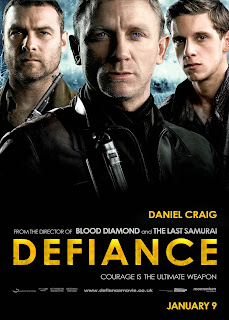
"Defiance" (2008)

Defiance
 (2008) is the true story of four Jewish brothers in Belarus who not only evaded the Nazis all through World War II, but also helped more than a thousand other Jewish people elude them as well.

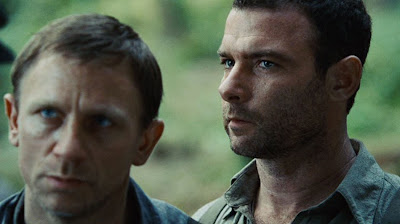
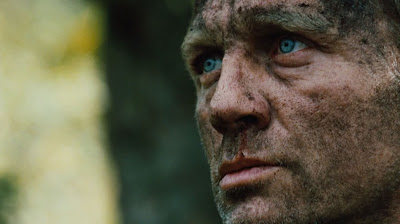
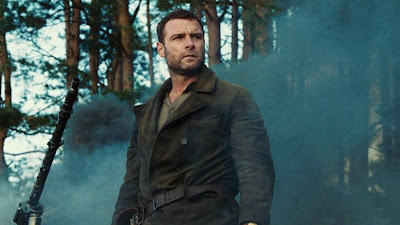
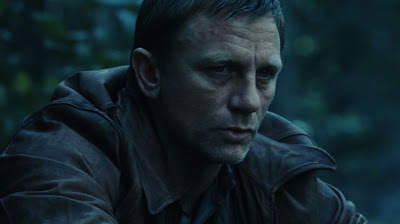
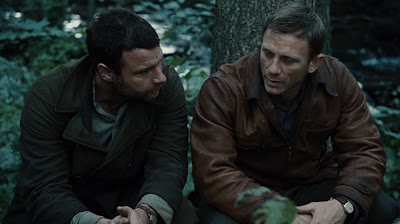
Zus (Liev Schreiber) and Asael (Jamie Bell) Bielski are stunned when they discover their parents were murdered by Nazis at the family farm.  Their younger brother Aron (George McKay) has survived, and they're soon joined by oldest brother Tuvia (Daniel Craig).  The four brothers hide in the forest nearby, grieving and trying to figure out what to do next.  Tuvia gets a gun from a neighbor and executes the local man who led the Nazis to the Bielski farm, and then the brothers set out to survive in the forest.

It turns out there are other Jews hiding in the forest.  The Bielski boys all basically grew up in the forest, so they're excellent at hiding and surviving there.  The other people look to them for guidance and help, and Tuvia agrees to lead them.  First, he's helping a dozen people, then several dozens, and then hundreds.  Under Tuvia's direction, the people build a whole hidden village deep in the forest, with a school for children, organized food collection, and their own little militia. 

This sounds kind of idyllic, but it's not -- the Nazis are an ever-present threat who find the fugitives multiple times, forcing all the people to flee and set up all over again.  Hunger is also a persistent problem, as you can't exactly farm in the forest.  People die both onscreen and off, including Tuvia's and Zus's wives, who had not followed them into hiding.


Zus is the "wild" brother, and he grows impatient with Tuvia's emphasis on caution and hiding and survival over striking back at the Nazis.  Zus leaves to join a Russian otriad, or partisan group, and becomes an enthusiastic soldier.  Occasionally, the Russians and the Jews will work together against the Nazis, but sometimes, they come into conflict with each other instead.

Mixed in with all the war and death and fighting and fear is a little bit of romance.  Asael falls in love with a girl named Chaya (Mia Wasikowska), Zus gets involved with a fellow fugitive, and Tuvia takes a long time to realize/admit he's in love with the lovely Lilka (Alexa Davalos).  The romances are understated and quiet, and all three are quite different, which I appreciated, because no couple falls in love the same way as any other couple.


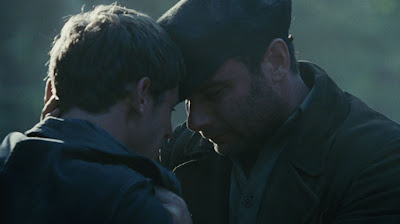
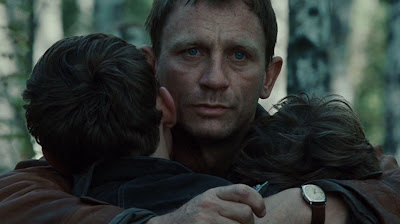
One of the little things I like best about this movie is how physically affectionate the Bielski brothers are to each other.  In grief and in joy, they reach for each other and hold each other close.  Over and over, they touch at random moments, with a pat on the back here, a hand on the shoulder there.  It really helped sell that they're brothers, as this is how many families I know relate, including my own.


This may be a spoiler, so skip this paragraph if you like, but since it's based on history, I will just go ahead and tell you that by the end of the war, there were more than 1200 Jewish people in the camp!  I love that the movie tells you at the end what happened to the Bielskis -- three of them survived the war and moved to New York City.  Aron is still alive today!


When I re-watched this movie last week, I realized that I very strongly identify with Tuvia Bielski.  He's quiet, and he internalizes a lot of things, which I also do.  He is a reluctant leader, but he also doesn't have a problem being bossy if people need bossing and no one else steps up to do the job.  He would rather do hard things himself than delegate them to others.  And he spends an enormous amount of energy and time caring for others, then gets all shocked when he needs care himself... and when someone offers to help him, he's reluctant to accept.  Yeah, there's a lot of me in the movie version of Tuvia.  I hadn't realized that before, but I'm sure that's a big part of why I like this movie so much.


The other reason I like it is, obviously, the casting.  I'm a longtime fan of Liev Schreiber, and he is fantastic as the mercurial, brooding Zus.  He happens to look extra awesome when he's scruffy, and he's scruffy for the entire movie, so that is a total bonus.  And he gets some very cool scenes at the end that involve a tank.


Daniel Craig spends most of the movie conveying a sort of repressed fury mixed with annoyance.  He plays Tuvia as a loner who doesn't want to have to lead and organize and counsel a bunch of strangers, but he realizes he has the necessary skills, so he does it anyway.  Also, Craig is great at conveying inner turmoil with just his eyes, and he has several scenes where his eyes tell you all the things he refuses to actually speak about what he's witnessed or done.


I really like the accents both Schreiber and Craig use; they sound very authentic to my admittedly thoroughly American ears.  My husband lived in Ukraine as a teen and speaks enough Ukrainian to understand a lot of the Russian dialog in the movie, and while we watched this, he kept telling me that the subtitles for the Russians were leaving out a lot of words and condensing things a bunch, which kept cracking me up.  Just little things like, "He didn't call him 'comrade,' he called him 'comrade commander, sir'" and things like that.


It was really cool to see a young George McKay in this, as I like him so much in Ophelia (2018) and 1917 (2019).  He was sixteen when they filmed Defiance, but his character looks and acts a lot younger.  I also enjoy seeing Jamie Bell and Mia Wasikowska together in this, since they also appear together in Jane Eyre (2011).


Is this movie family friendly?  No.  It has a lot of bloody violence, some very bad language, and a little crude and suggestive dialog, though nothing very icky.  There are no love scenes, but there's a scene where Tuvia and Lilka are both shirtless in bed together, mostly covered by a blanket and clearly having just shared an intimate encounter.  If those things would bother you, and you have a filtering service, this is a movie I would definitely watch using that, as it's a wonderful bringing-to-life of an important part of history.

EDIT: I forgot to mention that there's also a scene at the beginning where you see a mass grave filled with naked corpses, getting filled in by Nazis.  You can't really see the bodies close enough for it to be a nudity thing, but it's pretty horrible when you remember this stuff really happened.  That's probably the worst scene in the whole film for me, and I had kind of blocked it out of my memory.


This is my second entry into the You Knew My Name: The Bond, Not Bond Blogathon hosted by Pale Writer and Reelweegiemidget Reviews!

Monday, May 31, 2021

My Ten Favorite Movies Featuring Fallen Heroes

Today is Memorial Day here in the USA, which means I'm taking some time to thank God for all the brave people who have laid down their lives in defense of our country and our freedom.  It's the sort of day when I'd like to pull a movie off my shelves that honors and memorializes such sacrifices.  I've put together a list of my ten favorite movies that feature an American soldier paying the ultimate price, just in case you're looking for ideas of something to watch today.

None of these films glorify war.  Instead, they show the terrible price paid by so many men and women to ensure that our freedom is kept safe, and to help free others around the world.

1.  Midway (2019)  

Historically accurate, dazzling, elegant presentation of the early Pacific Theater of Operations during WWII, from the attack on Pearl Harbor on December 7, 1941, through the Battle of Midway June 4-7, 1942.   One of the best movies I have ever seen.

2.  Hell is for Heroes (1962)

One small American squad (Bobby Darin, Steve McQueen, Fess Parker, James Coburn, Bob Newhart...) holds off a Nazi attack thanks to lots of clever ruses and some spectacular sacrifices. This was written by Robert Pirosh, who also created my beloved Combat!, and this whole movie almost feels like a long episode of the show.

3.  Operation Pacific (1951)

Commander Duke Gifford (John Wayne) leads a submarine crew on a bunch of adventures (most of them based on actual WWII events) and tries to win back his ex-wife (Patricia Neal).  This was my son's favorite movie when he was six.

4.  Captain Newman, MD (1963) 

Darkly tragicomic story of Captain Newman (Gregory Peck), an Army psychiatrist trying to help American soldiers deal with and overcome mental and emotional trauma they've sustained during the war.  Some, he helps.  Some, he can't reach.  Angie Dickinson and Tony Curtis play a nurse and an aid, while the troubled soldiers are played by people like Bobby Darin, Robert Duvall, and Eddie Albert.  Although there are no actual battle scenes, at least one soldier who is healed enough to return to combat is later killed, which lends a lot of gravitas to the story.  Important note: Bobby Darin received an Oscar nod for his role in this.

5.  The Longest Day (1962) 

The story of the D-Day invasion, told from many viewpoints, with one of the most impressive casts ever assembled: John Wayne, Richard Burton, Robert Mitchum, Henry Fonda, Sal Mineo, Richard Todd, and a very young Sean Connery, to name a very few. Until we had kids and lost our big chunks of movie-watching time, Cowboy and I used to watch this together every D-Day.

6.  Gettysburg (1993)

The story of the battle that tipped the balance of the American Civil War in favor of the Union Army.  It's loaded with wonderful actors like Martin Sheen, Sam Elliott, C. Thomas Howell, and Tom Berenger.  This movie introduced me to one of my personal heroes, Colonel (at the time) Joshua Lawrence Chamberlain (Jeff Daniels).

7.  The Patriot (2000)

A widower (Mel Gibson) refuses to take up arms in the American Revolution for a long time, but his son (Heath ledger) fights valiantly for the Patriot cause, and his father eventually realizes he must take his own stand for freedom.  I haven't been able to watch this since we lost Heath Ledger in 2008, but I'm hoping I'll be able to again one day.

8.  Sands of Iwo Jima (1949)

We get to know a squad of Marine recruits, led by Sgt. Stryker (John Wayne), as they prepare for the assault on Iwo Jima.  The recruits view Stryker as a cold-blooded bully, but when they actually hit the beach, they understand at last what he was trying to teach them.

9.  Mister Roberts (1955)

Mister Roberts (Henry Fonda) wants to get off the Navy cargo ship where he's assigned and onto a battleship so he can take part in WWII before it's over.  But his cruel captain (James Cagney) refuses to sign his transfer papers.  Other sailors, including Ensign Pulver (Jack Lemmon) and Doc (William Powell), have their own agendas.  This is kind of a dark comedy.  Lemmon won an Oscar for his supporting role.

10.  We Were Soldiers (2002)

The story of American forces preparing for and enduring their first major battle in Vietnam.  Mel Gibson, Sam Elliott, Greg Kinnear, and Barry Pepper all turn in unforgettable performances.

Friday, January 08, 2021

"Two Years Before the Mast" (1946)


If you have ever read Two Years Before the Mast by Richard Henry Dana, you need to put everything you remember from it firmly out of your head when watching this movie because it has very little to do with anything you'll see here, storywise.  At least, as far as I remember it from when I read it like a decade ago.  I remember it as being a really interesting first-hand account of life on a full-rigged ship that sails from Boston, around the Cape, to California, and then spends a lot of time describing life in California.  There was also a lot of stuff about cowhides.  Stacking cowhides, transporting cowhides, lowering cowhides over cliffs, restacking cowhides... there's not a single cowhide in evidence in this film.

Now, it is true that Dana's book brought the mistreatment of sailors to the attention of the general public and created so much sympathy for them that laws were made safeguarding their rights as human beings and so on.  The movie gets that part right, anyway.


Mostly, though, this movie is an excuse to make a seafaring adventure story starring Alan Ladd, something exciting like the Clark Gable vehicle Mutiny on the Bounty (1935), which is also based on a book that tells a true story, interestingly.

Anyway, we start this picture with a little history and moralizing:


Ahhhh, brutal drudgery.  Sounds like we're in for a good time!


Now, the fact that this is based on a book by Richard Henry Dana, and the fact that the little history lesson at the beginning talks about him rising up to champion the oppressed sailors, all makes it sound like this is going to be a movie about Richard Henry Dana.  But he's not the hero.  Because every movie needs a surprise, I guess.

Instead, the story centers around Charles Stewart (Alan Ladd), the spendthrift son of a wealthy shipowner who has no thought for anyone but himself and no plans beyond this evening.  He's never worked a day in his life, and his biggest problem is making sure the points on his collar are perfectly matched.


When one of his father's ships returns to port, Stewart decides to celebrate by going slumming in a waterfront dive.  He thinks the people there are quaint, harmless, and so very comically beneath him.


Imagine his surprise when he wakes up aboard that ship, far out to sea.  He's been shanghaied, along with a bunch of other guys.  Because very few people will willingly serve aboard that particular ship, which Stewart's father owns.

Well.  Pampered sons of wealthy shipowners are not big fans of brutal drudgery, as you might imagine, so Stewart demands that the ship turn around and take him home, and be quick about it!  However, Captain Thompson (Howard da Silva) believes that he is the Supreme Ruler when at sea.  He orders Stewart to join the ship's company "before the mast," which means as a common seaman, not an officer.


In the fo'c'sl, or forecastle, which is the part of the ship in the front (ahead of the mast) where the common sailors live, Stewart meets Richard Henry Dana (Brian Donlevy), who came to see on a secret mission.  Dana spends a lot of time writing down everything that happens.  And he doesn't let anyone read what he's writing.  But he befriends Stewart, in a way, and is the first person on the ship to be nice to him at all.

It's a treat to see Brian Donlevy as a good guy, at least for me.  I grew up watching him play the villain in Destry Rides Again (1939), and more recently in The Virginian (1946), as well as playing a crook in The Glass Key (1942) opposite Ladd.  But he's very well suited to playing a straight-up good guy too, and I would not mind seeing him in more roles like this.


Barry Fitzgerald lends some comic relief as only Barry Fitzgerald could.  He's crotchety and irascible and so loveable that it's amazing everyone around him doesn't just hug him in every scene.  He's playing the ship's cook here, and another very nice guy.


William Bendix plays not such a nice guy, as an officer who obeys the captain's orders without a qualm... at least at first.  He's pretty fond of administering punishment, and you start out thinking his character is another sadist like the one he played in The Glass Key, but he's got a good brain and heart to go with his fists here.

William Bendix and Alan Ladd were best friends for many, many years.  Ladd used his star power to make sure his buddy got work on as many of his pictures as he could, which is why you see them together so, so often.  (I've probably mentioned that before.  Sorry if I'm starting to repeat myself in my old age.)


Now let's talk about Howard da Silva a little bit.  Here's a versatile actor, folks.  I've seen him play fumbling and quiet in The Great Gatsby (1949); I've seen him play charming and sly in The Blue Dahlia (1946).  But here, he is nasty, cold, vicious, calculating, and horrible.  Ugh, ugh, ugh.


Two Years Before the Mast is mostly famous for the scene where Alan Ladd is beaten for striking an officer.  Justly so, because it's a very memorable scene, not so much because Ladd is shirtless (I mean, let's face it -- we see him shirtless in at least half his movies), but because he does a really fantastic job of portraying a guy who is scared of being beaten (he witnessed another man be punished early in the voyage), but defiantly holds his head up and accepts his punishment like a man.  

He's got a stereotypical character arc, going from weak and foppish to bold and manly after learning to do real work in the real world but, because it's Ladd, we sympathize so much with him, we don't care that it's kind of a hackneyed arc.


Oh, and also, we have an entirely pointless romantic subplot concerning Maria Dominguez (Esther Fernandez), a passenger they pick up along the way and take to California with them.


She's really only here to give Ladd someone to smile at, someone to champion him, someone to give him a reason to flex those lovely biceps extra often...


Still, she's very pretty, and has some nice moments.  And props to the company for getting an actual Mexian-American actress to play this Spanish-Mexican-American character.  


Maria is very nice and visits Stewart when he's clapped in irons for attempting mutiny.  She does help hammer home the idea of doing your duty and taking pains to help others instead of always looking out for your own interests and desires, so I guess her role isn't entirely pointless.


Oh, uh, yes, mutiny.  Of course, mutiny.  The crew is slowly dying of scurvy because Captain Thompson refuses to put in for fresh food because he is bent on setting a record for fastest time to California and back.  There's a cabin boy (Darryl Hickman) who's dying faster than most, and the crew are all very concerned about him in particular because he's such a sweet kid.  So Stewart decides to pull a one-man mutiny, and, well, I already spoiled how that ends up by showing you him in shackles, didn't I.  Sorry?  Maybe skip to below the shot of The End if you don't want anything else spoiled.


More mutiny happens later on, and Stewart must bid an earnest farewell to Maria.  She's going to get married to some guy in California as soon as she lands, so, you know... it's been fun, but we know they'll never see each other again.


Anyway, the crew has to decide if they are going to sail off to some South Sea island and live like kings with the natives forever like the crew of the H.M.S. Bounty, or if they're going to be good Americans and go home again and stand trial.  Thanks to Dana and Stewart, they probably stand a pretty good chance of being believed when they say the mutiny is justified.  So they go home.  But really, this picture is just here because Ladd spends the whole scene leeeeeeeeeeeeeeeaning in that chummy way, and I couldn't leave it unmentioned.


Well, they get home, and Stewart reunites with his father, who likes him a lot better now that he's not a good-for-nothing anymore. Funny how that works.  The shipowners try to repress Dana's book, but fail, and oh, woe is them -- they have to start treating sailors like human beings!  Oh my!


All's well that ends well, and we're left with this gorgeous shot of the ship.  I have a terrible weakness for full-rigged "tall ships," and the presence of this one, plus the presence of Ladd, means I do enjoy watching this film even though it's kind of haphazard and cliched.  It's still a fun ride, and I'm glad the Universal Vault Series has released it :-)

Is this movie family friendly?  Yup.  The beating scenes would probably be too much for really little kids, and there are some '40s-style violent deaths, but that's it.