Showing posts with label Cary Grant. Show all posts

Monday, June 01, 2026

My Ten Favorite Marilyn Monroe Movies

Today is Marilyn Monroe's 100th birthday!  To celebrate, I'm sharing this list of my ten favorite Marilyn movies.


1. How to Marry a Millionaire (1953)  Three women (Marilyn Monroe, Lauren Bacall, and Betty Grable) pool their resources to rent a swanky apartment so they can date rich men and each marry a millionaire.  The only problem is, they keep falling in love with guys who aren't rich.  It's sweet and funny and quirky -- and the first Marilyn Monroe movie I showed to my kids!  Marilyn's character is the funniest of the trio, especially her running gag about needing to wear thick glasses but thinking they make her look too studious and unglamorous... but when she doesn't wear them, mishaps always ensue.

2. Gentlemen Prefer Blondes (1953)  Singer-dancer-friends Lorelei (Marilyn Monroe) and Dorothy (Jane Russell) take an ocean voyage to Europe just for funsies.  Their steps are dogged by a private detective hired by Lorelei's fiance's father, who is convinced Lorelei is trapping his son in a disastrous marriage.  The girls sing, dance, and dodge would-be suitors.  Marilyn's "Diamonds are a Girl's Best Friend" scene really is as iconic as you've been told.

3. Monkey Business (1952) A chemist (Cary Grant) tests an age-reversing elixir on himself and his wife (Ginger Rogers), with hilarious results.  I'm not sure why this movie isn't better known, because it's really funny.  Marilyn only has a small role, as the chemist's boss's secretary, but she's good fun while she's onscreen.

4. Some Like it Hot (1959) Two male jazz musicians (Tony Curtis and Jack Lemmon) witness a mob hit and try to hide out in an all-female jazz band by disguising themselves as women.  Absolutely nobody in their right minds would ever mistake Tony Curtis and Jack Lemmon for women, which makes the entire thing ridiculous and genuinely funny.  Marilyn Monroe sings with the jazz band, and of course she winds up in a romance with Tony Curtis -- and the funniest part of the whole movie, for me, is Tony Curtis's Cary Grant impression.

5. The Seven Year Itch (1955) When a bored and imaginative man's (Tom Ewell) wife and kids flee New York City for the summer, he begins romanticizing what could happen with the cute girl (Marilyn Monroe) in a nearby apartment.  She sees him only as a friend, too old to be her boyfriend, and nothing serious ever happens between them, no matter how hard he imagines it will.  My husband and I can never mention Rachmaninoff without quoting this movie.

6. Don't Bother to Knock (1952) A lonely pilot (Richard Widmark) pursues a relationship with a sexy babysitter (Marilyn Monroe) who works at the hotel where he lives, only to slowly realize she is a very scary woman.  It's so cool seeing both Widmark and Monroe playing against type in this excellent noir film.

7. There's No Business Like Show Business (1954) A showbusiness family endures ups and downs over the years, including one son's romance with a singer (Marilyn Monroe).  This is one of those movies that is mostly just enough plot to string together a lot of really great musical numbers, but I like that kind of movie so long as there is a legitimate reason for the musical numbers to take place -- like in this movie, where they are the family's bread and butter.

8. The Asphalt Jungle (1950) One of the most famous noir films ever, and deservedly so.  A lot of desperate characters work together to pull off a big heist, but justice hunts them down relentlessly.  Marilyn Monroe has a very small part here as the girlfriend-on-the-side of the heist's mastermind (Louis Calhern), and she deftly steals scenes right out from under him.

9. Niagara (1953)  Technicolor film noir masterpiece about two married couples visiting Niagara Falls.  Newlyweds (Jean Peters and Casey Adams/Max Showalter) befriend an older couple (Joseph Cotten and Marilyn Monroe) whose marriage is deteriorating, with disastrous consequences.  I have a love-hate relationship with this movie, but I love it enough to add it to this list, anyway.

10. The Misfits (1961) A divorcee (Marilyn Monroe), an aging cowboy (Clark Gable), a bronco buster (Montgomery Clift), a pilot (Eli Wallach), and a landlady (Thelma Ritter) form a found family of sorts because none of them really quite fit in with anyone else.  This is mostly remembered today as the final finished film for both Gable and Monroe, and it's not exactly a pleasant movie to watch.  But it's a really fascinating bunch of character studies, if you like those.

How many of these have you seen?  Do you have any favorites that aren't on this list?


This post is my contribution to the Marilyn Monroe -- 100th Birthday Blogathon hosted by Kristen at Hoofers and Honeys this weekend.

Love blogathons and blog parties?  Check out my Upcoming Blog Events page every now and then to find links to all the events I plan to host or participate in.  There are lots of great events happening this month in particular!

Sunday, August 27, 2023

"Indiscreet" (1958)


I first saw Indiscreet (1958) in my late teens.  Some local station must have shown it, and we recorded it because my family liked Cary Grant.  I remember thinking it was such a funny, smart movie, but that my mom didn't really like it.  I think I get why she wouldn't like it the first time, but I'm not sure why she was cool with That Touch of Mink (1962), which has similar moral quandries, but didn't like this one.  I can only recall that this was a movie I tended to watch when my parents were out of the house because my mom never wanted to rewatch it.


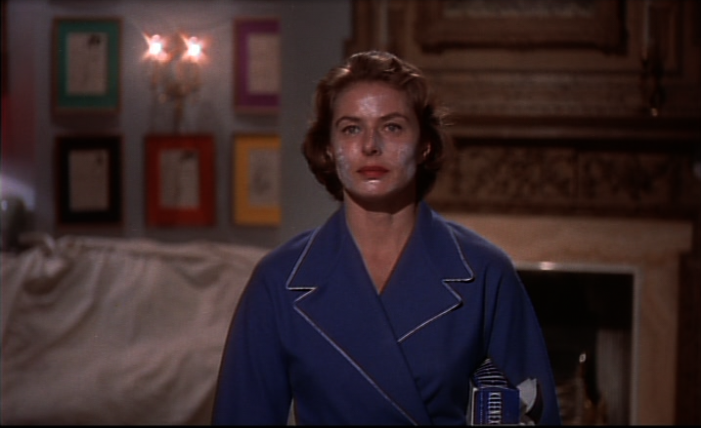
Anna (Ingrid Bergman) is a famous and popular actress on the London stage.  She's also suddenly single again, having broken up with her latest boyfriend and come home to her London apartment to be alone and get over him.  Not expecting company, she nibbles a snack and puts cold cream all over her face.  Her sister Margaret (Phyllis Calvert) and brother-in-law Alfred (Cecil Parker) stop by to change clothes before going to an important dinner -- they don't live in London and often use Anna's flat to change, whether she is there or not.


Unexpectedly, at least to Anna, a dapper banker named Philip (Cary Grant) stops by too.  He's to be the speaker at the dinner that Alfred and Margaret are attending, and they are escorting him there, or something.

Although Anna has cold cream all over her face when he first sees her, thus rendering her hideous by Hollywood standards, Philip is obviously enchanted by her.


At the end of the evening, Anna invites Philip back to her apartment for a nighcap.  

Random side note: I really love Anna's apartment, and have long dreamed of doing a similar thing with colored mattes around cool sketches reaching up to the ceiling.  I haven't ever lived anywhere that this would work, but I still think it is super nifty.


Anna and Philip are obviously attracted to each other, and they know it.  But Philip drops a bomb in the middle of their flirtatious shared drink: he is married, and he can't possibly get a divorce.

Another side note:  I have a particular fondness for the way that Cary Grant says the word "divorce."  He says "dee-vorce," and it's cute and different and funny, and I like it.


Philip makes a graceful exit, having made it clear that if he embarked on a relationship with Anna, it could never end in marriage, it could only be temporary.  Anna decides she doesn't care and invites him to go to the ballet with her the next evening.  Instead of going to the ballet, they wander around London with Anna's chauffeur Carl (David Kossoff) following them discreetly in Anna's car.


By the end of the evening, Anna and Philip have come to an unspoken agreement.  They will see each other romantically, they will commit adultery together, they will be... indiscreet, basically.  And, while I am wholeheartedly opposed to adultery, I can't help but love the way the filmmakers handle this.  Because we don't have any dialog about it.  We don't have any scenes of the two characters sharing a bed.  We don't even have very many kissing scenes.  It is 100% closed-door, in modern parlance, including a moment when the pair go into Anna's apartment and literally close the door on the camera, and that is all we have to know.  We, the audience, know what they're intending to do together, but we never have to see it, or start to imagine it.  We just merrily go forward, seeing what happens to two people who fall in love when they know they morally should not.


We get a couple of cute scenes of Philip and Anna talking on the phone from their respective abodes, and you might say this is copying Pillow Talk (1959), except that Indiscreet was released a year before that Doris Day romp.


Philip and Anna give each other gifts, go to parties together, spend cozy evenings together, go shopping together -- but always, there's that lingering sense that they could be having an even better time if they didn't have the simple fact hanging over their heads that Philip has a wife somewhere.


This shot is really only here to add to my growing collection of unusual ways to stage kisses. 


Well.  We get two-thirds of the way through the movie, all glamor and romance and lovely accents... and then another bomb drops.  This is a very big bomb, the kind that causes a paradigm shift.  I am going to SPOIL it here, quite thoroughly, so if you don't want spoilage, please STOP reading here and drop down to under the picture that says "THE END."

Can't say I didn't warn you.

The second bomb is this: Philip is not married.  He has never been married.  He just lies and tells people that he's married so that his paramours never try to get him to marry them.  He's a serial monogamist who pretends to be a serial bigamist.

This paradigm shift makes Anna -- and the audience -- reevaluate everything Philip has said and done.  And the hilarious thing is, it makes Anna feel more immoral than when she thought she was committing adultery with him.  As long as she believed Philip was being honest with her, she didn't mind being an adulteress.  But now that she's discovered she's just a common fornicator who's been lied to, she is furious.  Livid, even.  How dare he deceive her?

And this is what makes me love this movie.  It points out the absolute absurdity of assuming that one form of sexual relationship outside of marriage is any worse than any other.  And it points out all the problems that result from going to bed with someone you're not married to, whether or not either of you are married to someone else.  

Also, it's handled in a super funny way, with lots of sharp, witty dialog.

Deceit piles up on top of deceit until both Anna and Philip are going in circles trying to figure out what's true.  And, of course, everything smooths out in the end, and they wind up deciding to get married to each other.  One hopes they have also learned the vital importance of being honest with each other too.


END of SPOILERS!  It's safe to read again.

Is this movie family friendly?  Weirdly, yes.  Like I said, aside from some kissing, there's no real sexual content here.  No cussing, no violence.  Kids probably won't find it funny, and won't fully understand what's going on, but it's not a dirty movie in any way.  Does have one shouted cuss word, but said with Bergman's accent, so it's not necessarily obviously a cuss word.


This review is my contribution to the 6th Wonderful Ingrid Bergman Blogathon hosted by the Wonderful World of Cinema in honor of Bergman's birthday this week.

Friday, June 17, 2022

Movie Music: Henry Mancini's "Charade" (1963)

Is there any composer at all who embodies '60s cool so completely as Henry Mancini? Yeah, didn't think so. And nowhere does his music exude cool so much as in the soundtrack for Charade (1963).  It's a thrilling adventure that stars Cary Grant and Audrey Hepburn and James Coburn and Walter Matthau and George Kennedy, and if you want to know more about it, you can read my review here.


If you like cool '60s movies OR rompy mysteries OR classy, sassy movies with a Hitchcock vibe, then you need watch this movie. But if you don't have time to watch it just this minute, you can hang out here and listen to a few of my favorites from the soundtrack. 

"Main Title" has this sexy, lounge-y theme set over some very tense and insistent percussion. Like someone telling you to run away from the bad guys, but be sure to look really fetching while you do so. 


"Megeve" has that mellow '60s sound going on -- a good rhythm to keep life moving along, but overall it's laid-back and happy to just hang out in the background while you sip a few cocktails and discuss who's cooler, Frank Sinatra or Dean Martin. 


"The Drip-Dry Waltz" comes from that super-famous scene where Cary Grant takes a shower, fully clothed. Oh yes, he does, in his own charming Cary Grant way, and it's a scene almost guarantee it will make you laugh (and want to watch the whole movie -- that's what happened to me. I saw this scene in some sort of PBS program when I was a teen and could not rest until I'd found and watched the whole movie). But anyway, the song is a frothy little bit of adorableness that perfectly matches the scene in every respect. 


If you want, you can listen to the whole album here on YouTube!

(This review originally appeared here at J and J Productions on May 10, 2016.)

Saturday, November 13, 2021

"Charade" (1963)


Some people call Charade (1963) "the best Alfred Hitchcock movie that Hitchcock never made."  I can see why -- it's got so many of the same ingredients of classic Hitchcock suspense films.  Exotic European locales? Check.  Confused, innocent person pursued by hitherto unknown Bad Guys?  Check.  Beautiful woman in danger?  Check.  Chic costumes?  Wry humor?  Cary Grant?  Check, check, checkity check.

But I love Charade far more than any of Hitchcock's movies.  In fact, there are no Hitch films on my top 100 list, but Charade is firmly there.  I think that's because there's one key difference between Charade and even my favorite Hitchcock films:  I believe the happiness of its ending.  With all of Hitch's films, with the possible exception of The Trouble with Harry (1955), there's always this lingering... off feeling at the end.  Will the hero and heroine live in peace and happiness now that they're through whatever harrowing ordeal we've watched them survive?  In Hitchcock's movies, the answer is usually 'maybe.'  But with Charade, at least for me, the answer is a total 'yes.'


Regina Lampert (Audrey Hepburn) is suddenly, violently widowed when her husband falls from a train... or is pushed.  At his funeral, some very weird characters (played by James Coburn, George Kennedy, and Ned Glass) show up and behave fairly weirdly near the coffin.  


Then, they start threatening Regina.  They claim her husband had a lot more money than she knew about, and they insist he stole it from them.  The trouble is, no one can find the money.

A handsome, helpful man called Peter Joshua (Cary Grant) helps her out of a couple of jams, protecting and rescuing her from the three weirdos several times.  Peter and Regina had met before, just before her husband died, and she's all to happy to have him around giving her advice and shielding her from harm.


However, things keep getting stranger and stranger.  It's as if Regina is trapped in a kaleidoscope that a little kid keeps turning.  Names, identities, stories, and situations shift without warning, keeping her constantly off-balance.  Without Peter Joshua there to steady her, she would surely lose her footing completely.


Watching Audrey Hepburn and Cary Grant together is pure magic.  Grant didn't initially want to make the movie because he felt the 25-year age gap between himself and Hepburn made the film's romance too ridiculous.  The screenwriters added a lot of little jokes about it to appease him, and he agreed to make the movie after all.  Thanks to those jokes, what might have been a slightly weird love story turns into a quirky and charming one, all because the characters acknowledge their age difference and accept it, so we do too.  Completely brilliant.

(Oh, and Regina was planning to get a divorce before her husband suddenly died, so that neatly eliminates any weirdness about her falling in love right after her husband's funeral.  For me, anyway.)


I watched this with my best friend a week or so ago.  I love this movie and have seen it many times, but she had only seen it once and didn't like it.  That made her curious to know why I love it.  I decided it mostly boils down to the fabulous dialog that makes me laugh and laugh and laugh, and the fact that I totally love the two main characters.  The lovely costumes and exciting story are fun bonuses, but they're not what draw me to the story.  I am here for Hepburn and Grant trading snappy, snarky, sassy one-liners and falling in love along the way, and that's all there is to it.


While we watched this together, my best friend commented that she really doesn't understand why Regina keeps trusting Cary Grant's character when his story changes every twenty minutes or so.  He's obviously lying to her -- he admits that repeatedly, and tells her new lies.  Why does she continue to trust him for so long?  I had to think about that for a bit, because it's a good question.  


I finally concluded that she trusts him because his words change, but his behavior doesn't.  He is always, always there for her, ready to help, rescue, shield, encourage.  He cheers her up, makes her laugh, feeds her, comforts her.  His truthful actions speak louder than his lying words, and those are what she trusts.  Only when she thinks she can't trust his actions anymore does her trust in him waver.

(Mild spoilage in this paragraph.)  Also, here's something I never picked up on while watching it all these times, but did while screencapping it -- Cary Grant is nearly always shot facing toward the right of the frame.  That codifies him as being a trustworthy good guy heading in the right direction.  Whenever he and Audrey Hepburn share the screen, he's on the left, looking right, as you can see in my screencaps.  That very subtly lets the audience know that yes, he is a good guy doing the right thing.  Pretty cool.  (It also means that whenever they share the screen, Audrey is looking left and thus signals that she's confused, going backward, or not doing things quite the way she ought, which is also super interesting.)  (End spoilage.)

Is this movie family friendly?  Mostly.  There are a couple of instances of taking God's name in vain, and maybe another mild cuss word or two.  There's this weird scene with people on a riverboat playing a game where they have to take an orange from the other person without using their hands that gets a little suggestive.  And there's a very tense and menacing scene where someone is threatened while getting burning matches dropped on them.  There's a gunfight and some hand-to-hand fighting, all sixties-style and non-gory.


This is my contribution to the Distraction Blogathon hosted by Taking Up Room.  The money in Charade is a MacGuffin because no one in the audience actually cares about it, it's just a reason to have a bunch of guys chase Audrey Hepburn while she trades sparkly quips with Cary Grant.  If you like classic cat-and-mouse movies, but you haven't seen Charade (or haven't seen it recently), it's FREE on Amazon Prime right now!  And it's not expensive on DVD either.

Thursday, December 01, 2016

"Father Goose" (1964)

This is the very first Cary Grant movie I ever saw.  And I was so excited by it, at the age of 13 or so, that the next day, I told my art teacher the entire plot in great detail.  Except I forgot to tell her the title, and so after about five minutes of me telling her allll about it, she was like, "What was this movie called?"  "Oh, um, Father Goose."  And she had totally seen it before, and I was a little deflated because I had discovered the funniest movie ever... and she'd discovered it first.

But anyway, I still love this movie.  One of my absolute favorite comedies.  It concerns one Walter Eckland (Cary Grant), a snarky misanthrope who wants nothing more than to sit out WWII on his recently acquired boat.  His frenemy Houghton (Trevor Howard) tricks him into being a plane spotter for the Allies, radioing in the movements of enemy Japanese airplanes.  Walter doesn't like it at all, and he likes it even less when he ends up rescuing a French woman, Catherine Freno (Leslie Caron), and seven little girls of various nationalities.  Freno was fleeing with them from the encroaching Japanese, trying to get them back to their families or something.

Walter and Catherine get along together about as well as my 9-year-old and my 4-year-old, which is to say they snarl and snap at each other a lot, do everything in their power to aggravate each other, and both behave badly for quite some time.


And then they fall in love.


And then the Japanese figure out the island is inhabited and attack.

And, most surprisingly of all, this movie is actually funny!  It's got a wonderful dry humor, with some of the best snappy one-liners and zingy comebacks ever written by someone not named Joss Whedon.  Here's one of my favorite lines that I think would be funny even without all the context, to give you idea of the flavor:

"We could have transferred in George Dickens if he hadn't gotten himself eaten that way."

Seriously, Dickens, what a slacker!  Getting eaten rather than going and helping out the Allied cause.  Tsk tsk.  Anyway, yes, this is a very very very quotable movie.  Love the dialog to bits.  There's also a lot of wonderful visual comedy, mostly in the form of Cary Grant's facial expressions.  His reaction shots are priceless.

While rewatching this movie so I could review it, I spent a lot of time thinking about how it plays with gender stereotypes.  Catherine Freno is supposed to be an uptight spinster whose frigid insistence on straightening pictures and making rules is keeping her from finding happiness with a man.  Walter Eckland is supposed to be a shiftless, slobby escapist who looks out only for himself and would be so much better off if he would just get his act together, take on some responsibility, and find happiness with a woman.  The obvious expectation would be that when Catherine loosens up and Walter straightens up, then they can be together and be happy because then they're better people than before.


Except that's not quite how the movie goes.  Catherine's rules are important.  They help keep the girls, herself, and even Walter safe.  Her insistence on discipline and propriety protects those seven girls during a very scary separation from their parents.  All along, she can tell the difference between rules for the sake of rules, and rules that will keep people from harm.  And Walter's not actually shiftless, he just doesn't like doing the right thing solely because it's expected of him.  He's perfectly willing to sacrifice himself to save Catherine and those seven children, not because he's become a nicer person by the end of the film, but because he's been a nice one all along.  Crusty and growly, yes, but he was never shiftless and selfish -- other characters just assumed he was.


Instead of Catherine loosening up and Walter straightening up, what actually happens is that they learn to see the truth about each other's behavior, the why behind the what.  Catherine has been in important diplomatic positions since a young age, and knows the importance of propriety and protocol because she has seen how they influence people for good or bad.  Walter realized a few years earlier that people who are more concerned about appearances than about who a person is are superficial and not worth dealing with, and he's been searching for a world where he can be valued or not based on himself alone.

He thinks at first that Catherine is someone who would judge him on whether or not he's wearing a necktie, and she thinks at first that he's someone who subverts propriety for no good reason. But when they realize that their initial impressions were wrong, that's when they learn to care for each other.  They don't change inside, either of them, but instead, they stop hiding who they are behind barriers they've erected to keep themselves safe from the world.


It's pretty profound, especially for a movie that is unabashedly silly at times.  If you've never seen this, please do yourself a favor and find it.  You can often find the whole thing on YouTube, pick up a used DVD copy fairly cheaply online, or watch it on a service like Amazon Instant Video.


Is this movie family friendly?  Mostly.  There are a couple of mild bad words, and several instances where a character was going to say a bad word, but it gets cut off or silenced.  There's a bit of danger and excitement, with a fighter plane shooting at the characters and so on.  There are some tame kisses, and a bit of very vague innuendo in dialog.  I would let my kids watch this with me around to mute the bad words -- in fact, I'm hoping to show it to them soon.


I wrote this review specifically for the Cary Grant Blogathon hosted by Phyllis Loves Classic Movies.  Follow the link above to check out the other entries!

Tuesday, October 04, 2016

Upcoming Blogathons You Don't Want to Miss

I always like to keep you informed of what sorts of blog parties and blogathons I'll be joining in the future, and I've got three lined up for the rest of this year!  I suspect some of you might want to join these too, or at least enjoy reading the entries.  You already know about the one I'm hosting, but I'll list it again, just to be complete.


First up will be A Celebration of Classic Hollywood, hosted by Rose at An Old-Fashioned Girl from November 1 to 7.  I'll be reviewing a western I've loved since childhood, Destry Rides Again (1939).  It stars a very young, charming James Stewart, and is one of the funniest westerns I've seen.

There aren't a lot of people signed up for that event yet, and Rose is open to reviews of any film made from 1917 to 1970, so you can take your pick from thousands of wonderful films!


Next up will be the Cary Grant Blogathon hosted by Phyl at Phyllis Loves Classic Movies from November 29 to December 1.  I'll be reviewing Father Goose (1964), which I believe was the first Cary Grant film I ever saw.


And, finally, you probably know already that Quiggy and I are co-hosting the John Wayne Blogathon from December 9 through 11.  I'll be reviewing Without Reservations (1946) for our event -- it's basically a rom-com, and not at all what most people expect from a "John Wayne movie."  I can't wait to share it with you!

Click on any of the links in this post to find out more about these events, see what people are planning to share, and even sign up yourself if you're so inclined!

Thursday, August 11, 2016

My Ten Favorite Alfred Hitchcock Movies


Eva's Alfred Hitchcock Blogathon has begun!  This is my contribution to the event, the list of my favorite Hitch films.  Are any of these your favorites?  Does your taste coincide with me, or differ wildly?  I'd love to hear which of his films you love best!


1.  Shadow of a Doubt (1943)  A young woman (Teresa Wright) who idolizes her uncle (Joseph Cotten) slowly comes to suspect that he's not the nice, kindly man she thought, but actually a serial killer.  Yes, I love this one especially much for Joseph Cotten, as he's a pet of mine and this is one of his best performances.

2.  To Catch a Thief (1955)  French authorities ask a reformed cat burglar (Cary Grant) to help them catch another jewel thief, using the glittering assets of a lovely socialite (Grace Kelly) as bait.  This is just one gorgeous costume after another, with snazzy dialog to match.

3.  The Trouble with Harry (1955)  Harry is dead, and various people try to figure out what to do with his body.  It's kind of a screwball black comedy, if you can imagine that combination.  Daffy and delightful.

4.  North by Northwest (1959)  A normal guy (Cary Grant) gets mistaken for a spy by an Evil Bad Guy (James Mason) and goes on the run with a lovely blonde (Eva Marie Saint), who I'm sure had a connection to the plot somehow, but I can never remember what it is.  It doesn't matter, cuz this one is great fun even so.

5.  Rear Window (1954)  Wheelchair-bound photographer (James Stewart) and his girlfriend (Grace Kelly) spy on their neighbors and suspect one of them has committed murder.  But how to prove it?  Voyeuristic filmmaking at its best, it reminds us that we're just peeking at movie characters through a window too.

6.  Dial 'M' for Murder (1954)  A rich tennis champ (Ray Milland) wants his wife (Grace Kelly) to die, and each time his plan goes awry, he concocts a new one.  The real mystery for me is why she ever married him the first place, but whatever, it's tense and thrilling.

7.  Strangers on a Train (1951)  Two strangers (Farley Granger and Robert Walker) meet on a train (you could've guessed that much from the title, right?) and casually discuss the idea of killing off each others' annoying relations.  Only then one of them actually does it.  This one always gets me on the edge of my seat even though I don't particularly like any of the characters.

8.  Rebecca (1940)  A young lady (Joan Fontaine) marries a rich, older widower (Laurence Olivier) and finds herself tormented by the idea of his first wife.  Secrets and obsession at their darkest.

9. The Man Who Knew Too Much (1956)  An American couple (James Stewart and Doris Day) on holiday in Morocco accidentally get involved in a conspiracy and find not only their own lives threatened, but their child's as well.  I really just like this one for the cast, as the plot never grabs me very much.  But I do love James Stewart and Doris Day.

10. Stage Fright (1950)  A young actress (Jane Wyman) tries to prove that her friend (Richard Todd) is innocent of killing the husband of his mistress (Marlene Dietrich).  And then she starts to wonder if he's innocent after all.  This is another one I mostly love for the cast, as I have a soft spot for Richard Todd.  It's got a great plot and everything, I just mostly like it for him.


Don't forget to visit Coffee, Classics, and Craziness for all the Hitchock-themed fun over the next few days!

Saturday, February 20, 2016

My Ten Favorite Movies Set in the 1940s


In honor of 1940s Week over at An Old-Fashioned Girl, I've put together a list of my 10 favorite movies that take place during the 1940s.  Because I'm fascinated by how WWII affected the military and civilians alike, and how it changed the world on so many levels, you'll notice that many of these directly involve the war.


1.  The Best Years of Our Lives (1946) (and more thoughts)

Three veterans (Dana Andrews, Frederic March, Harold Russell) find returning to civilian life and their families (Myrna Loy, Teresa Wright, Virginia Mayo, Cathy O'Donnell) much harder than they'd expected. An amazingly frank look at post-war America.  Particularly noteworthy is the performance of Harold Russell, a real-life double amputee who served during WWII and will break your heart.  In a good way.

2.  The Great Escape (1963)

The Nazis put all their worst eggs (Steve McQueen, James Coburn, Charles Bronson, James Garner...) in one prison camp, and naturally all those escape artists work together to escape. I love this on so many levels, from the whole band-of-misfits-working-together angle to the clever planning to the actual escape itself. And it's based on a true story!

3.  Laura (1944)

While solving the murder of beautiful, talented Laura Hunt (Gene Tierney), Detective Mark McPherson (Dana Andrews) falls in love with her memory. One of the most haunting murder mysteries with one of the biggest plot twists.

4.  Operation Pacific (1951)

Commander Duke Gifford (John Wayne) leads a submarine crew on a bunch of adventures (most of them based on actual WWII events) and tries to win back his ex-wife (Patricia Neal). My 8-year-old son asks to watch this at least once a month right now. This is a clean and lovely movie.

5.  Father Goose (1964)

A misanthropic drunk (Cary Grant) reluctantly becomes an island spotter during WWII and winds up caring for a group of young girls and their oh-so-proper chaperon (Leslie Caron). This is both sweet and salty, and I love it dearly.

6.  It's a Wonderful Life (1946)

George Bailey (James Stewart) decides he's worth more dead than alive, and it takes an unlikely angel (Henry Travers) all of Christmas Eve to convince him otherwise. There's a reason it's so famous -- it's really that good.

7.  Hell is for Heroes (1962)

One small American Infantry squad (Bobby Darin, Steve McQueen, Fess Parker, James Coburn, Bob Newhart...) holds off a Nazi attack thanks to lots of clever ruses and some spectacular sacrifices. This was written by Robert Pirosh, who also created my beloved Combat!, and this whole movie almost feels like a long episode of the show.

8.  State Fair (1945)

A family spends a week at the Iowa state fair, where the daughter (Jeanne Crain) falls in love with a newspaper man (Dana Andrews), the son falls in love with an entertainer, and the parents take home prizes for their mincemeat and hog. There's a 1960s remake that stars Bobby Darin in the Dana Andrews role, but aside from dearest Bobby, I feel that version lacks the charm of this one.

9.  The Monuments Men (2014)

A special American task force tries to rescue important art from the Nazis. Another great ensemble cast (Matt Damon, Cate Blanchett, Jean Dujardin, Bill Murray, John Goodman, George Clooney...), and another true story.

10.  To Have and Have Not (1944)

Fisherman Harry Morgan (Humphrey Bogart) gets tangled up with a wandering woman (Lauren Bacall) and a bunch of anti-Nazi French patriots during WWII. Loosely based on characters from the Ernest Hemingway novel by the same title, but I like it far better than the book.

Monday, October 19, 2015

My Ten Favorite Comedies

Clearly, I like my comedies old-fashioned.  Of the ten titles here, three were made in the '90s, and the rest were made in the '50s and '60s.  These are all what I consider "non-romantic" comedies -- my list of favorite rom-coms is here.  The first of these is also on my list of favorite Christmas movies.


1. We're No Angels (1955)

Three escaped convicts (Humphrey Bogart, Peter Ustinov, and Aldo Ray) try to rescue a bumbling businessman (Leo G. Carroll) from his unscrupulous cousin (Basil Rathbone). One of the two funniest movies I have ever seen, and also one of the most heart-warming.  DO NOT get the 1989 remake by mistake.

2.  Mr. Hobbs Takes a Vacation (1962)

Roger Hobbs (James Stewart) and his wife Peggy (Maureen O'Hara) vacation with their family in a decidedly eccentric house, encountering many gently comic adventures.  This is one of those movies I quote all the time in my head.

3.  The Russians are Coming!  The Russians are Coming! (1966)

A Russian submarine gets stuck on a sandbar outside a tiny New England village, and Lt. Rosanov (Alan Arkin) goes ashore to find a way to free it without starting World War Three.  This is the other funniest movie I have ever seen, and I'm way overdue for a rewatch.

4.  Oscar (1991)

A wealthy mobster (Sylvester Stallone) tries to go straight and become a banker, but is constantly hindered by everyone from his daughter and wife to the chauffeur, an elocutionist, and some supposedly vicious tailors.  I am not a big fan of screwball comedies, which this resembles, but oh, this movie makes me laugh.

5.  Father Goose (1964)

A misanthropic drunk (Cary Grant) reluctantly becomes an island spotter during WWII and winds up on a deserted island caring for a group of young girls and their oh-so-proper chaperon (Leslie Caron).  This is both sweet and salty, and I love it dearly.

6.  Monkey Business (1952)

A scientist (Cary Grant) tests an anti-aging formula on himself and his wife (Ginger Rogers), with unexpected results.  Marilyn Monroe has a small role too.  This is one of the few movies that Cowboy will willingly watch over and over.

7.  Much Ado About Nothing (1993)

Two soldiers (Kenneth Branagh and Robert Sean Leonard) woo cousins (Emma Thompson and Kate Beckinsale) in Shakespeare's classic dramedy about how what we believe about someone might be more important to us than the truth.

8.  The Odd Couple (1968)

Fussbudget Felix (Jack Lemmon) and slob Oscar (Walter Matthau), try to share an apartment while Felix tries to come to terms with his recent divorce.  It's delicious.

9.  Dave (1993)

A lowly temp agent (Kevin Kline) who impersonates the President for fun gets called on to impersonate him for real when the actual President has a stroke.  It's kind of like The Prince and the Pauper, only happier.

10.  Harvey (1950)

A gentle tippler (James Stewart) has a giant, invisible rabbit named Harvey for a best friend.  His sister takes him to a psychiatric hospital to get rid of the rabbit, with surprising results.  Oh, this movie warms my heart.  It's less laugh-out-loud funny than the other titles here, but I do get some chuckles from it too.