Showing posts with label Shakespeare. Show all posts

Friday, May 17, 2024

"Ophelia" (2018)

It's always fun to see a new take on a favorite old story.  I have read Ophelia by Lisa Klein (read my review here) twice, and I very much enjoy the way Klein reimagines Hamlet from Ophelia's perspective while also putting a few spins on the story that draw from other Shakespeare plays.

When Ophelia (Daisy Ridley) is still fairly young, Queen Gertrude (Naoimi Watts) takes her in and helps her learn to be a lady-in-waiting.  Ophelia's father Polonius (Dominic Mafham) is pleased by this because he hopes it will help advance his career, as he is a new advisor to King Hamlet (Nathaniel Parker).

Until he goes away to further his education in Paris, Ophelia's brother Laertes (Tom Felton) helps her learn to read and learn things from the books kept locked in the library, which girls aren't supposed to enter.  The other ladies-in-waiting are not kind to Ophelia because she is a commoner, but the fact that she can read endears her to Queen Gertrude, who has Ophelia read aloud to her when she is bored.


Eventually, Prince Hamlet (George MacKay) returns from his own studies abroad with his friend Horatio (Devon Terrell).  Ophelia and Hamlet flirt and hesitantly begin to fall in love, but Hamlet and Horatio must return to their studies in Wittenberg, and Ophelia must stay at Elsinore.


Queen Gertrude allows herself to become distracted by her husband's brother, Claudius (Clive Owen).  Distracted from what?  Loneliness, fear of aging, and worry that her husband is more interested in politics than in her, basically.  When King Hamlet dies mysteriously and suddenly, Prince Hamlet and Horatio return for his funeral, but arrive only in time to witness the queen's remarriage.  She weds Claudius, who is then declared King of Denmark, an elected role, but one that would probably have gone to the prince if his uncle had not stepped up to the throne before Hamlet could return.  


Hamlet tries to figure out the truth behind his father's death and Ophelia tries to help Gertrude, who may be in danger from her new husband.  Gertrude has sent Ophelia several times to visit a healer and potions maker (also Naomi Watts) who lives in the woods outside the castle.  Ophelia tries to bolster the queen with her own courage and optimism, but Gertrude relies more and more on tinctures and potions from the woman in the woods.


SPOILER ALERT for the next paragraph because this story DEVIATES from Shakespeare's version, so the following things may be surprises.

Ophelia and Hamlet get married in secret.  Ophelia tries to convince Hamlet to run off and start a new life with her, but he becomes increasingly determined to find out if his uncle killed his father.  In the end, Ophelia chooses to leave without him, with Horatio's help, and she is able to escape the madness in Elsinore.

END OF SPOILERS

This is a very, very pretty movie. The costumes are lavish and lovely, especially the dresses worn by Gertrude and her ladies-in-waiting.


I like that the ladies tend to wear the same clothing over and over, with different accessories or slight alterations.  That seems very realistic, much more so than everyone having a different outfit for every scene.

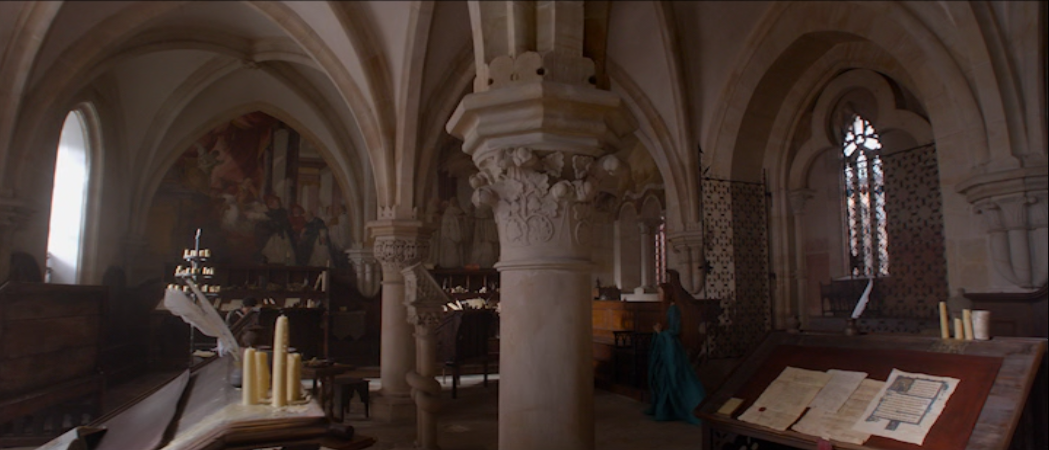
Elsinore is stately inside and out.


Some of the staging and cinematography is particularly striking.  Here is King Hamlet, being prepared for burial.  If you click on the image, you can see it larger, and you'll notice how many skulls are in this shot.  It's a small detail, but really cool.  


All the candles remind me so much of the underground, candlelit graveyard from another Hamlet retelling, The Wild and the Dirty (Johnny Hamlet) (1968).

The opening shot of the film is particularly cool because it deliberately recreates the famous painting Ophelia by Sir John Everett Millais.


Anyway, time to talk a bit about the characters and how they are portrayed!


Daisy Ridley's Ophelia refers to herself as being headstrong and willful, but I mostly get the sense that she simply cares very deeply about the people around her.  She doesn't let other people make up her mind for her, but she does take their opinions into consideration.  She's a sweet and loving daughter and sister, and tries to be a loyal servant to the queen, but she is mostly very lonely.  The other ladies-in-waiting pick on her and tease her and shun her, and so of course she is warmed and charmed by Hamlet paying attention to her.


George MacKay's Hamlet is at times stubborn, at times clueless, and at times very tender and affectionate.  Which is how I like my Hamlets.  He's the kind of mess we all have been in our late teens and early twenties, only he's been plopped into a horrific situation and has no good guidance for how to react to it.  I like how playful this Hamlet can be, and how much he does appear to care about Ophelia.

However, the romance between Hamlet and Ophelia leaves me feeling something is lacking.  In the book, there is a lot of time spent developing their friendship, affection, and love.  In the movie, they dance once and have a couple of conversations and arguments, and then they're pledging eternal love all of a sudden.  I wish the filmmakers had spent another ten minutes on showing their relationship deepening, or even given us a five-minute montage of them enjoying hanging out together and getting to know each other.  That's my one real quibble about this film -- the book is much better in that regard.


Tom Felton's Laertes is studious and earnest.  I love that he teaches Ophelia to read and sneaks her into the library.  He definitely has some hotheaded tendencies, which works well for the ending.  He's not a favorite Laertes for me, but I like him.


Devon Terrell's Horatio deserves more screen time.  He's much more important in the book, and becomes an ally for Ophelia.  Here, he mostly hangs out on the sidelines.  What time he gets is very nice, though -- he's a bit playful, has big dreams for the future, and is a good friend to Hamlet.


Naomi Watts's Gertrude is a mess, but she's meant to be -- she's like a cautionary tale of what can happen to a woman if she believes her value as a person is tied to her looks and how much other people like her.  


Clive Owens's Claudius is scary.  I usually find Owens quite handsome, but he's harsh and unpleasant for most of this film.  He's definitely doing the hulking villain thing to the utmost.


Dominic Mafham's Polonius is the nicest Polonius I have ever seen.  He has a kindly relationship with both Ophelia and Laertes, though he's a bit distant -- but they have a lovely family dynamic, obviously caring about one another even if they don't always know how to show it.  Ophelia gives him a sweet little kiss on the cheek at one point, and he smiles so sweetly.  Though he does think that Ophelia's being a lady-in-waiting and then attracting the prince's attention are both things that can advance his career, this Polonius does not use his daughter as a pawn the way some do.


One random tiny thing I love about this movie: Nathaniel Parker playing King Hamlet.  He played Laertes in the 1990 movie starring Mel Gibson.  He was my first Laertes, and a big part of why I love that character so much.  That makes it extra 'specially awesome to see him here in a different role!  He's an interesting Hamlet too -- warm one moment and distrustful the next.  I'd love to have seen more of him, as I think they could have fleshed him out a bit more.

Also a random side note:  Naomi Watts is married to Liev Schreiber in real life, and Liev Schreiber plays my favorite Laertes ever, in the version of Hamlet (2000) starring Ethan Hawke.  This also makes me happy.


Is this movie family friendly?  Um, it's not really appropriate for kids, as there is a short love scene (no nudity, and the couple is married), there's a witch character with some mildly creepy stuff in her home, and there's some poisoning and stabbing and so on.  Fine for older teens, depending on the teen?

I have an ongoing series called Hamlet Comparisons where I like to rate the various characters as portrayed in different adaptations and productions of Hamlet.  Here's how I'd rate these:

Hamlet: A 
Horatio: A- 
Laertes: A- 
Ophelia: A 
Claudius: A- 
Gertrude: A- 
Polonius: A-
Overall Production: A


This has been my contribution to the It's in the Name of the Title Blogathon hosted this week by Gill from Realweegiemidget Reviews and Rebecca from Taking Up Room.

Monday, March 27, 2023

Sooooooo... I wrote a book on the sly...

Yes, it's true.  I wrote a book this winter without telling anyone.  Well, almost anyone -- my husband and kids did know about it, and I eventually told a couple friends because I couldn't bear to keep it to myself anymore.  I was just having So Much Fun writing it!

If you're subscribed to my author mailing list, you've heard about this just a bit, as I announced it in my newsletter last week.  But I'd like to talk more about it here now.

This book is called Murder Most Foul, and it's a retelling of Shakespeare's Hamlet set in 1940s California.  If that sounds awfully familiar, yes, I first had this idea ten years ago, and I wrote it up as a fake movie review right here back in 2013.


I have loved that idea ever since, but I was always so busy writing other things, I just never got around to trying to flesh it out.  Well, you may recall that I broke my arm back in June.  Typing was good therapy for getting my hand and arm muscles back in shape, but at that time, I was revising My Rock and My Refuge, and that involved a lot more using the mouse rather than straight typing.  So, I thought, what could I work on a bit now and then that would be typing new words, not fussing with revising already written things?

That's when I remembered Murder Most Foul.  I thought, you know, if I tried hard, I could write the whole first draft before Christmas, and I could give it to my friend Cheryl, who was even nuttier about Hamlet than I am... or, at least, just as nutty.  Cheryl and I became friends before my oldest kid was born, so at least 16 years ago.  Probably closer to 20.  We bonded over our shared love of Hamlet and Combat! and Vic Morrow, initially.  Although we never met, we corresponded by email and snail mail all that time.  We sent each other obscure adaptations of Hamlet on DVD, and lots of other fun little things too, over the years.  A retelling of Hamlet as a 1940s murder mystery would tickle her to no end.

So, I started writing, sometime in July, just a paragraph or a two at a time.  Slow work, but very satisfying.  I loved seeing this world and these characters come to life.  I would grin like a little kid whenever I was working on it because everything was gelling so perfectly.

I got about three chapters into it... and Cheryl died.  

This wasn't super unexpected -- she'd had cancer about eight years ago, and the treatments for that had taken a hard toll.  She'd been living in an assisted living facility for a long time, pretty much ever since she beat cancer.  Occasional bouts of pneumonia were the most-serious thing I'd heard of in recent times, but she was in her 70s and not in great health.  At the same time, her recent letters had been upbeat.  So, her death was a surprise.  

I stopped writing Murder Most Foul.  I'd had such a great time imagining how much Cheryl would enjoy it that, with her gone, I couldn't work on it anymore.


I finished My Rock and My Refuge and launched it into the world in November, and breathed a sigh of relief because I intended to take a couple of months off from writing and just enjoy watching lots of movies and reading lots of books.

That's when I suddenly felt the need to work on Murder Most Foul again.  I realized I loved it too much to abandon it.  Even though I couldn't give it to Cheryl for Christmas, I could still finish it.  I could dedicate it to her memory.  And, maybe I could even write it quickly enough that it would still be finished before Christmas.  I could give it to my best friend/writing mentor/editor as a gift instead!

I did not finish it before Christmas.

In fact, I finished it at the verrrrrrrry end of February, with two days to spare before a planned trip out to see my bestie.  I really wanted to surprise her with a new book to read when I got to her place, and I did it!

So, yes, I will have a new book coming out later this year that is NOT part of my Once Upon a Western series.  It's not a western at all, or a fairy tale retelling.  It's not even exactly the same as that fake movie review I wrote ten years ago, though it does have the same basic cast in mind.  But I love it a lot, and I hope a lot of you will too. 

Sunday, December 11, 2022

"Hamlet at Elsinore" (1964) -- Initial Thoughts

Although many, many productions of Hamlet had been filmed before this 1964 version, this is only the second one to have been recorded in the Kronborg Castle at Elsinore (Helsingør, in Danish), where the play takes place.  The first was a silent film, and no one has done another since, which is kind of weird because they do a live production of Hamlet there every summer, and it's a really big deal.  They get big-name actors, and I'm surprised they don't record the performances more often.

Anyway, this particular production was done by the BBC in 1964, and it was recorded on videotape, not film, which I suspected when I was watching it.  Early videotape has a very distinctive look; once you've seen it, you won't have a hard time recognizing it.  Christopher Plummer received an Emmy nomination for his portrayal of Prince Hamlet, as this was telecast in Great Britain and the US.  Oddly, considering the fabulous cast, it was not made available on home video or DVD until 2011.  I'm so glad it wasn't lost, and that we can watch it now, because it is overall so good.  The print gets a little grimy here and there, though, but it's never unwatchable.


It kind of boggles my mind that this was made only one year before The Sound of Music (1965).  Christopher Plummer's Captain von Trapp always strikes me as quite a middle-aged chap in that, but he exudes youth and promise in this.  I would have thought this was about ten years earlier, not one, and the fact that Plummer can convince me he's so young here really adds to my admiration of his performance.


Over all, Plummer is a sympathetic Hamlet.  He is generally gentle and even playful, which I found very pleasing.  But sometimes he ran around and shouted and waved his arms a lot, and that was jarring.  I think he was playing Hamlet as actually going somewhat mad, so I guess all the shouting and arm-waving was supposed to show that?  It was usually super abrupt and unexpected, though, and sometimes pulled me out of the story, which I did not appreciate.


But I really loved a lot of his readings of lines that are often just considered throw-aways or ignored totally.  He clearly put a LOT of thought into his portrayal.  I know that Plummer was a stage actor before he got into movies, and you can see he's very comfortable with this style of storytelling.  I suppose all the shouting and gesticulating might be a carryover from his stage acting, actually, as that's such a different style from film.


Michael Caine was an absolute stand-out as Horatio.  Solid, dependable, loyal, brave, even wise -- everything a Horatio ought to be.  I can't believe Caine has never done any more Shakespeare.  He absolutely sold me here.  At the very end, his exchange with Fortinbras was particularly moving.  I would rather have liked to see how he would play Hamlet himself. 


The other stand-out in this production was Robert Shaw as Claudius.  Oh my goodness!  He was fantastic!  When I looked at the casting for this and saw him here, I was kind of dubious because I mostly think of him as the bad guy in The Sting (1973), and that's kind of a blustery sort of role, more blunt cudgel than sharp knife.  


But oh my, he was so good as Claudius.  Crafty, cunning, and quite sexy.  Wandering about in a dressing gown with no shirt underneath, and canoodling in bed with Gertrude, and then there's this whole thing with him being half-drunk at the play-within-a-play that was super interesting.  I think he's going to edge his way onto my Top 5 Claudiuses list with another viewing or two.


I'm afraid that Polonius (Alec Clunes), Ophelia (Jo Maxwell Muller), and Laertes (Dyson Lovell) were not particularly noteworthy.  Lovell and Muller started out pretty well as an affectionate pair of siblings, but their first scene was their best, and they both bored me later on, until Ophelia's mad scenes.  Muller shone there, I thought.  But Lovell never got interesting again, alas.  And Clunes as Polonius grated on me, though I think that was probably intentional, as this Polonius is not sympathetic at all.


June Tobin was okay as Gertrude.  She pretty clearly didn't believe Hamlet at all in the closet scene, and really preferred to think he was actually mad, as evidenced by the aforementioned satisfied canoodling later on.  No avoiding sharing her bed with Claudius for this Gertrude, which was interesting just because it's so different from a lot of portrayals.


The one rather odd bit of casting was Donald Sutherland as Fortinbras.  Maybe it's just because I've seen him in quite a few other things, but he just felt weirdly modern in the role, while all the others felt suitably... well, Elizabethan, if not actually ancient Danish.  That may just be a personal quibble, though.

The only thing I didn't like much at all was the way the person voicing the Ghost just ranted and shouted and roared and yowled.  If you can chew the scenery with just your voice, that actor did it.  Also, they did a lot of extreme close-ups that were supposed to be really cool or whatever, this being the sixties, but they seem very dated now.


Having the whole thing actually filmed in the real Kronborg Castle was really cool, though the acting was so good that I rarely pulled out of the story enough to think, "Oh, so that's what the actual courtyard looks like!" and so on.

Overall, it's a solidly enjoyable production, and I look forward to watching it again.  For the purpose of my Hamlet Comparisons, here's how I rate the various portrayals:

Hamlet: A
Horatio: A+
Laertes: C 
Ophelia: B 
Claudius: A
Gertrude: C
Polonius: C 
Overall Production: A-

Random note, but wow, 1964 was an amazing year for Hamlet fans.  Not only did this get filmed and telecast, but that's when Richard Burton was playing Hamlet on Broadway, and his version was filmed and released to theaters!  Wow.

Is this version of Hamlet family friendly?  Well, mostly.  But you do have Claudius and Gertrude kissing in bed, him shirtless and her in a sort of corset thing, but it goes no farther than kissing.  But there are a whole lot of paintings all around the castle featuring a lot of naked people, and some families might not be comfortable with that.  


This is my contribution to the Charismatic Christopher Plummer Blogathon hosted by RealWeegieMidget Reviews and Pale Writer this weekend.

Wednesday, August 24, 2022

I Have Finally Figured It Out

After twenty-five years of Shakespeare's play Hamlet: Prince of Denmark fascinating me endlessly, I finally have an answer to the question "Why do you love Hamlet so much?"  I know why I was drawn to it when I first read it at the age of 17, and why I feel pulled to watch some version of it every time I move.  Why I take it off the shelf to read when I am stressed.  Why I crave it at those very particular points of my life.

(All pics from my Bookstagram)

It's because I hate change.  Anyone who knows me knows that change is my least-favorite thing.  Changed plans stress me out more than anything else.  People who change make me sad.  Graduations and weddings and funerals make me cry.  Change bothers me.  Sometimes deeply.

And, you know what I realized today?  Hamlet hates change too.

In fact, he spends the first four acts of the play raging against change.  

Everything in his life has changed.  His father has changed from alive to dead.  And then his dead father changes into a ghost.  His mother changes from loving wife of his father to loving wife of his uncle.  His uncle changes from some random dude at court into the king AND Hamlet's stepfather.  His ability to woo and court Ophelia changes from being totally fine to totally forbidden.


And Hamlet's whole life plan changes from "I'm happy at college, and some day I'll probably be king" to "I'm not permitted to go back to college, and I probably won't ever be king" to "I need to avenge my father by killing my uncle, so now I'm definitely never going to live long enough to go back to college, much less be king."

And he hates it.  He rages against it.  He refuses to accept the inevitability of change.  Claudius and Gertrude try to remind him in the very beginning of the play that death is inevitable, and Hamlet is not having it.  He refuses to accept that.  He nopes right on out of there, as fast as his inky cloak will let him.  No, no, no, change and death are not inevitable, you can just take that idea and shove it where the sun don't shine.


And then, while he's off hanging out with pirates between acts 4 and 5, Hamlet changes.  He accepts the inevitability of change and of death.  He comes back to Denmark, and he's ready for whatever is next.

And THAT is what I am drawn to, when my life is in upheaval.  That journey of Hamlet's from raging against the inevitability of change to accepting it is exactly the journey I need to take myself, every time I move somewhere new or take on a new job or face some really stressful situation.  I've always said Hamlet is cathartic for me, and that watching or reading it kind of cleanses me emotionally.  And I was never quite sure how else to explain that, but now I know.  I'm processing my own hatred of change by sharing Hamlet's, and his journey eases me along in my own.

So.  Now I know.  And now you do too. 

That's all I've got for today.  Carry on about your business.

Friday, June 03, 2022

"The Wild and the Dirty" (aka "Johnny Hamlet") (1968)

I spent quite a few years hankering to see this movie.  A Spaghetti Western version of Hamlet?  Yes, please!  My husband tracked down a copy for me as a gift a couple years ago, and I was happy to discover it lived up to my years of expectations.

The Wild and the Dirty (1968) is also known as Johnny Hamlet.  And its original title is Quella Sporca Storia nel West, which I think roughly translates more as "That Dirty Story in the West."  That sounds like a much skankier film than this is, so I can see why they translated it just a bit differently.

The copy I have is in a two-pack from "The Spaghetti Western Collection," as pictured here, and it is entirely dubbed into English.  Except for Gilbert Roland's lines, I assume, as he appears to be speaking English throughout, and I think that sounds like his voice?  Horst Frank might be speaking English too, but I try not to pay much attention to him.  You'll understand why later.

I am not marking any spoilers here.  I figure a) this is a really obscure movie and you're probably never going to see it, and b) it's based on Hamlet, so there aren't really any surprises anyway.  Except one at the end, but we'll get to that.

The Wild and the Dirty (1968) begins with Johnny Hamilton (Andrea Giordana, billed as Chip Corman) asleep on a beach, dreaming dark things about his father and happy things about frolicking with a girl back home.


Neither dream lets us see anyone or anything very clearly.  Smoke obscures the figure he recognizes as his father, and its face remains turned away.  The girl never shows her face for more than a moment.  Their happy, playful flirting and kissing is mostly hidden behind a tangled mess of flowers.  Johnny's past is both obscured and separated from his present.

What awakens him?  An actor, sitting on the beach nearby, reciting the "To be or not to be" soliloquy from Hamlet.  It's a little bit meta and a little bit of a knowing wink to the audience, and it definitely makes us aware we're about to watch a pretty original spin on this classic Shakespearean tragedy.
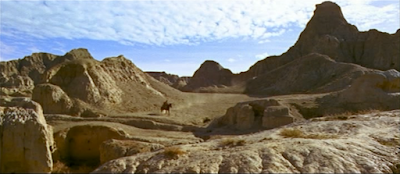

Johnny Hamilton is on the way home after the American Civil War.  He's clearly enduring some PTSD, and he's also anxious about what may have been happening at home while he was away.  This is a serious and pensive Hamlet, but I get the impression he was once a pretty cheerful guy.  Before he goes on his way that morning, he saves the actor and his companions from a couple of guys trying to ambush... someone.  It's unclear whether they're there to attack the acting troupe or Johnny.


Johnny arrives in his hometown and has a staredown with a couple of creepy, scuzzy locals.  He doesn't notice his old friend Horace (Gilbert Roland) because Horace is inside a building when Johnny rides by. But Horace spots Johnny immediately, and watches from a window as Johnny silently passes through town. 


You need to know that Gilbert Roland is very, very wonderful in this movie.  Notice the director gives us two different views of his ruggedly handsome, but weary face.  Very kind of him.  I suspect my friend DKoren will particularly appreciate that.

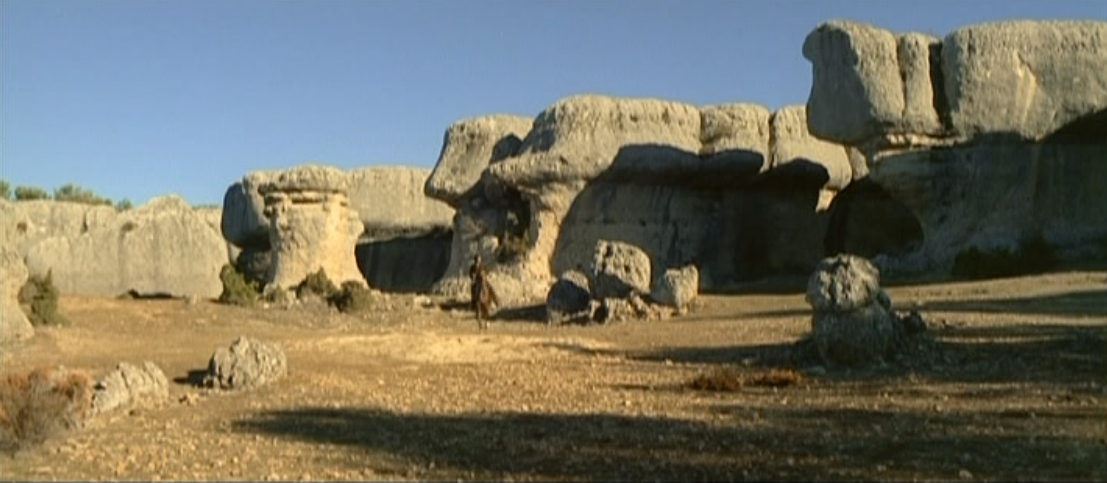
Johnny arrives at the Danark Cemetery, and it's so completely cool that I'm going to spam you with a bunch of screencaps of it, because this cemetery... is inside a cave.  And it is fantastic.  Feast your eyes:


I'm telling you, this is one of the coolest set-pieces I have ever seen in a movie.  Not just in a Hamlet movie or in a western, but in any movie.  It is sooooo evocative and atmospheric and creepy, but also kind of peaceful at the same time.

Here in the underground cemetery, Johnny meets up with the gravedigger (Franco Latini) and finds his father's grave.  It has an ominous note carved into the gravestone:
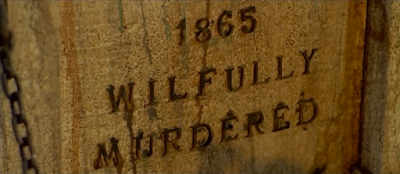

Well, so much for needing a ghost to come bearing the bad news.  This gravestone will do the job nicely.

Next thing we know, those two creepy, scuzzy men from town arrive at the graveyard and taunt Johnny about his father's death.  Now, up until this point, Andrea Giordana has been playing Johnny like he's in a sort of fog, just drifting about from one event to the next.  But one look at the fire in his eyes here, and you know that's all changing:


I love that he still has tears drying on his cheeks.  It's so subtle, but so perfect.

Anyway, those two creepsters try to goad Johnny into a fight.  But someone in the shadows shoots their guns out of their hands, and off they run.  Who is this unseen benefactor?  Oh, nobody important, just Johnny's best pal and mentor, Horace.  He has this little habit of turning up just in the nick of time and rescuing Johnny from baddies, you see.  Handy guy to be friends with.
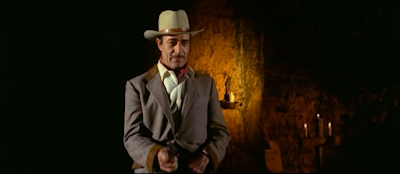

Horace tells Johnny that his father's murder is blamed on a bandit named Santana.  Johnny's uncle Claude then killed Santana. But Horace doesn't sound very convinced about either of those "facts." Johnny heads home to Ranch Elsenor to find his mother and try to learn more.  Buuuuuut, more shocks await him there.  He walks in and sees his mother Gertry (Francoise Prevost) in the arms of his uncle, Claude Hamilton (Horst Frank), rolling around on a bed like they were teenagers.


Side note: doesn't Andrea Giordana have interesting eyes?  Green in the middle and blue around the edges.  I'm not sure I've ever seen eyes quite like them before.  Beautiful.


Annnnnnnyway, of course, Gertry and Claude are all, "Hey, guess what?  We got married!  Isn't that fun?  It's totally not weird.  Why are you being weird about it?"  Because, well, Johnny's understandably quite discomfited by this whole situation.  He reacts by pouting, taking long walks, thinking a lot, and generally being upset by all that's happened.


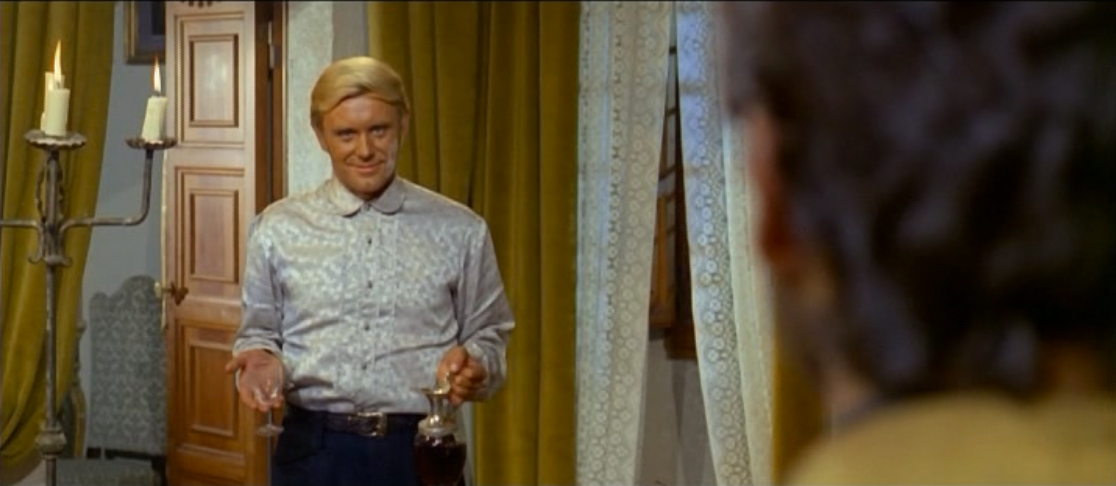
But, let's face it: if your uncle married your mom after dispatching the guy who killed your dad, and your uncle looked like a '70s Ken Doll, you'd be weirded out too.


Yeah, Claude doesn't even try NOT to be creepy most of the time.  Ew.

Well, at least one person besides Horace is happy to see Johnny back from the war, and that's the sweet and lovely Ophelia (Gabriella Boccardo, billed as Gabriella Grimaldi).  She gets called Emily for some reason in cast lists, but the English dub-over has Johnny call her Ophelia, so I'm calling her Ophelia here.


They meet up in that millhouse behind Johnny in the picture of him being all broody.  That's the same millhouse he dreamed about in connection with Ophelia, and we get the sense that this was their usual rendezvous spot before he went to the war.  Smooching and conversation ensues.  Also, the mill is the second-coolest set in the movie, after the cemetery.  How come more westerns don't have scenes inside mills?  They totally had all sorts of mills in the Old West: gristmills, sawmills, etc.  And they make such cool sets.
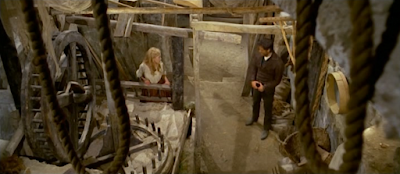

Well, anyway, Ophelia is possibly a little bit... not all there.  She tells Johnny she's sad because her father keeps yelling at her to marry, but she'd promised Johnny to wait for him, and then he took a long time getting home from the war, so her father's been harsh to her.  She says Johnny's father is much nicer, knows all about her waiting for Johnny and approves, and even nicknamed her "blue eyes."  Which is not very original, since she does have blue eyes, but hey, it happens.  I think she's talking about Johnny's real father, who is now dead, but she might be talking about Uncle Claude.  In which case, ew!  Ophelia!  What even?
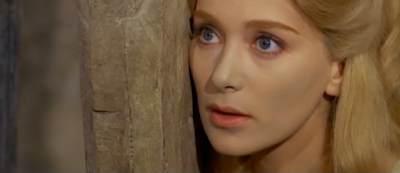

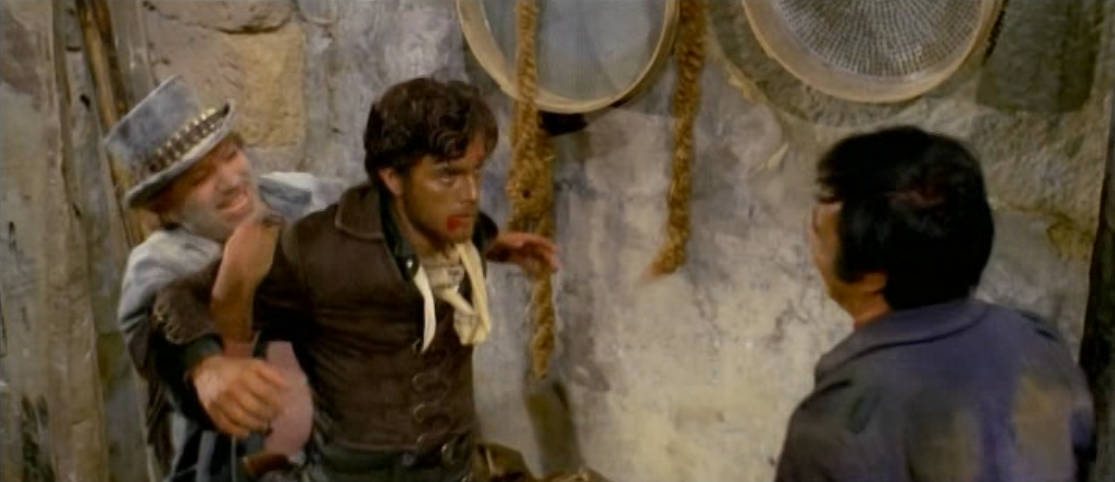
Um, so, Johnny jumps to conclusions and thinks she's talking about Uncle Claude, and he yells at Ophelia a lot, suspecting she gave herself to Claude and now is running back to Johnny because his uncle's finished with her.  But before he can yell too much, back come the two creepy scuzzmeisters.  They proceed to beat Johnny up pretty badly, and then rough Ophelia up while he's helpless to stop them.  Don't worry, though -- Ophelia comes off pretty well.  One of them rips her shirt and forces a kiss on her, and then he lets her run away.  After all, she's the sheriff's daughter, so they don't dare actually hurt her much.  They'd rather get their jollies beating Johnny up again anyway.


Happily, you remember how I mentioned Horace had this really helpful habit?  Well, guess who turns up in the nick of time again.


Don't you want Horace for a guardian angel?  Cuz I sure do.

Oh, this is Ophelia's charming father, the Sheriff (Giorgio Sammartino, as Giorgio Sanmartin).  I guess the writers decided he didn't deserve a first or last name.  I agree with them.  Actually, Horace says he has a better name for him than Sheriff, but doesn't tell us what it is.  Use your imagination, I guess.


Sheriff is just here to tell Johnny to stay away from Ophelia, and then he rides off after trading insults with Horace.

Well, Horace has a clue he picked up near Johnny's father's body, a very distinctive silver thingamabog.


He's hoping it will help him and Johnny track down the real killer, because they are both starting to suspect it wasn't Santana at all, and that Claude's shooting of Santana was a cover-up for the murder.

So, Johnny starts asking questions.  He chats up Uncle Claude about why he ever suspected Santana.  He waxes philosophic about the nature of cowardice and courage while sharing an evening drink with Horace.  And then, that acting troupe from the beginning arrives!


With them is the lovely actress Betty (Stefania Careddu), who has been interested in Johnny since he saved their lives back on the beach.  Or maybe even before that.  And, since Ophelia has been forbidden to spend time with Johnny now, and since he's mad at her anyway, Johnny returns Betty's interest, and how.


Now, before you think we've gone completely off track and left the plot behind just because the director's wife thought there weren't enough smoochy-smoochy scenes or something, look what Johnny discovers!  Her earrings match that thingamabob Horace found by his father's body!


Betty says she got them from a man down on the border a couple of weeks ago.  Does this mean Johnny's father's killer is still alive?  (Cue lots of dramatic music.)
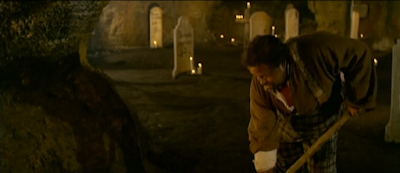

Johnny hires the gravedigger to dig up Santana's grave and see if anyone's in it.  Because we did NOT build that amazing underground cemetery set to only use it for one scene.  Unfortunately, there actually is a dead body in the coffin, and it even has a gunbelt with those little thingamabobs on it.

Uncle Claude is not super happy about Johnny digging around in the past, so to speak.  He scolds Johnny for "sniffing around like a miserable, stinking dog," and Johnny gets good and angry over this, treating us to this perfectly scrumptious glare:


Uh, yeah, where was I?  My goodness, that glare is distracting.  Oh!  Yes.  Meanwhile, back in town, Betty the actress turns up dead, and robbed of her earrings, too.  Next, Johnny gets ambushed in the saloon, and we all know what that means.


That's three times Horace has come to Johnny's rescue, if you're counting.

Johnny decides to go on a little trip to try to find out where Betty the actress got those earrings.  His mom brings him his dad's fancy dueling pistol because we haven't seen her much yet, and she looks really nice in that red dress.


Cue Johnny riding around among some really interesting rock formations.


He has a big fight with some of Santana's henchmen, discovers that Santana isn't dead after all, and ::GASP!:: that Santana is actually pals with Uncle Claude.  Something about bonding over a gold shipment they robbed together, though it turns out that it's possible Uncle Claude stole the gold from Santana and kept it for himself.  

Santana gets pretty miffed about probably getting double crossed, as one does.  So, they all head off to force Uncle Claude to show them where he hid the gold.  But before they do, Johnny gets probably my favorite line in the whole thing.  He tells Uncle Claude "I refuse to waste time with any more of your play acting.  Once you understand that, I'll be all right."  I LOVE that line.

One ambush later, and Johnny's in serious trouble.  I think you know by now what that means.


Time for Horace to randomly come riding by and rescue him!  Alas, Horace gets shot in the leg in the process.  Johnny helps bandage him up once they're safely away, and the two friends say goodbye before Johnny rides off to find his destiny.  Neither of them expects to see the other alive again.

Meanwhile, back at the ranch, Uncle Claude shoots Ophelia and dumps her body in the river along with Johnny's dad's gun, which Johnny dropped during that ambush.  Now, Johnny's wanted for Ophelia's murder.

Annnnnnnnnnd it starts to look like Johnny's destiny is pretty danged unpleasant.


He gets caught, beaten, and trussed up between two poles to die in the sun because just killing him would have ended the movie too soon.  We can't end the movie until we have an overly long gunfight between Uncle Claude's pals and Santana over the whole double-cross thing with the gold shipment.  

This also gives Gertry a chance to figure out her new husband is a skunk, get shot by one of his henchmen, ride around in the desert after having been shot, and try to rescue her son from the Sheriff's "justice."  Which she has no choice but to do, since Horace is off nursing a wounded leg and is unavailable for rescues at the moment.


Or is he?

Commence rescue number five!  That guy Horace is unstoppable.

Johnny's hands are all messed up, so when he and Horace go after the two creepy skeezeoids from town and Uncle Claude, he has to tie his gun to his hand.  Which I think is a pretty neat visual version of Hamlet's line "O, from this time forth, My thoughts be bloody, or be nothing worth!" (Hamlet, IV, 4)


A couple more shoot-outs occur, which take care of all the bad guys.  When the smoke and gold dust clear, the gravedigger arrives with a wagonload of coffins, ready to get to work.


He's greeted by the last two men standing.


I promised you a surprise at the end!  Johnny Hamilton doesn't die!  He rides away with Horace, leaving all the death and destruction behind.  And the gravedigger, even though he says he's the fastest shovel in Texas, maybe the whole west.


Is this movie family friendly?  Basically, yes.  There's some kissing between Claude and Gertry and between Johnny and Betty, both involving lying on a bed, but kissing is all that happens.  Emily's dress is torn from her shoulder, exposing her corset, which covers as much as a one-piece bathing suit would.  It's clear that her attacker is messing with her just to get to Johnny, and she runs away without being molested more than that.  There's a little bad language, and definitely a lot of violence, most of it gunplay, but some of it fist fighting.  And Johnny looks dead at one point, when he's hung on the X-style cross, which could be scary to younger viewers.  I would say this is fine for teens and some tweens, but a bit much for children.  Or, too much for my ten-year-old, anyway.

Here's how I'd "grade" this adaptation of Hamlet:

Hamlet/Johnny Hamilton: A
Horatio/Horace: A+
Laertes: N/A
Ophelia/Emily:  C
Claudius/Claude:  B-
Gertrude/Gertry:  C
Polonius/Sheriff: N/A
Overall Production: N/A because it's a retelling, not a production of the play.

If you want to see how it stacks up against the other 19 adaptations/productions of Hamlet I've seen, check out my "Hamlet" Adaptations page.


This review is my entry for the Foreign Western Blogathon hosted by Moon in Gemini this weekend.

I took a lot of really nice screencaps of Gilbert Roland that never fit in the review, so I'm just going to share the best two here, because I can't bear to deprive you of his handsome closeups.