Showing posts with label Jean Simmons. Show all posts

Wednesday, February 12, 2025

My Ten Favorite Musicals -- 2025 Update

I shared my original list of ten favorite musicals a whole decade ago!  I've definitely got some slightly different favorites now, though many of the same dear favorites are still tops.  Here is my current list!  As usual, all titles are linked to my reviews if I have reviewed a particular movie.


(Random note, but I find it amusing how this graphic color-coordinated itself.  I didn't try to arrange the movies so they would have white posters all in a block and colorful ones in another block!  So funny.)

1. Guys and Dolls (1955)

Nathan Detroit (Frank Sinatra) bets Sky Masterson (Marlon Brando) that he can't get social reformer Sarah Brown (Jean Simmons) to go on a date with him. This movie made me fall in love with the stories and writing style of Damon Runyon, which the musical is based on. Personally (and that means in person), I adore the odd patter the characters speak. 


An ex-GI painter (Gene Kelly) falls in love with a girl (Leslie Caron), not knowing she's engaged to his night club singer friend (Georges Guetary). The whole movie is an excuse to sing and dance to Gershwin tunes, which is one of the best reasons for making a musical I've ever heard. 


3. White Christmas (1954) 

A team of showbiz stars (Bing Crosby and Danny Kaye) try to rescue a retired general (Dean Jagger) from bankruptcy by staging a show at his ski lodge. Why yes, this heads up my list of favorite Christmas movies too. 


P. T. Barnum (Hugh Jackman) gathers up the misfits of the world and gives them jobs, friendship, and a purpose.  And that includes his protégé Phillip Carlyle (Zac Efron), who falls in love with a trapeze artist (Zendaya).  The message of everyone deserving friendship and love and a place to belong, no matter what they look like, really resonates with me.


5. The Phantom of the Opera (2004)

A talented young singer (Emmy Rossum) is mentored and stalked and abducted and generally haunted by a disfigured man (Gerard Butler) who lives under the Paris Opera House.  Thank goodness for her childhood friend Raoul (Patrick Wilson), who stands by her and helps her however he can, and eventually falls in love with her as well.  This production is overwhelmingly lavish and opulent and everything it ought to be.  I'm particularly taken with Patrick Wilson's portrayal of Raoul as a brave and manly young fellow who protects and defends and is generally awesome.  And his voice is like butterscotch.  I wish Wilson made more musicals.


6. State Fair (1945) 

A family spends a week at the Iowa state fair, where the daughter (Jeanne Crain) falls in love with a newspaper man (Dana Andrews), the son falls in love with an entertainer, and the parents take home prizes for their mincemeat and hog. There's a 1960s remake that stars Bobby Darin in the Dana Andrews role, but aside from dearest Bobby, that version lacks the charm of this one. 


7.  Hello, Dolly! (1969)

A fairy-godmother-like matchmaker (Barbra Streisand) finds love matches for two store clerks (Michael Crawford, Danny Lockin), two milliners (Marianne McAndrew, E. J. Peaker), an irascible businessman (Walter Matthau) and his niece (Joyce Ames)... and herself.  I have a penchant for fairy godmothers, and Dolly Levi has been an inspiration to me since I was in single digits. 


8.  West Side Story (1961) 

A modern retelling of Romeo and Juliet set in 1960s NYC, with rival street gangs taking the place of rival families. So heartbreaking and beautiful, with some of the coolest dancing ever -- I much prefer it to Romeo and Juliet. The soundtrack was one of the first CDs I ever bought, and I know all the words to every song. 


9.  Brigadoon (1954) 

Two hunters (Gene Kelly and Van Johnson) stumble on an enchanted Scottish village that only exists one day out of every hundred years, whereupon one of them falls in love with a local girl (Cyd Charisse).  I'm getting goosebumps just thinking about it. 


10. Oklahoma! (1999) 

A cowboy (Hugh Jackman) tries to win the heart of a girl who claims she hates him. Yes, you read that correctly: Hugh Jackman. This is the London stage version, not the famous Hollywood one, and I prefer it because, well, Hugh Jackman!


This post is one of my contributions to We Love Musicals Week.  I hope you've been enjoying the fun so far!

Friday, June 14, 2024

"Guys and Dolls" (1955)


Guys and Dolls
 (1955) is my favorite movie musical.  I love so much about it -- the songs, the cast, the costumes, the scenery, and the storyline!  But above all, I love the dialog.  This musical is based on the short stories of Damon Runyon, particularly his 1933 story "The Idyll of Miss Sarah Brown."  Runyon wrote a distinctive style of dialog that became known as "Runyonese" that is filled with slang, humorously uses long and flowery words at random, and diligently avoids contractions.  The dialog for the film embraces Runyonese, with spectacularly funny results.


When I saw this movie for the first time, I was fifteen and had no idea what it was about, what Runyonese was like, nothing.  My friend Jesse and I had spent the afternoon painting faces at a Halloween festival, and we stopped to rent a movie on the way back to my place.  We both loved old classic movies, and we thought the colorful VHS cover at the video store looked really fun, so we rented it on a complete whim.

We spent the next two and a half hours laughing and laughing and laughing. We both fell in love with all the songs and the crazy dialog and the costumes -- in fact, I watched the movie all over again the next day with my mom and brother before returning it to the video store.  And Jesse and I would fangirl over it with great glee for months afterward, whenever we happened to get together.

A few years later, I found a collection of Damon Runyon's stories and read them, and was endlessly delighted to discover that Runyonese is just as funny when you read it as when you hear it.


Guys and Dolls revolves around two romantic pairings: Nathan Detroit (Frank Sinatra) and Miss Adelaide (Vivian Blaine), and Sky Masterson (Marlon Brando) and Sergeant Sarah Brown (Jean Simmons).  Nathan and Adelaide have been engaged for fourteen years, but Sky and Sarah have only just met.  


Nathan Detroit needs a thousand dollars to rent a place to hold his famous floating crap game, and he bets Sky Masterson a thousand dollars that Sky cannot take any random woman on a date.  Sky takes the bet, Nathan names Sister Sarah as the woman he should take out, and the bulk of the film is about Sky's attempts to convince Sarah he is a repentant sinner who wants her street mission to save his soul, when really he just wants her to fly to Havana with him so he can win the bet.  Except that, he starts to fall in love with her for real, which complicates everything.


Marlon Brando and Jean Simmons were not trained singers, but they recorded their own songs for this film anyway.  Brando later said that they cobbled his songs together from the multitude of takes they recorded, but Simmons sang well enough she did not need such extreme editing.  Neither of them hold a candle to Sinatra, but they do not need to!  The unpolished, more realistic sound of their songs adds to their charm.  Not only are neither Sky nor Sarah great at singing, neither one has ever been great at this whole falling-in-love thing.  But they do so anyway.  It totally works.


I have read that Sinatra very much wanted to play Sky Masterson and was so angry that the studio cast Marlon Brando instead, who was not really a singer or a dancer (but WAS hot box office right then), that he refused to speak to Brando most of the time.  They spent the bulk of the filming communicating through others.  Their characters definitely come across as rivals who like to one-up each other, so the off-screen antagonism does not hurt the film.


One of my favorite parts of the whole movie is the crap game staged as a ballet set in the sewers.  Which is not a sentence you will run into very often, am I right?  But it works gorgeously, and it involves my favorite song from the film ("Luck be a Lady").  I would link to clips of it here, but it is kind of the climax for the plot, and I do not want to ruin it for anyone here who has decided they want to see the movie for the first time.


I have heard a lot of people saying that Marlon Brando is miscast in this film, and I think that is hogwash.  His Sky Masterson is unfairly attractive, all elegant masculinity and effortless cool.  There is no reason to wonder why Sarah Brown is drawn to him despite her best intentions not to be.  I have always been upset that Brando has never played any other character quite as wonderful, though, admittedly, I have only seen ten of his other films, so perhaps I will stumble on one sometime that I also love him in -- his turn as Mark Antony in the 1953 Julius Caesar is the closest I have found so far.

Random historical tidbit: when Damon Runyon was an up-and-coming New York City reporter, he was mentored by famed western lawman-and-gambler-turned-sportswriter Bat Masterson.  It is widely acknowledged that Runyon named his coolest character, a gambler from the west called Sky Masterson, after his mentor.


Is this movie family friendly?  Basically, yes.  Miss Adelaide is a singer and dancer at a nightclub, and her songs are a little risque both in the lyrics and her costumes (see above).  Not racy enough to stop me from watching this movie recently with my kids, who are currently 12, 14, and 16, but some families may find they wish to fast-forward or skip those scenes (you can skip them without missing any part of the plot).  There are some kisses and some very mild innuendos in the dialog elsewhere.  By today's standards, it is super tame, but for the '50s it was probably almost a little edgy.

You can watch this movie on DVD and Blu-Ray, or stream it on Amazon Prime, YouTube, FreeVee, Tubi, the Roku Channel, and probably other places too -- it is not hard to find.


This has been my contribution to the Seventh Broadway Bound Blogathon hosted by Taking Up Room this weekend!  Guys and Dolls was originally a Broadway musical -- according to Wikipedia, it opened on Broadway in 1950, ran for 1200 performances, and won the Tony Award for Best Musical that year!

Monday, January 01, 2024

My Ten Favorite New-to-Me Movies of 2023

Here we are at the end of another year, the assigned time for rounding up lists of favorites in various categories.  I'll be posting my favorite reads from 2023 on my book blog on Tuesday, but today, it's time to talk about my top ten favorite movies I saw for the first time over the past year!


1. Fort Dobbs (1958)  A man on the run from the law (Clint Walker) rushes a pioneer woman (Virginia Mayo) and her feisty son (Richard Eyer) to the safety of a cavalry fort during a Comanche uprising.  I watched this movie over and over this year -- it's everything I want in a western.  Heroic and honorable hero and heroine, real danger and real courage, and a found family, with great dialog and intelligent characters.  And a few surprises!  Good, good stuff.

2. Dungeons and Dragons: Honor Among Thieves (2023)  A thief (Chris Pine) tries to rescue his daughter (Chloe Coleman) from a conman (Hugh Grant) with the help of a warrior (Michelle Rodriguez), a wizard (Justice Smith), and a guerilla (Sophia Lillis).  Another exceedingly smart script that delights me.  This movie manages to feel like a bunch of teens playing D&D while also being way smarter and more well-plotted than I ever expected.

3. Blackbeard's Ghost (1968)  A track coach (Dean Jones) accidentally awakens the ghost of the dread pirate Blackbeard (Peter Ustinov), who attempts to help the local track team win over long odds in a bid to find eternal peace.  This is a resoundingly funny and adorable movie.  

4. New in Town (2009)  A high-powered executive (Renee Zellweger) from Miami arrives in Minnesota to shut down a factory, only to fall in love with the workers, the town, and the union representative (Harry Connick, Jr.).  I avoided this movie for over a decade because I thought it was going to make fun of Minnesotans and Midwesterners, but it doesn't.  The love story is actually remarkably charming and natural, too.

5. Indiana Jones and the Dial of Destiny (2023)  Indy (Harrison Ford) tries to stop a former Nazi (Mads Mikkelsen) from traveling back in time.  Thought I was going to be disappointed by it, but I wasn't, which makes me really happy.

6. The Boys in the Boat (2023) True story about a rowing team of poor boys from Washington state who defy long odds and go to the Olympics.  Absolutely a feel-good movie in the best possible way.  It was an uplifting, pro-American, pro-hard work movie that felt like it could have been made in the '80s.  Or the '60s.  Really good stuff.

7. Howl's Moving Castle (2004) A young woman (Emily Mortimer) falls afoul of a witch (Lauren Bacall) and gets turned into an old woman (Jean Simmons).  She then encounters a mercurial wizard (Christian Bale) and his fire demon (Billy Crystal) and befriends them, with lots of adventures and a love story ensuing.  I read the book for the first time this year too, and I like them both about equally.

8. Lady in the Lake (1946)  Philip Marlowe (Robert Montgomery) tries to figure out who murdered a woman and dumped her body in a lake.  Yes, it's gimmicky -- the whole thing is shot in "first person" as if the camera is Marlowe -- but the storytelling is strong anyway.  I love the Raymond Chandler book more, but this is one of the Marlowe movies I like well enough to keep a copy for my shelves.

9. Rachel and the Stranger (1948)  A widowed pioneer (William Holden) marries a bondservant (Loretta Young) so she can take care of his house and son without impropriety, but when his old friend (Robert Mitchum) comes for a visit and shows interest in her himself, the pioneer has to decide just how married he really wants to be.  It's basically a pioneer romcom, and I didn't like it much the first time I watched it, but it kept rattling around in my head until I rewatched it, and I liked it much better then.

10. Botany Bay (1952)  Alan Ladd falls afoul of another sadistic sea captain, just like he did in Two Years Before the Mast (1946).  You'd think he'd learn!  This time, the captain (James Mason) actually keelhauls Ladd's character.  Twice.  Um, yes.  Not fun.  At least, not if you're a Ladd fan!  But it all turns out okay.

A few fun stats from my movie-watching in 2023:

Total movies watched: 137

New-to-me movies watched: 26

Movies re-watched: 111

Movies seen in the theater: 11

Movies watched more than twice this year: Fort Dobbs (6), Dungeons and Dragons: Honor Among Thieves (3)

Month with the most movies watched: July (19)

Month with the least movies watched: June (3)

Number of Alan Ladd movies watched: 9

Friday, February 15, 2019

"Hamlet" (1948)

I'd seen Laurence Olivier's Hamlet once before, probably between 2002 and 2004, though I'm not entirely certain.  I remember I was not a big fan of it, though I never bothered recording my thoughts on why.

Well, I watched it again this week so I could review it for We Love Shakespeare Week, and... I am still not a big fan of it.  Which I think says more about me and my personal needs from a Hamlet production than anything else, as there's nothing bad or wrong about this film.  It just doesn't work for me personally, and I'd like to explore that a bit here.

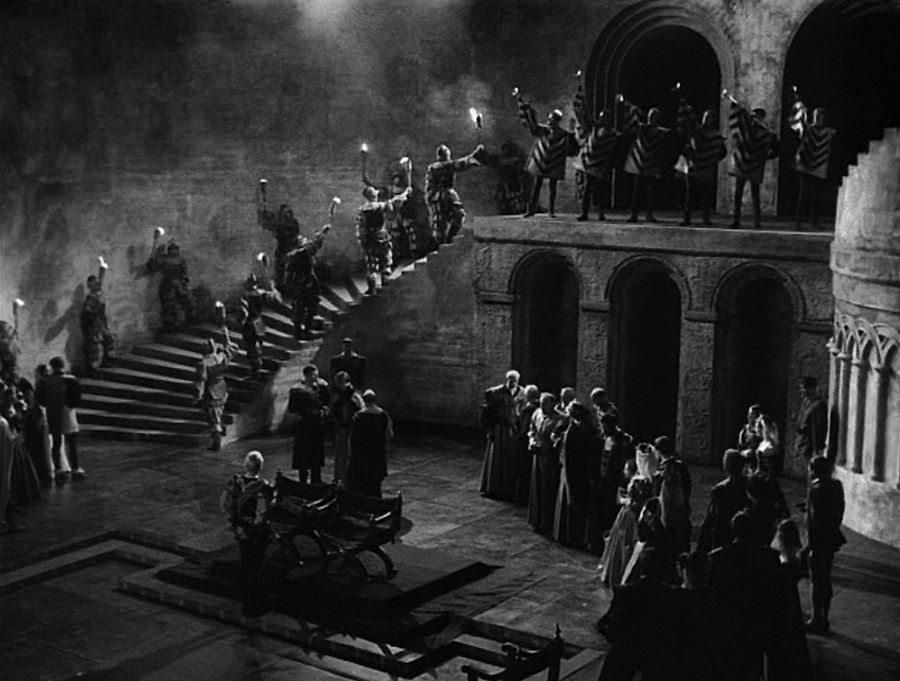
This is a very pretty film, in an austere way, with lots of lovely costumes and some stunning sets.  This Elsinore is cold and forboding, but not a place of decay or despair.  It's more like a place forsaken, emptied of life and passion.  And that's very much what I feel is missing from this whole film:  passion.  The words are here, the movements are here, but I can't connect to the emotions.  They may be hidden under the surface, but I just can't find them most of the time.  And that disappoints me.

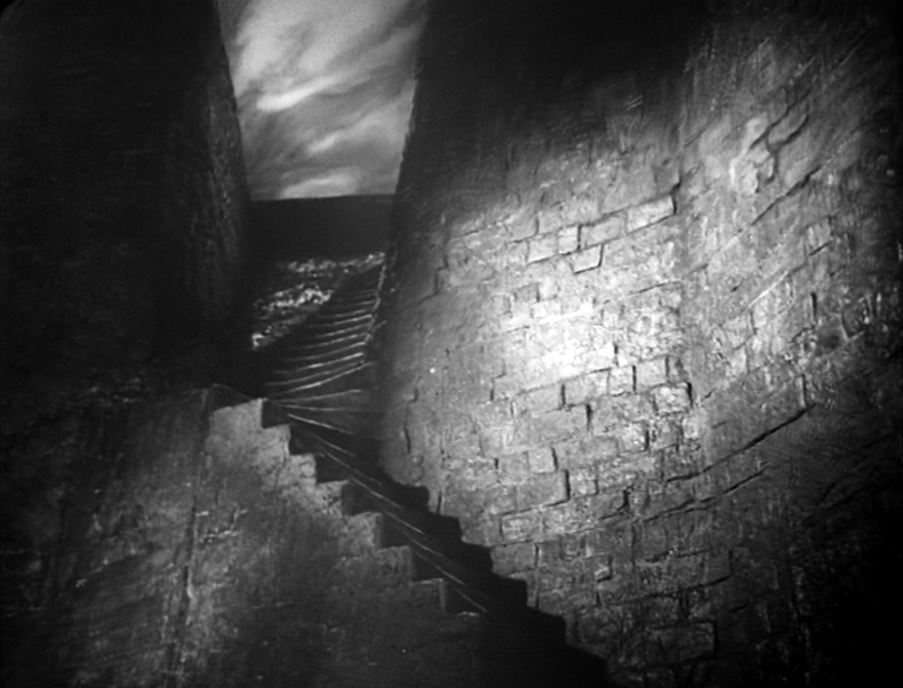
These are the opening shots of the film.  Look how empty, how cold, how mystery-shrouded, yet barren they are.


For me, Hamlet is a story that focuses on the core emotions and problems of the human condition.  Being versus not being.  Following your emotions or your rationality.  Acting according to your convictions.  Duty and honor and obligation and desire.

But what does Olivier say this is?  He says this is primarily a story of a man who cannot make up his mind.  He states that right at the beginning of the film.  And I just don't see it that way.  So no wonder I disagree with his directing and acting!  I disagree with him on the whole point of the play.  (He directed it as well as starring, so I consider most of the decisions here to be his.)

Over and over, the camera looks at the characters from up high or far away, as if insisting that the audience maintain their distance.  This might also be trying to tell us that Hamlet feels detached from life, from the court, from the recent events.  He sits apart from the rest of the court in the opening scenes, though that's fairly typical staging.  But perhaps the repeated distancing of the camera from the action is meant to emphasize that separation?


I'm not saying they shoot everything from far away -- plenty of the action is closer to the camera, and once in a very great while, you even get a superb closeup.


But it's definitely a deliberate choice to keep looking at people from far away, and often from above.


Possibly they're trying to emphasize the theme of spying.  Hamlet is repeatedly spied upon during the play, by Polonious, by Claudius, by others (there's no Rosencrantz and Guildenstern in this version, but in the play, their whole reason for hanging out in Elsinore is to spy on him).  So that might be part of it -- putting us in the position of a spy.

There's one spot where Hamlet gets to do a bit of spying himself -- Olivier has him overhear Polonius and Claudius decide to watch him interact with Ophelia, which makes him later asking her where her father is very interesting -- he's testing her, trying to see whose side she's chosen.


Mostly, I think my problem with this version is that Hamlet himself seems very detached.  Cold, even.  It's like he's not allowing himself to feel anything at all.  Is he afraid of feeling too much?  Is he working extra hard to mask his emotions?  Holding himself very deliberately in check so as to remain aloof from all the trouble in Elsinore?  I DO NOT KNOW.  And that really bugs me.  I should know what he's feeling and thinking.  I don't want an inscrutable Hamlet, I want a Hamlet I can sympathize with.


Even with Ophelia, he's distant, remote.  I don't see love or passion or even friendly feelings in his scenes with her.  Maybe a little disappointment. Certainly no pangs of despised love.


I don't know why Olivier chose to play Hamlet this way!  Because it's very obviously deliberate.  He can play passionate, he can play emotional, he can play great depth of feeling.  I've seen him do it.  I like him really well in Rebecca (1940), Pride and Prejudice (1940), and Wuthering Heights (1939).  So why does he go all cold, dead fish for this?  Is it because he's 40 and feels somehow that he's too old for the role?  I don't personally think there's an age limit on how old or young you have to be to play Hamlet, but maybe he was worried about looking like he was trying to be younger than he was?  I wish I knew.

Now, Jean Simmons is amazing as Ophelia. She's nineteen, with a fragile, ethereal beauty.


She's got a very sweet, cute relationship with her brother, Laertes (Terence Morgan).


I like how he shields her a little from their blustery, somewhat gruff father Polonius (Felix Aylmer).


Really, this Ophelia is my favorite part of the film.  At such time as I watch this version again, it will be for her.  When she goes mad, you can't help but grieve, for she's like a lost little girl who needs rescuing.


But Hamlet remains detached from her, separated by himself, by others, and finally by her death.


Let's see, what about the rest of the cast?  I'm afraid Normal Wooland was a fairly boring Horatio.


Polonius (Felix Aylmer) and Gertrude (Eileen Herlie) were adequate.  But Claudius (Basil Sydney) disappointed me.  He wasn't conniving, he wasn't treacherous, he wasn't even interesting.  He was just kind of there.


I was rather charmed by Terence Morgan as Laertes, so that definitely pleased me.  Laertes is so often overlooked when casting and performing Hamlet, but I find him terribly important.  How he and Ophelia behave toward each other, and whether or not he serves as a good mirror image of Hamlet can elevate or drag down a production for me.


I felt like he could have been a little more tender toward Ophelia in their last scene together, but he did a great job being overcome with is emotions, so I'm okay with it.

So, when Hamlet comes back from his pirate adventure, usually he's played as being sort of settled down.  Calmed.  No more wild and whirling words.  He's ready for whatever his future holds.  But that's not at all the way I felt about him here!  If anything, he just seemed sort of relaxed and cheerful.  Playful, even!


In fact, I loved him in the gravedigger scene!  He finally felt alive and real.  I wish so much he'd been more like this for the rest of the movie, because if he had, I would absolutely dig it to pieces.


Is this a bad production?  NO.  It's beautifully shot.  It's nicely acted.  It just... does not suit me.

For the last few years, I've been "grading" the various Hamlet productions I watch when I review them.  Here's how this one measures up, for me:

Hamlet: B-
Horatio: C
Laertes: B+
Ophelia: A
Claudius: D
Gertrude: C
Polonius:  C
Overall Production: B

If you want to see how that compares to other versions I've seen, check out My Thoughts on Various Hamlet Adaptations.

I'll leave you with this gorgeous shot of Hamlet, all shrouded in confusion and being quite inscrutable.  Because it's really pretty.  And because I might have a teeny bit of a crush on Olivier right now.


This has been my final contribution to my We Love Shakespeare Week party!  I'll be posting the answers to the party games this weekend, and drawing winners for the giveaway on Sunday.  Be sure to check out everyone else's posts via the links here.


Thursday, January 31, 2019

"The Big Country" (1958)


Everything in this movie is big.  The scenery, the characters' egos and ideas and desires -- even the names of the stars.  And the filmmakers don't let you forget it, either.  They crammed the movie with sweeping vistas, outsized sets, and characters caught up in larger-than-life struggles.  If you like Hollywood Epics with a capital E, this is the movie for you!


Wealthy sea captain Jim McKay (Gregory Peck) leaves his sailing ships and heads for Texas to meet the family of the girl he fell in love with back East, Patricia Terrill (Carroll Baker).  Her father, Major Henry Terrill (Charles Bickford), welcomes Jim McKay with an enormous party, during which everyone from miles around shakes Jim's hand and reminds him that Texas is a Big Country.  He dares to tell one of them that yes, he has seen something just as big before: the ocean!  They don't believe him.  Nothing could be bigger than Texas.


Patricia is headstrong, spoiled, and bossy.  Somehow, remarkably, she's acquired the friendship of a sensible, clear-sighted, and intelligent woman named Julie Maragon (Jean Simmons).  Maybe it's because they're just about the only unattached young women in the area, or maybe Patricia likes that Julie gives her good advice and doesn't defy her bossing.  Much.


Jim McKay soon learns that Major Terrill has an arch-enemy, Rufus Hannassey (Burl Ives).  The Hannasseys and the Terrills have been feuding for a long time now.  Why?  Mostly because they're the two biggest landowners in the area, and because the heads of both families are ornery and mean.


The only reason the area has had any semblance of peace is that there's only one good water source, the Big Muddy.  And neither Terrill nor Hannassey controls the Big Muddy.


Julie Maragon does.  For decades, she (like her father before her) has allowed both the Hannasseys and the Terrills to water their stock in the river on the condition that they keep the peace.  The first to break that uneasy truce will lose all rights to use the vital water.  This puts a lot of pressure on Julie from both sides, but she bears up under it with grace and conviction.  She's going to keep the peace in this land if it kills her.


Now, Major Terrill and Patricia decide that, because Julie is Patricia's best friend, Julie can be convinced to give Patricia her land and all the water rights as a wedding present when Patricia marries Jim McKay.


However, Rufus Hannassey's oldest boy, Buck (Chuck Connors) has decided that Julie fancies him.  Buck is a crude, cowardly bully, so used to getting his own way that he thinks he can get Julie to marry him just by telling her she wants to.


As you might imagine, Julie Maragon is very tired of being pulled and pushed back and forth by these people.  She'd like nothing better than to find someone to sell her land to, someone that she could trust to continue the agreement that the Hannasseeys and Terrills have to play nice in order to use the water.

And then she finds someone who's willing and able to take on that task:  Jim McKay.


The funny thing is, everyone else in the movie is utterly certain that Jim is an inept tenderfoot who's scared to do anything manly.  They've marked him as a timid greenhorn who couldn't stand up to a medium-strong wind.  That's especially true of Steve Leech (Charlton Heston), Major Terrill's sort-of-adopted-son who runs his ranch for him.  He tries to trick Jim into riding a bronc, but Jim won't do it, so he decides Jim's a coward.  He and everyone else in the film think if a man won't show off what he can do, then he can't do it.


Everyone except Julie Maragon.  She sees Jim McKay for what he is -- so comfortable in his own skin, so confident in his own abilities that he has no need to parade them before others.  So Julie sells Jim her ranch, and they get the transaction all properly deeded and recorded.  Just in time, too, because Buck has convinced Rufus that Julie's willing to marry him.


So the Hannasseys kidnap Julie and tell her she can't go free until she's either signed over her land or married Buck.  By this time, Buck doesn't much care about the water anymore, he just wants Julie, any way he can get her.  And he almost does get her, though happily he's too dumb to be quiet about it, and his attempt on Julie's virtue comes to nothing.

Julie's kidnapping is all the excuse Major Terrill needs to go riding out to the Hannassey homestead, looking for blood.


Meanwhile, Jim has seen Patricia for what she really is: selfish.  He's broken with her for good.  Now he offers to ride into the Hannasseey camp alone to see if he can rescue Julie without bloodshed.


Also, he wants to find out if she might regard him as highly as he does her, though he doesn't mention that as one of his reasons.


The two sides engage in a mighty battle, and you'll be happy to know that murderous, would-be-rapist Buck Hannassey gets what he deserves.


Now, why do I dig this movie so much?  Partly it's the cast, as I really like Gregory Peck, Jean Simmons, and Charlton Heston.  They've all been among my favorites since I was a teen.


But a lot of it is because this is a fish-out-of-water story where the ocean fish, Jim McKay, doesn't just survive perfectly well in the waterless world of Texas, he thrives.  And not by conforming to the local customs.  He goes about things his own way, he solves problems without being asked, and he generally behaves beautifully to everyone involved.  He's a hero in every way, and I love that he ends up with a woman he can respect.  A woman who appreciates him for who he is, not for how he makes her look.  And a woman who's not afraid to work hard and wait a long time to make her dreams come true.


EDIT: I forgot to mention the music!  Jerome Moross's score for The Big Country is one of my absolute favorite soundtracks of all time.  It's magnificent.  I wrote vast chunks of my book Cloaked and its short sequel "Blizzard at Three Bears Lake" while listening to it.  You can hear it here on YouTube in its entirety, or just the (brilliant) main title theme here, also on YouTube.

Is this movie family-friendly?  Well, there's quite a lot of violence, but '50s-Hollywood violence, so lots of punching and kicking and shooting, but nothing more gory than a little red paint for blood.  Drinking and smoking occurs.  There's a little very mild bad language.  There are two instances of a man forcing a kiss on a woman, plus quite a few scenes of people kissing and enjoying it.  I mentioned that there's a rape attempt, though kids will probably see it as just a sneaky attack of violence, as all rapey intentions are implied.  Fine for kids 10+, especially if they watch a lot of old westerns and understand that the violence is just pretend.


This has been my contribuition to the 90 Years of Jean Simmons Blogathon hosted by Phyllis Loves Classic Movies and The Wonderful World of Cinema.  Visit either of those blogs for the complete list of the blogathon entries!