Showing posts with label action/adventure. Show all posts

Monday, August 10, 2026

Ranking the MCU Movies by Favorite

One of my favorite Instagram movie accounts, Old Hollywood Swoon, recently has been ranking various groupings of movies.  Movies in a franchise, or by a director, etc.  I have really enjoyed those posts, and they reminded me of when I ranked all of the Alan Ladd movies I had seen by order of favoriteness.  And I thought, why not do more posts like that?

So, I will.  Beginning with the Marvel Cinematic Universe, because I have been re-watching those movies slowly with my teens over the past few months.

Just to be clear: for me, the MCU ends with The Avengers: Endgame (2019).  I watched a couple of movies and Disney+ shows that take place after it and did not like them or where the franchise was heading, so I decided to just stop there.  For me, this is the MCU.  I'm not dissing the later movies, especially since I haven't seen most of them.  But this list won't include later movies and the TV shows.


I haven't reviewed all of these movies, but the ones I've reviewed have their titles linked to my reviews.

1. The Avengers (2012)
2. Thor: Ragnarok (2017)
4. Thor (2011)
5. Captain America: The First Avenger (2011)
6. Iron Man (2008)
8. Spider-Man: Homecoming (2017)
9. Captain Marvel (2019)
10. Doctor Strange (2016)

11. Black Panther (2018)
16. Ant-Man (2015)
17. Iron Man 2 (2010)
18. Guardians of the Galaxy (2014)
19. Iron Man 3 (2013) 

21. Black Widow (2021)
22. Guardians of the Galaxy, Vol. 2 (2017)
23. The Incredible Hulk (2008)

Wow.  I've reviewed way more of those than I thought I had.  I should fill in that handful of gaps sometime.

What is your ranking of MCU movies by favorite like?

Monday, July 20, 2026

"The Prisoner of Zenda" (1952)

For decades, I thought that Zenda was a person, an exotic and powerful woman.  I thought The Prisonder of Zenda was some kind of Stockholm Syndrome story where some guy is captured by this queen or whatever and ends up falling in love with her.

My brain sometimes makes up stories for titles that have no actual bearing on the story that the title is attached to.  It's awfully good at this.  And often wrong.

A few years ago, my friend DKoren read the book The Prisoner of Zenda by Anthony Hope and told me I absolutely had to read it because it was a rip-roaring good swashbuckler.  Not at all what I had anticipated, since my brain had made up this wholly fake story about the title.  I gave it a whirl, as I almost always enjoy the things DKoren says I will.  And I loved it!  

Just so we are clear: Zenda is a castle.  Not a woman.  A man is kept prisoner in the castle by his half-brother, not by a woman.  The story my brain invented is completely unrelated to the book or movie.  Which is great, because I didn't want to see a movie about the story I made up, or read the book!

After I read the book, I watched the 1937 adaptation, which stars Ronald Colman, Douglas Fairbanks Jr., and Madeleine Carroll.  My DVD copy came as a two-pack, with the 1952 adaptation on a second disc.  So, not long after, I watched that too.

Oddly enough, the 1952 version is shot from the exact same shooting script as the 1937.  The lines are basically the same, the shots are composed the same way, the whole thing is a very close match, except for the cast being different, and the fact that the 1952 version is color instead of black-and-white.  This threw me off-balance the first time I watched it, but now I have seen the 1952 version seven or eight times, and watching the 1937 will probably throw me off balance instead!

The basic story is this:

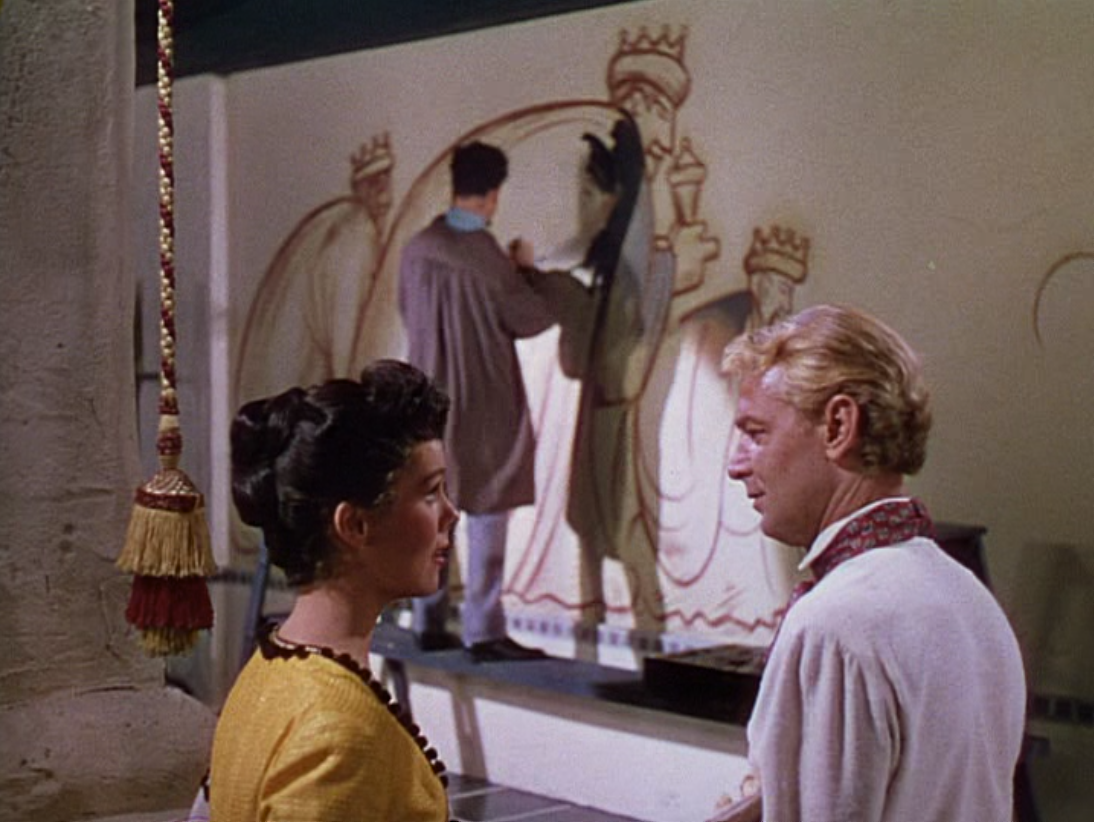
Sometime during the Victorian Era, a wealthy British man of the world, Rudolf Rassendyll (Stewart Granger), goes on a fishing tour of Europe and crosses into the small country of Ruritania just before its new king is to be crowned.  


Rassendyll has a bit of a connection to Ruritania:  his great-great-something-grandparent was a wrong-side-of-the-blanket child of a long-ago Ruritanian king.  He's reminded of this when he's fishing away at a peaceful mountain stream and encounters two Ruritanian officers, Colonel Zapt (Louis Calhern) and Fritz von Tarlenheim (Robert Coote) who are astonished by his appearance.  


The reason pops up in a couple of minutes in the form of a distant cousin also named Rudolf (also Stewart Granger) who is about to be crowned king of Ruritania.


Rassendyll accepts his relative's offer of a night's lodging in the royal hunting lodge.  The two drink and feast themselves into oblivion.  When Rassendyll wakes up, the future king is dead drunk and unable to be wakened.  Zapt and Fritz are frantic, because if their Rudolf isn't crowned king that very day, his vile half-brother Black Michael (Robert Douglas) will claim Rudolf isn't fit for the throne and take it himself.  And destroy the country.  


Fritz and Zapt beg Rassendyll to impersonate Rudolf just long enough to be crowned in his stead, and then he can go his merry way as soon as they find the real king.  All he'll really have to sacrifice is his mustache.


Of course, it's not that simple.  Rudolf is promptly kidnapped by Black Michael and his henchman Rupert of Hentzou (James Mason), who keep him a prisoner in, you guessed it, the castle Zenda.  Black Michael is super shocked when Rudolf appears to get crowned after all!  


Also, King Rudolf is betrothed to Princess Flavia (Deborah Kerr), and Rassendyll is smitten with her on sight.  The longer it takes to find the real King Rudolf, the harder it becomes for Rassendyll to give up Flavia, whom he quickly grows to love.


(SPOILER)  One of the things I love best about this story is that Rassendyll and Flavia do the right thing, not the easy thing.  They are a great lesson that personal emotions and feelings are not the most important things in the world -- that truth, honor, and integrity can mean more.  (END SPOILER)

One of the most interesting differences between the 1952 and 1937 versions is the attitudes of Rudolf Rassendyll and Rupert of Hentzou.  In the 1937, Rassendyll is serious and kind of cunning; Rupert is witty, charming, and a devil-may-care.  In the 1952, Rassendyll is witty, charming, and jaunty; Rupert is snide, sly, and acidic.  That does make both movies feel enough different from each other that you can't really say one is a carbon copy of the other.


I haven't found anywhere in this review to talk about Antoinette (Jane Greer), Black Michael's paramour who plays a very significant part in the plot and has some of the best costumes in the film.  I'm just trying not to spoil toooo much of the fun, because anyone who hasn't seen this yet and enjoys swashbucklers really ought to watch it!


Also, I really wish there were more scenes of the two Rudolfs hanging out because they seem to get along quite nicely.  And the movie magic in the scenes where Stewart Granger shares the screen with himself delights me every time.


Is this movie family friendly?  Basically, yes. There's a mention of Rassendyll's forebear having an illegitimate child, and Black Michael is also an illegitimate child, which gets mentioned in the kind of oblique way you'd expect from a Code Era movie.  There's no cussing.  Princess Flavia and Antoinette do show off some cleavage in their period-appropriate costumes.  There's some kissing and sighing and yearning. Rupert of Hentzou gets away with a bit of snide innuendo here and there.  It has quite a bit of swordplay and some gunplay.  My daughters were in single digits when they first saw and loved it.  


This is a one-day-late contribution to the 2026 Classic Literature on Film Blogathon hosted by Paul at Silver Screen Classics. 

Friday, April 11, 2025

My Ten Favorite Val Kilmer Movies

My heart is still heavy over Val Kilmer's death.  I've been rewatching some of my favorites of his movies, and today, I'm sharing the list of my top ten favorites with you.  


1. Tombstone (1993)

A free-wheeling recreation of that one time Doc Holliday (Val Kilmer) and his friend Wyatt Earp (Kurt Russell), plus Wyatt's brothers (Sam Elliott and Bill Paxton), had a showdown with Ike Clanton and his pals, and Tombstone, Arizona never got over it.  This movie is a wildly good time, particularly every scene Val Kilmer is in.  And the score by Bruce Broughton is one of my all-time favorites.

2. Willow (1988)

A small farmer (Warwick Davis) reluctantly teams up with a big braggart (Val Kilmer) to save a baby princess from a wicked queen (Jean Marsh).  Along the way, the braggart falls in love with the queen's daughter (Joanne Whalley) onscreen and off.  It was one of the first fantasy movies I ever saw, and it's still a dear favorite.

3. Spartan (2004)

When the daughter of an important American government official is kidnapped, an impressively capable agent (Val Kilmer) is sent to retrieve her before she's sold into slavery overseas.  It's a tense thriller that makes plain the all-too-real ease with which human trafficking occurs here in the U.S., and the difficulty in rescuing someone from it.  And it's cool seeing Clark Gregg work with Val Kilmer.

4. Real Genius (1985)

A teen genius (Gabe Jarrett) enters a school for the scientifically gifted, where he and his offbeat roommate (Val Kilmer) try to stay sane while also solving a mystery surrounding just what their scientific discoveries and creations are being used for.  My college roommates and I were obsessed with this movie for a while, and we used to wear these funny headbands around campus (even to classes) as a nod to Val Kilmer's character in this movie.


5. Batman Forever (1995)

Bruce Wayne/Batman (Val Kilmer) tries to stop Harvey Dent/Two-Face (Tommy Lee Jones) and Edward Nygma/The Riddler (Jim Carrey) from taking over Gotham, while also mentoring an orphan (Chris O'Donnell) and romancing a psychiatrist (Nicole Kidman).  Is this movie a dayglo comic book extravaganza?  Yes.  Does it also have a compelling storyline and some really good character development?  Also, yes.  I just rewatched it this week for the first time in a while, and was excited to find I still really love it.

6. The Saint (1997)

Simon Templar (Val Kilmer) is a professional thief who gets involved with Russian spies and a beautiful scientist (Elizabeth Shue) while just trying to do his job: stealing some nuclear macguffin or other.  The real treat here is all the disguises Templar uses, which lets Kilmer transform himself again and again in ridiculously fun ways.

7. Thunderheart (1992)

An FBI agent (Val Kilmer) with Native American heritage is assigned to solve a murder on a Sioux reservation, despite the efforts of others to either cover up the truth or use the crime to pursue their own agendas.  The fact that Val Kilmer had Native heritage himself (he was 1/8 Cherokee) is a total bonus for how perfect he is in this role.  The story is based on true incidents.

8. The Ghost and the Darkness (1996)

A professional hunter (Michael Douglas) teams up with a British engineer (Val Kilmer) to take down two man-killing lions that have been attacking workers trying to build a bridge in Africa.  It often feels like a throwback to the adventure movies of the '50s and '60s, but with more realistic violence.  Maybe that's because the screenplay is by William Goldman, who wrote The Princess Bride (book and screenplay both), as well as screenplays for movies like Butch Cassidy and the Sundance Kid (1969) and Maverick (1994).

9. Prince of Egypt (1998)

Animated take on the life of Moses (Val Kilmer), growing up in Pharaoh's household and being tasked by God with leading the Jewish nation out of slavery in Egypt into the Promised Land.  Excellent take on the historical account from the Bible, and the songs are really cool, too.

10. Top Gun: Maverick (2022)

An Air Force pilot (Tom Cruise) has to train the wild son (Miles Teller) of his fallen wingman for a dangerous mission.  Val Kilmer gets a small scene as Tom Cruise's former rival and current superior officer, and it's a moving one.


Please note that Tombstone, Spartan, Thunderheart, and The Ghost and the Darkness are all rated R, so you may want to investigate their content levels further before watching them if that is of concern to you.

Monday, February 17, 2025

"The Iron Mistress" (1952)

Happy 9th Alaniversary to me :-D  I shall celebrate by reviewing Alan Ladd's biopic about James Bowie, the legendary frontiersman and inventor of the Bowie Knife.  

(Quick aside:  I always thought that a Bowie Knife and an Arkansas Toothpick were the same thing, but it turns out they're slightly different styles of hunting-and-fighting knives... which were both originally made by the same knifemaker in Arkansas.  Huh.)

The movie opens with Jim Bowie (Alan Ladd) leaving his Louisiana backwoods home for the first time to go sell his family's lumber in New Orleans.  In New Orleans, he gets tangled up with the aristocratic de Bornay siblings, Narcisse (Douglas Dick) and Judalon (Virginia Mayo).  He quickly falls for the spoiled and scheming Judalon; Narcisse tries to warn his new friend away from his sister, but of course, Jim Bowie's not thinking with his head at the moment.


Nothing Jim Bowie does convinces Judalon he's worthy of her love.  She doesn't dig poor guys.  Oh, she enjoys kissing him from time to time, and flirting with him, but no, she could never love a poor man.  So, Jim goes home, works hard, and gets rich.  When he encounters Judalon again, he's on an equal economic footing with her... and she's married.  But Judalon claims she's trying to get a divorce.  Jim believes her, of course.  


And then there's this whole thing involving horse races where Jim enters a horse race, and his horse wins, and all the aristocrats refuse to pay their gambling losses unless he can prove he owns the horse.  Insults and challenges ensue, and Jim ends up attending a duel as the second for a friend.  The duel is a set-up, an ambush to kill both Jim and his friend because they just don't belong in the fancy New Orleans world, no matter how rich they get.  


The movie does a reasonably good job recreating the Vidalia Sandbar Fight here -- a real-life event where a duel turned into a brawl.  Jim Bowie gets shot, then stabbed with a sword, but cuts down his opponent with a special knife he had made to his specifications.  Oh, and he still has the other guy's sword sticking out of him when he does it (which is historically accurate). 

Judalon reneges on her promise to leave her husband for Jim Bowie.  He leaves for Texas, hoping to find a new purpose for his life.  But he's ambushed on the way and left lying on the road, presumed dead.  There, he's found by Senorita Ursula de Varamendi (Phyllis Kirk), who takes him to her family's home so he can recover.


It turns out Ursula's father is the Governor of Texas.  She clearly would like to get together with Jim Bowie, but he is still obsessed with Judalon.  He leaves Texas, saying he's going to wrap up his business affairs in New Orleans, but Ursula can see it's really so he can have one final chance to find and woo Judalon.


Bowie encounters Judalon and her husband Phillipe (Alf Kjellin) on a riverboat.  Phillipe is a terrible gambler and desperate for money.  When he loses a huge sum of money to some card sharps, Jim saves the day by exposing the cheaters and getting Phillipe's money back.  Judalon tells her husband she's leaving him for Jim.  Phillipe decides to ambush Jim in his cabin on the boat.  There's another guy called Black Jack Sturdevant (Anthony Caruso) aboard the boat and planning to kill Jim too because of reasons.  (I kind of left out his whole part of the plot, but he's been after Jim Bowie for a while now -- and he stole Jim's knife.)  


Now, we all know that Jim Bowie died during the siege of the Alamo, not on a riverboat, so obviously, he survives the ambush.  And he finally realizes that Judalon has never and will never love him, that she's a scheming opportunist and liar.  He is through with her at last, and heads back to Texas to marry Ursula (also historically accurate!) and start a new life there.  And he tosses his special knife in the river on his way out for symbolic emphasis.


While the main plot of this whole movie is made up (everything involving Judalon, basically), it does at least hit some facts here and there.  It's one of those "well, this COULD have happened" sorts of movies.  And it's a good time -- lots of knife fights and duels and brawls, Alan Ladd looks gorgeous throughout, and he even gets to do some stunts.  The two things that you would think most likely to stretch your credulity -- that fight where he kills a guy while he's got a sword is sticking out of his chest, and the fact that he married the governor of Texas's daughter --  are totally true.  


Is this movie family friendly?  Basically.  There's a lot of hand-to-hand violence and some gunplay, but it's all very '50s-style and non-gory, non-scary stuff.  Judalon clearly is untrue to her husband, and even kisses Jim after she's married to Phillipe, but it's very tastefully handled and could even be a good talking point for parents and children about what marital infidelity is.

You can easily find The Iron Mistress on DVD, but I don't know that it's streaming anywhere.

Monday, May 06, 2024

"The Ministry of Ungentlemanly Warfare" (2024) -- Initial Thoughts

You know what this felt like?  A 1960s-style WWII movie, but with 1970s-style levels of violence and language.

I really love movies where the director and actors are all having a really great time, and you feel like they're inviting you to just have fun and enjoy yourself alongside them.  That is absolutely the vibe this movie had.  Was it one of the most violent movies I have seen?  Yes.  But it wasn't dark and it wasn't eerie and it wasn't depressing.  And it contained that sense of camaraderie and the brothers-in-arms-who-will-die-for-each-other attitude that I absolutely love in true stories about WWII and the classic films about it. 

Also, there was really no shoehorning of modern sensibilities into this movie about real people and real events.  That's so delicious.  It was like Midway (2019) in that way.  These people FELT like they were 1940s folks.  Fantastic. 

Also, the film did not sidestep the issue of "Nazis hated the Jews."  In fact, it made it explicitly clear that the main bad guy decides to torture and kill someone not because he discovers they are a spy, but because he figures out they are Jewish.  And he is a completely evil character that the audience is never asked to sympathize with.  In our particular moment in time, that seems like a bold statement, and I appreciated it.

The Ministry of Ungentlemanly Warfare (2024) is about a ragtag group of five Allied men and one women, each with their own very specific set of often unsavory skills, who get sent on a daring black-ops raid against the Nazis.  It's kind of like The Dirty Dozen (1967) or The Devil's Brigade (1968), but make it British.  And a true story.  Like The Monuments Men (2014), but with a higher body count and more gallows humor.

Did I mention it's a true story?  It is.  I've been doing some digging around, and I need to read some books on this whole heist raid thing, because it is amazing.  My library only has the audiobook edition of Damien Lewis's book that this movie is based on (so rude!), so I simply have to buy my own copy.  Also, I need the movie soundtrack, but it looks like that's only on mp3 and not CD (also rude), at least so far.  May have to get the mp3 version, I guess.

This really isn't a review so much as a rambling assortment of my thoughts about the film.  Sorry.  I've only seen it once, and I have a lot of things I want to say, but it's not really an easy film to straight-up review.  I'm simply going to have to go see this movie again.  


The cast is delightful, especially Henry Cavill and Eiza González and Cary Elwes.  It's always weird seeing Cary Elwes in anything besides The Princess Bride (1987), but I got kinda used to him by the end of this.  Honestly, I went to see this because WWII + Henry Cavill + Guy Ritchie sounded like it might be a good mix, and I was not disappointed!

This is not a family friendly movie, though.  There is some serious cussing, some innuendo, and a LOT of violence.  Not quite the level of a Quentin Tarantino movie (which I have just kind of quit watching because they started turning my stomach), but blood spatter happens, and a lot of death happens.  Also, the bad guy is a sadistic creep who tortures people for his own pleasure.  We do not see that torture, but we see a victim of it (not in detail), and we fear very much for another character when it becomes obvious he has Very Bad Plans for them.  There were several places where the film started tilting toward the dark and disturbing, then very nicely sidestepped that and forged merrily ahead instead, much to my relief.  It had the attitude of, "There are really bad things happening in this world because there are very bad people in this world -- but let's blow something up instead of talking about that too much."  If that makes any sense.

Do I recommend this to people who are adults and won't be bothered by the violence?  Absolutely.  It's a remarkably good time.

Oh!  And they had little things at the end before the credits, telling us what happened to the actual people involved in the story, later during the war.  I love it when movies do that.

But it's kind of unfair that Henry Cavill can be completely covered with a shaggy beard and twirly mustache and still be that attractive.  The repeated gag about his character stealing progressively cooler coats was one of my favorite random little things in the movie.

Friday, April 12, 2024

"Paper Bullets" (1941)


This movie is a mess.

It's like they took all the things that would connect up the different parts of the story and chopped them out, assuming the audience would just jump merrily from conclusion to conclusion.  Or something.  

The message of the movie is clear: don't shun the children of criminals for what their parents did, or else they might become criminals themselves.  And I can get behind that message.  In fact, it's a good message, and deserves a coherent story to present it.  Alas, that's exactly what it doesn't get in Paper Bullets (1941), which is also known as Gangs, Inc. because why not give it two titles?  People are already confused.  It's fine.

Also, I suspect that the title cards at the beginning got redone when it was shown on TV in the late 1940s, after Alan Ladd became a big star, because he really just has a small (yet pivotal!) part, but his name is listed at the top in big, bold letters.  Maybe that's when it was retitled too?  The poster to the left is completely and utterly misleading, by the way.  Alan Ladd's character is not a hardened criminal who can kill you by glaring at you.  Though I guess we do see a mugshot of him at one point -- actually, of one of his characters.  He sort-of is playing two characters, though we really only ever see one of them.

Like I said, it's a mess.  Let's dig in and get our hands dirty exploring it, shall we?


The whole thing opens when a little girl named Rita Adams is reunited with her dad, who just got out of prison.  They get to live happily together again for two minutes and forty-two seconds, and then her dad is gunned down at her playground while shielding little Rita behind him.

Rita grows up in an orphanage, where she makes friends with Bob and Mickey.  Bob is a smart guy and Mickey is a tough guy, and Rita is pals with both, though she likes Bob more.  We get one whole scene in the orphanage, which is only there to introduce the guys and show us that Rita has a birthmark behind her left ear because that will be important for exactly two seconds when our story lurches into Rita's adult life -- we know the next person we see is Rita because of that birthmark.


Adult Rita (Joan Woodbury) shares an apartment with her sweet pal Donna (Linda Ware), works at a munitions plant or something, and is dating a rich drunk named Harold DeWitt (Phillip Trent).  Her life is peachy keen for about four minutes, until she gets fired because her employers found out her dad spent time in prison.  Donna says it's fine because the rent is paid, but Rita is NOT fine with this.

While out cruising around with Rita, her drunken boyfriend Harold kills someone in a hit-and-run accident.  Harold's rich daddy's lawyer tells Harold to convince Rita to take the rap for him, even if it means promising to marry Rita.  The lawyer tells Rita that she will get off lightly and not have to do prison time, but hahahaha, not true at all.  She goes to prison.


When Rita gets out of prison twelve seconds after we saw her sentenced, her old friends Bob (John Archer) and Mickey (Jack LaRue) are waiting to pick her up, along with her bestie Donna.  Good old Harold is nowhere to be seen.

Mickey has a bit of juicy news for Rita: Harold's dad, Clarence DeWitt (George Pembroke) paid the lawyer to make sure Rita went to jail so Harold wouldn't have to marry her.  Naturally, this news prompts Rita to embark on a crime spree.  Like every sensible girl who's discovered she was double-crossed by the man who said he'd marry her, she dons a blond wig and starts robbing rich guys, poker games, nightclubs, and brokerage firms.  What else would she do with her time?

Donna never seems to glom onto the fact that Rita is a one-woman crime wave.  The blond bandit in the papers can't be Rita because Rita has dark hair, obviously.  Meanwhile, Rita's orphanage pal Mickey has become kind of a big deal with the New York mob, and he invites Rita and Donna to move to New York.  Donna is a singer, and he promises to find her a place singing in a nightclub.


Everything goes super well in New York.  We're only twenty-six minutes into the film, and Donna is a singing sensation!  Rita has plans to keep busy in the big city too, of course.  Heh heh heh.

Meanwhile, good old Harold's dad, Clarence DeWitt, has started stirring pots and claiming that the New York police are in league with the mob.  The police chief cooks up a great plan to prove this is not true and that it's DeWitt who is in with the mob.  His plan?  Have a sweet policeman wannabe named Jimmy Kelly (Alan Ladd) pretend to be mobster Bill Dugan (also Alan Ladd, but with messy hair) and infiltrate the mob to gather evidence.


This is a fool-proof plan.  Jimmy Kelly has never been trained in how to be a policeman, much less how to pass himself off as a mobster, but since he's identical to Bill Dugan, it'll be fine.  Never mind that Dugan isn't even in prison or some other city -- he's here in New York too, but obviously that won't complicate anything.

(I was really hoping for some split-screen action where Alan Ladd confronts Alan Ladd for impersonating himself, but that clearly was too fancy for this B picture, so all we get is two photographs to compare.  Sigh.)


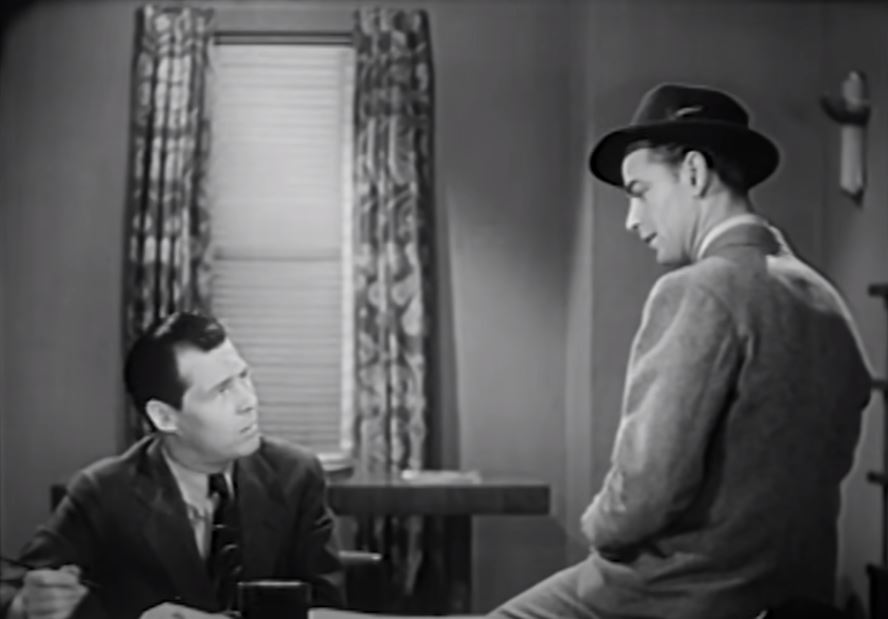
Because there are only four or five mobsters in all of NYC, Bill/Jimmy works with Mickey to collect bribes.  This gives Alan Ladd some chances to work on his Tough Guy act, as well as practice delivering barbed banter, which is the most fun this movie provides.  I never said the movie had nothing going for it.


We get treated to Leaning Alan Ladd...


...Hat-Tipping Alan Ladd...


...Smiling Alan Ladd...


...and Desk-Perching Alan Ladd!  You can collect them all!

Anyway, old man DeWitt gets a grand jury rolling to investigate a bunch of mobsters.  Rita decides this is her chance to get back at him for sending her to prison.  She takes to the radio, spouting allegations about DeWitt being in league with the mobsters himself.  Then she meets up with the mob bosses and says she can help them take DeWitt down or something, if only they'll let her be a mob boss too.

What mob boss in his right mind is going to turn down an offer like that?  Clearly, this chick is capable of running a big crime organization.  She knows how to talk on the radio, after all.  And she has a Plan for a way to blackmail DeWitt into doing what she wants, which involves some incriminating letters that Mickey stole fifteen minutes earlier in the film.

Rita wants to become a mob boss so she can make lots of money and build a nice playground for underprivileged kids.  I am not even joking.


Meanwhile, Bill/Jimmy and Donna have met up and gotten friendly.  They engage in some cute flirtation in Donna's dressing room, where Donna begs Bill/Jimmy to give up racketeering and get an honest job.  


Bill/Jimmy alllllmost tells Donna he's actually a good guy.


But he doesn't.  Which is probably wise.

This is the best scene of the whole movie, so pardon me if we lingered there a bit.


Bill/Jimmy gets to give the movie its original title: "Paper bullets" are votes.  Now you know.

Some plot happens.  The bad guys discover, accidentally, that Bill/Jimmy is really Jimmy, not Bill at all, through no fault of his own.  Three bad guys take Jimmy on a little ride, resulting in the absolute worst car chase scene in the history of cinema.


The police chief and a pal chase that car around, trying to rescue Bill/Jimmy.  The entire chase scene consists of shots of bored people inside the cars alternated with shots of black cars zooming around at night.


You can't tell which car is which or what is going on.  At all.  And this goes on for a little over two minutes.  Then, one car... goes over a cliff or something?  The only way we know it was the mobster car is that the police chief and his friend jump out of their car and look over the edge.


Since Bill/Jimmy was in that car, we can assume he has died.  That's certainly what Rita and Donna assume.


We, the viewers, are left to assume exactly that for nearly nineteen whole seconds before the police chief reveals, with a chuckle, that it's not true at all, we're just faking Bill/Jimmy's death.  Because of reasons.


Then Rita and Bob (remember Bob from the orphanage?) get married!  Bob is an airplane designer or something?  Totally decent guy.  No idea that his new wife and her best friend Mickey are mobsters.  That is, not until they've been married for a minute and a half, when a guy shows up with an arrest warrant and subpoena for Rita as they leave the Justice of the Peace's office.


There go her plans to build a big playground for underprivileged kids!

Mickey kills somebody for something, we have a bunch of courtroom stuff that drags on for at least three minutes, and then the police spring a surprise witness: Bill/Jimmy!  He's alive!


Donna is super happy to see him!  Mickey is not, and tries to shoot him (because he totally just waltzed into the courtroom packing a gun in a shoulder holster and nobody cared).  But that was just the evidence the police wanted to arrest Mickey too.  The mob bosses, including Rita, are all found guilty and sentenced to prison.  Poor Bob vows he'll wait for her and be faithful to her for as long as it takes for her to get released.  (At the clip this movie travels, that should take about forty seconds, but who's counting?)


I guess Donna got her playground built after all, even though she went to prison, because this is the movie's final shot.  I would totally play in a playground with a creepy sign like this on its gate, wouldn't you?

I spent way too much time taking screencaps of this mess.  I hope you enjoyed them.  At least Alan Ladd is super cute in it, and he gets a fair bit to do, too!

Either this movie is in the public domain, or it's so nonsensical that no one cares to protect it, because you can watch it on YouTube with no problem.  Just in case you like movies that make no sense!  Or you want to see a prototype of Alan Ladd's tough-but-actually-nice-inside characters.


This has been my contribution to the Second Annual Favorite Stars in B Movies Blogathon hosted by Films from Beyond the Time Barrier.