If you are the sort of person who falls into a swoon over any adaptation of a Jane Austen novel that does not have what you yourself deem to be "period correct" costumes, you might want to stop reading right here. Because I really love this movie, and I promise I have heard all your moanings and whingings and protestings before, and I don't need to hear them again. You shan't dissuade me from loving it.
Or, if you are the sort of person who has always wanted to see this adaptation, but you heard it was "awful" or "unwatchable" because the costumes are not "Regency Era-appropriate," read on! Because there's a reason the filmmakers selected the costumes they did, and it had nothing to do with being stupid and ignorant, and everything to do with being canny and prudent.
In case there is anyone reading this who does NOT know the basic plot of Pride and Prejudice by Jane Austen, let me briefly explain it:
Elizabeth Bennet (Greer Garson) and her four sisters need husbands. Why? Because the property their father (Edmund Gwenn) inherited from his father is "entailed," which means it can by law only pass on to the next male heir. And the Bennets have no sons. The family can live comfortably, even well, as long as Mr. Bennet lives. But the minute he dies, his cousin Mr. Collins (Melville Cooper) will inherit everything.
Mrs. Bennet (Mary Boland) therefore spends her every waking minute trying to find a way to provide for her daughters in their adult lives. Her only real plan is a hope that at least one of them will manage to marry a rich gentleman, and then either the other daughters can also find husbands who will care for and support them, or else they can be provided for in some way by said rich gentleman and whichever daughter married him.
Naturally, when a rich bachelor named Mr. Bingley (Bruce Lester) moves into the neighborhood, bringing along his sister, Miss Bingley (Frieda Inescort) and his good friend, Mr. Darcy (Laurence Olivier), Mrs. Bennet is overjoyed. And overflowing with schemes. Surely Mr. Bingley will marry either her eldest daughter Jane (Maureen O'Sullivan) or the next in line, Elizabeth. Mrs. Bennet does everything in her power to throw Jane and Mr. Bingley together, and her scheming works... for a while.

But, while Mr. Bingley is good-humored and affable, Mr. Darcy strikes people as dour and stuffy. He doesn't like to dance with strangers. He doesn't flatter people. He doesn't smile very much. Well, that last isn't actually true -- this Mr. Darcy does smile quite a lot after the first few times we meet him. He's actually rather pleasant and charming... but he's also terribly proud. He can't abide Mrs. Bennet or the two youngest Bennet girls, Kitty (Heather Angel) and Lydia (Ann Rutherford). Because they offend him so much, he is convinced he and Mr. Bingley should really have nothing to do with any of the Bennet family.
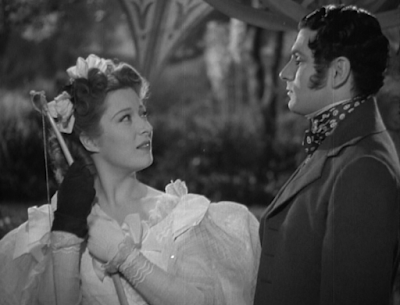
But Mr. Darcy's path keeps crossing Elizabeth Bennet's. He falls in love with her, even though she swears he is the last man she could ever be persuaded to marry. When her sister Lydia falls into disgrace, he does everything in his power to set things right for her, just to help Elizabeth. Gradually, he learns not to let his pride cloud his judgement, and she learns not to let herself be prejudiced for or against a person before she knows them reasonably well.
I very much enjoy Greer Garson's portrayal of Elizabeth Bennet as an intelligent, witty, good-humored young woman. And I am particularly fond of Laurence Olivier as Mr. Darcy. He's less socially awkward than we usually see Mr. Darcy portrayed, which emphasizes his insistence on propriety and taking pride in his station in life as being a choice, not simply a character trait.
One stand-out side character, for me, is Lady Catherine de Bourgh (Edna May Oliver). She's just as acerbic and haughty as she ought to be, on the surface, but she has a humorous kindliness underneath that you get to glimpse at the very end, and I love that.
This particular film is actually an adaptation of a 1935 stage play by Helen Jerome. Shocking as this may seem to us today, when Jane Austen can feel so ubiquitous in the literary and movie scene, this is actually the first movie adaptation of Pride and Prejudice! Not the first appearance of P&P on film -- someone filmed a stage play a couple of years earlier, but that was not really a movie production.
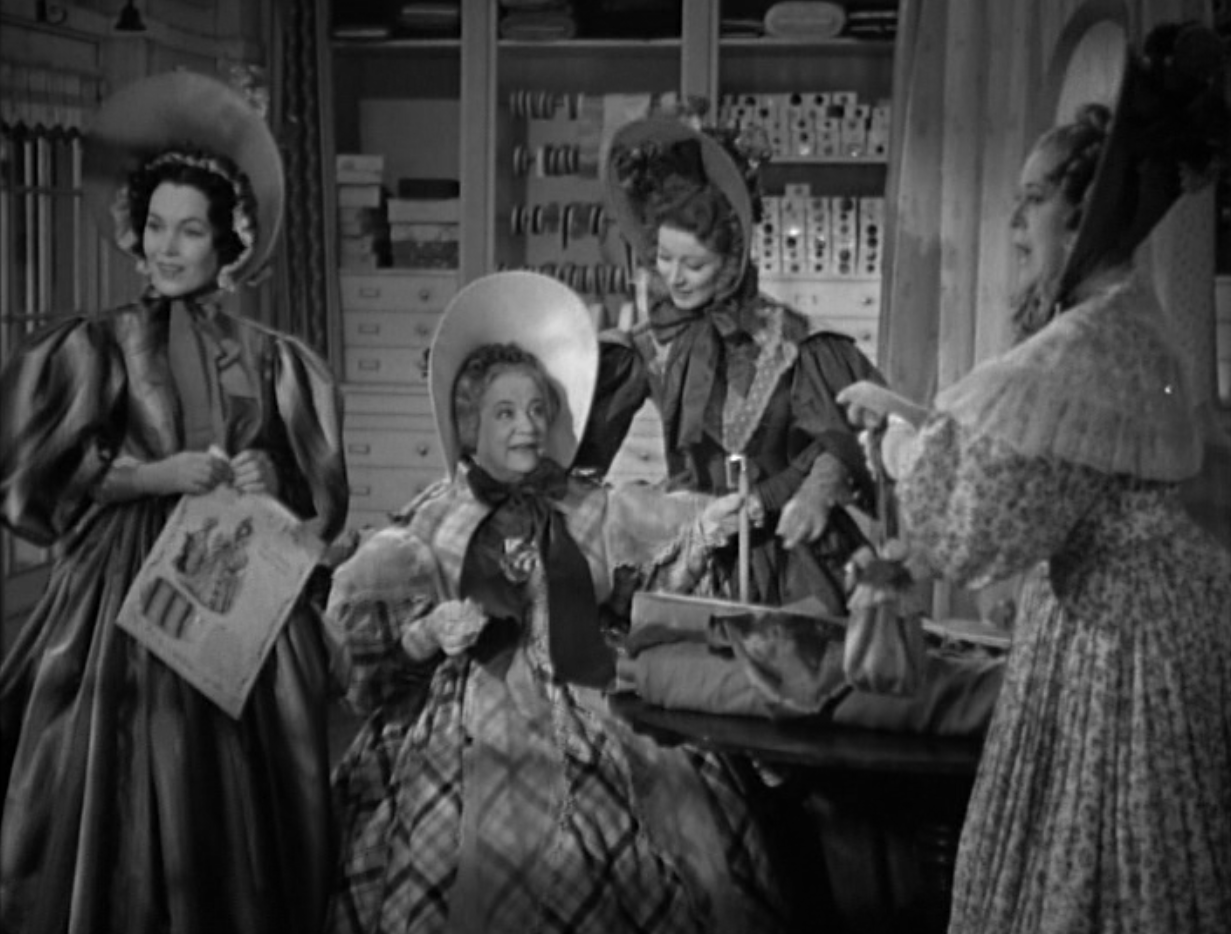
And now we come to the reasons why this adaptation is set in the Victorian Era instead of around 1813 in the Regency Era when the book was written. They have to do with two important historical events: 1) the Great Depression, which was still besetting Americans with poverty and worry when this film was released, and 2) the 1939 runaway hit status of the movie Gone with the Wind.
Times were still hard in 1940. And if moviegoers were going to part with a little of their too-scant money to go see a movie, they wanted it to be a movie that would transport them into a different world for a while. They wanted escapist movies that would help them ignore their troubles for a little while. Exotic locations, lavish costumes, opulent sets, romance between beautiful actresses and handsome actors -- those were the ingredients of a smash hit in that era. The more of those ingredients you could add to your movie, the better your chances of having a smash hit.
The smashiest of smash hits in that era (and, indeed, if you adjust for inflation, it's still the highest-grossing movie of all time) was Gone with the Wind, which came out just one year earlier. American moviegoers were entranced by the hoop-skirted gowns and elegant formal suits. They found the wealth and opulence on display in the mansions onscreen to be mesmerizing. And the enemies-to-lovers romance between the main characters captivated their imaginations.
And, the truth is, all of those costumes and sets cost the studios a lot of money. So, when the studio greenlit the adaptation of another famous novel featuring sweeping enemies-to-lovers romance, this time one by British author Jane Austen, they figured why not make sure audiences who loved Gone with the Wind got some of the same ingredients that made that movie such a hit? They set this movie version in the Victorian Era and gave all the women eye-catching hoop-skirts and extravagant hats. That let the studios reuse some of the costumes from Gone with the Wind for extras in crowd scenes, and they even reused some set pieces from GWTW for an outdoor party scene in this film.
Unfortunately, there wasn't enough Technicolor film available when they began shooting this film, rumored to be because
Gone with the Wind had used so much of it. So, they shot it in black-and-white, and the audience was denied the full splendor of those marvelous costumes and sets. Still, audiences responded favorably to the film, and it earned nearly $2 million at the box office. Unfortunately, it failed to completely recoup its expenses, and any more thoughts of adapting Jane Austen's novels for the big screen were shelved. It wouldn't be until the 1970s that anyone made another film version of one of her books, and it wouldn't be until the runaway success of the 1995 BBC version of
Pride and Prejudice that Jane Austen's novels would become the cultural phenomenon in America that we are still enjoying today.
Is this movie family friendly? ABSOLUTELY! My kids have seen it quite a few times, and my 11-yr-old is particularly fond of it.