Tuesday, July 11, 2023

When Everything Old is New Again: "X-Men: Days of Future Past" (2014)

I love X-men: Days of Future Past (2014), and a huge part of why I love it is how it handles time travel. I’ve long liked the idea of time travel, especially how it can lead to awesome character development as people deal with the differences between what might have been and what now is, depending on how their actions change things. 


Days of Future Past begins in a dystopian near-future where mutants have been hunted almost to extinction. Only a few have survived, including Professor X, Magneto, Wolverine, and Kitty Pryde. Kitty’s powers used to be walking through walls, but they’ve expanded to being able to send a person’s consciousness through the walls of time into their past body, which comes in handy for warning their past selves about future ambushes from the giant robots called Sentinels that have been wiping out the mutants. 

Professor X and Magneto decide the best plan to save what remains of mutantkind is to have Kitty send someone to the 1970s to keep the Sentinels from ever being created. Initially, Professor X wants to go himself, but Kitty says a person’s mind can only stretch back for a few weeks—any more and it would break. 

Logically, then, the only one who can get sent back as far as the 1970s would be someone whose mind and body can heal as fast as they’re broken, namely Wolverine. Which, from a filmmaking standpoint, is also logical, since Wolvie doesn’t really age, so having Hugh Jackman play him in the 1970s and the near future works without major makeup or digital effects to age or de-age him. A little grey hair at the temples for Near-Future Wolvie, and none for Past Wolvie, and we’re good to go. 

Once Wolverine’s consciousness goes back to the 1970s, the real fun begins. Because he didn’t get his adamantium skeleton and claws until the 1980s, he has just his bone claws, which surprises him and leads to one of the funniest moments ever to involve a metal detector. The movies have always depicted him wearing ’70s flavored clothes, especially those awful paisley shirts, so for once, he really fits in well. Also, this allows him to meet up with younger Professor X, Magneto, and Mystique, and thus bridge the past and future versions of these characters neatly, passing the torch much more effectively than in X-Men: First Class

But the fun 1970s shenanigans, the epic prison break scene involving Quicksilver, and the meeting of the minds between future and past Professor X aren’t why I love this movie, though they add to the wonderfulness. No, this is my favorite X-Men movie, not to mention my favorite use of time travel, because of how it ends. I’m going to spoil that here, so don’t read the next two paragraphs if you haven’t seen this, but want to, and don’t desire major spoilization. 

I love the ending because it effectively wipes out the biggest reason Wolverine has to be filled with heartache and remorse: the death of Jean Grey at the end of X3: X-Men’s Last Stand. Wolvie’s actions in the past create a new future, one much happier than the one he was living in at the beginning of the movie, and not just because the Sentinels are no longer an issue. 

At the end of this movie, Wolverine wakes up back in Professor Xavier’s School for Gifted Youngsters, which we all know shouldn’t still be standing, much less in such lovely condition. He walks out into the hallways and sees characters who had either died or left the mutant family, and we begin to hope, just like you can see he does, that maybe others who died might also have been spared in this new timeline. And then, there she is —a woman with bright red hair, standing with her back to Wolverine and to us. Wolverine’s eyes widen with the realization that he has fixed so much more than he’d expected to as the woman turns around and reveals she is indeed Jean Grey. My heart nearly burst with joy for Wolverine the first time I saw it, because my heart has ached for him for so long, for the burden of grief he’s borne over having to save the world by killing the woman he loved… and now, that never actually happened. Oh joy, oh rapture unforeseen! 

Yes indeed, I like the idea of time travel. I even like it when it means that character development from old stories gets negated by new ones. There’s always room for more in the future, after all.


(This post originally appeared in the May/June 2015 issue of Femnista magazine.)

Saturday, July 08, 2023

Upcoming Blog Events

Just a quick note alerting you to three blogathons/blog parties that are happening in the next couple months!  I'm hosting one and participating in two.  In order of occurrence, they are:


I plan to review Pride and Prejudice (1940) for the 2023 Classic Literature on Film Blogathon, which takes place next weekend.


Later this month, I'll be co-hosting Legends of Western Cinema Week, July 24-28.  I've got a couple of games planned, and also a giveaway.  We'll provide a tag to fill out for those who enjoy blog tags, and people can contribute anything else related to western movies and TV shows that they so desire.


In September, I plan to review Daddy-Long-Legs (1955) for the Everything is Copy Blogathon.  

To learn more about those events, follow the links!

Saturday, July 01, 2023

"How to Marry a Millionaire" (1953)


Three beautiful models, Loco (Betty Grable), Schatze (Lauren Bacall), and Pola (Marilyn Monroe), are tired of dating losers and deadbeats who are cute or fun, but can't support a wife in style.  They concoct a fool-proof plan to land wealthy and wonderful husbands: pool all their money and rent a swanky place in Manhattan with an address that will attract rich men.  


That makes them sound like mercenary gold-diggers, I know.  And, that's what they want to be.  But all three are actually nice, kind, lovely girls who have convinced themselves that rich men are the best men, and that they deserve the best men.  So, they sublet a penthouse, pawn most of its furniture to pay for really nice clothes, and set out to catch some rich husbands.


Loco catches a grim businessman (Fred Clark) who invites her to a weekend at his lodge... which she thinks means a big meeting of some club like the Elks, but turns out to be his remote hunting lodge in New England.  Things go from bad to worse, as it turns out he's married, and Loco has to find a way to disentangle herself from the would-be Lothario.  In the process, she falls for a forest ranger (Rory Calhoun) even though he's not rich.


Schatze sets her sights on a wealthy widower (William Powell) and seems to have the best chances of getting married to a millionaire... but there's this scruffy guy (Cameron Mitchell) who keeps crossing her path.  She really likes him, but he seems to have no job or prospects, so she insists she can't fall for him.


Pola has such bad eyesight, she has to wear very thick glasses, but she thinks they make her look ugly, so she refuses to wear them when men are around.  Instead, she fumbles her way through life, running into things and wondering what the men she dates actually look like.  She gets involved with a man who says he's an oil tycoon (Alexander D'Arcy), but is actually a fraud, and it's only a lucky accident that keeps her out of his clutches and lets her meet a man on the run from the IRS (David Wayne) who turns out to be her thick-glasses-wearing soulmate.


By the end of the movie, Loco, Schatze, and Pola have all found husbands, some rich and some not, but all good men who love them.  The storyline could have devolved into tawdry or mean humor, but it stays frothy and light instead.  I watched this with my kids a few months ago, and they all laughed a good deal over it.


If you love 1950s fashion and style, this movie is an absolute visual feast.  The girls all have amazing costumes and the sets are a treat.  

Is this movie family friendly?  Mostly.  That married guy does take Pola off to his hunting lodge for a weekend alone, which she is scandalized to discover -- she refuses to sleep with him, but there's some dialog in that part especially that some people might find too risqué for kids.  It's all very oblique, so I didn't have a problem showing the movie to my own kids (and, in fact, I think it's good for tween/teen girls to know that it is not okay for a guy to try to trick a girl into being alone with him, and that it IS okay for the girl to object and do what she can to stay away from him).


This review is my contribution to the Betty Grable Blogathon hosted this weekend by Taking Up Room.

Friday, June 23, 2023

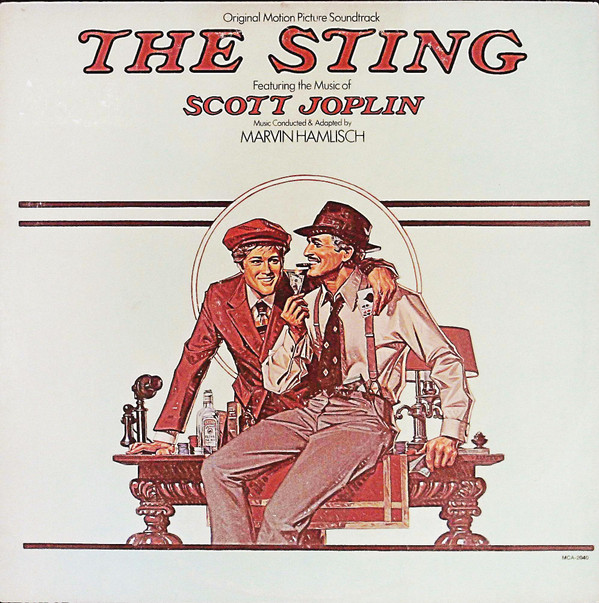
Movie Music: Marvin Hamlisch's "The Sting" (1973)

The Sting
(1973) follows two con artists (Paul Newman and Robert Redford) as they run a long con to ruin the man who had their friend murdered. It's set in the 1930s and filled with amazing period costumes, sets, and music. Marvin Hamlisch blends Scott Joplin's classic rags with original bluesy variations of other period songs to create a soundtrack that is a pure delight. Here are my three favorite tracks from a soundtrack I listen to whenever I need a quick pick-me-up.

My favorite song of all on this album is Joplin's "Easy Winners." I love how jaunty it is. I can't help smiling when I hear it.


"Luther" is more melancholy, a solemn contemplation of loss and mortality. It takes bits of "Solace," another of my favorite Joplin pieces, turns them minor, and melds them into a dirge.


"The Entertainer" is probably the most famous rag, whether by Scott Joplin or anyone else. The Sting uses it to great effect, as it's a great blend of spry playfulness and an undercurrent of more dramatic seriousness, which pretty perfectly describes the movie as well.


That's all for today, friends. If you liked these selections, you can hear the full soundtrack on YouTube here!

(This review originally appeared here at J and J Productions on January 29, 2016.)

Friday, June 16, 2023

"The Loner" (1965-66)


The classic western TV show The Loner only ran for one season, which is a bit disappointing.  And yet, that one season is packed with as many gems as some series that ran for three or four times as long, so I can't complain too much.

William Colton (Lloyd Bridges) survived the American Civil War, but it left him restless and unable to settle in one place, like many real-life veterans of that war.  He headed west on his cavalry horse Joshua, who had been with him through the war.  Searching for a place where he could belong, Colton encounters a wide variety of different people and situations.


The Loner was the first show Rod Serling created after The Twilight Zone ended.  Serling was dissatisfied with the TV westerns of the mid-sixties, which he felt were becoming increasingly unrealistic.  He aimed to present a serious western that would appeal to adults rather than schoolkids.  Unfortunately, audiences didn't respond the way he'd hoped, and the show only lasted a single season.

Rod Serling wrote 15 of the 26 episodes himself, which is a big part of what makes this such a strong, rewatchable show.  His episodes are particularly meaty, always featuring characters wrestling with serious problems and never presenting implausibly easy solutions.  Each episode is under 30 minutes long and crammed with excellent storytelling -- yet, they never feel rushed!  You can learn a lot about how to get the most story from the least space by watching this show.

Colton's strong sense of justice and honor gets him involved in other people's problems without him ever seeming nosy or presumptuous.  He just naturally ends up helping or leading when needed, even though he generally would rather keep to himself.  Whenever he rides into a new location at the beginning of the episode, the audience knows that he will leave it a better place when he rides away... but not by spouting platitudes, solving everyone's problems for them, or forcing people to do the right thing.  Rather, Colton has a way of encouraging people to confront their troubles themselves.


My favorite episode is probably the only two-part story, "The Mourners for Johnny Sharp."  Colton finds a young gunfighter called Johnny Sharp (Beau Bridges) dying alone.  Many people had reason for wanting Sharp dead, and Colton vows to the boy he will see justice done.  I love getting to see Lloyd Bridges act opposite his son Beau, and the whole second episode is some of the best character-focused storytelling I have ever seen.


Bridges's son Jeff also appeared in the episode "The Ordeal of Bud Windom," which is not quite as good an episode, but has some really good acting from Jeff Bridges, who was only 15 at the time.


I also really love "The Sheriff of Fetterman's Crossing" because I kept expecting the bungling sheriff (Allan Sherman) to mess everything up beyond belief, but everything turns out really well.  It is probably the lightest and sweetest episode in the series.


One of my favorite smaller aspects of this show is that, although Bridges was in his early 50s, the show runners have no issue with portraying him as an attractive, sexy man.  Colton generally has his shirt collar unbuttoned, and there are various episodes where he appears shirtless.  At the same time, they don't try pairing him romantically with young women, but show mature, middle-aged women being attracted to him instead.  Hollywood tends to think that romance is reserved for the young, and anyone over 35 can't possibly be attractive, but this show adroitly ignores such nonsense.

You can pick up this complete series on DVD for under $20.  I highly recommend it!


This has been my contribution to the Intruder Blogathon hosted by the Metzinger Sisters at Silver Scenes this weekend :-)

Saturday, June 10, 2023

"Where Eagles Dare" (1968)


World War Two rages. The Nazis and their pals have conquered Europe and have made inroads into Russia. The Allies are finalizing their plans to invade France and begin pushing the bullies back where they belong… and then the unthinkable happens. 

General Carnaby’s plane crashes in enemy territory, and he’s captured by the Nazis. They don’t know it yet, but Carnaby knows all the plans for where and when the invasion will happen. It’s only a matter of time before they realize just how valuable this American general is. And everyone knows the Nazis will submit him to inhuman cruelties just to get his information. 

There’s only one thing to do: rescue him. 

The British military puts together a crack team of spies led by their best man, Major Smith (Richard Burton). Smith is terse, efficient, secretive, suspicious, and deadly. The rest of the team are British agents too, except one man: an American OSS agent named Schaffer (Clint Eastwood). He doesn’t know why they want him along, and the rest of the team don’t know why he’s there, but the word is Go, so they go. 


I’m a huge fan of both Richard Burton and Clint Eastwood. Eastwood doesn’t get a lot to do in this movie except walk around looking confused and shooting people, but he’s nice scenery to have around, so I don’t mind. Burton gets the best role, convincing the audience he’s anything and anyone he says he is at the moment. Such is the power of his acting that a sneer or a monosyllable from him does more to develop his character than whole pages of dialog for others. 

The Nazis are holding Carnaby in an Alpine fortress you can only reach by cable car from the village below. It’s a massive, impregnable old castle filled with both regular Army and Gestapo troops. No way can anyone break in there. But they must. Can’t let the Nazis find out what Carnaby knows. 

From here on out, I will SPOIL a few things. This is a twisty spy thriller, and I need to tell you some twists. Can’t say I didn’t warn you. But I promise not to reveal the big suprises at the end. 

The team, and the audience, soon learn the truth: Carnaby is a fake. The British dressed up an actor who looks just like the real General Carnaby and are using him as a diversion. His mission is to feed the Nazis misinformation, but now the Allies fear the Nazis will figure out he’s a fake, so Smith and his cohorts need to rescue him before they visit unspeakable atrocities upon poor not-Carnaby. 

Smith, Schaffer, and the rest of the team parachute into the snowy Alps just outside the fortress. One of them dies, supposedly killed upon landing, but Smith doesn’t think so. Smith secretly meets up with a female agent sent to help him without the rest of the team knowing it. In fact, Smith does a lot of things in secret. Why? What game is he playing that he hasn’t invited the other men to join? 


The surviving members of the team disguise themselves as Nazis and prepare to infiltrate the castle. More of them die mysteriously, until the team is just Smith, Schaffer, and three other guys. The three other guys get themselves captured, but Smith insists he and Schaffer must try to finish the job. Schaffer’s a game fellow, and it’s not like he has anything else to do while stuck in the Alps in the middle of winter, so the two of them sneak into the castle. 

Remember those cable cars? Many feats of derring-do occur thanks to them, with people riding on top of them, jumping between one car and the next, and so on. The studio made Where Eagles Dare in 1968, right in the thick of Sean Connery’s reign as James Bond, and the action in this film is comparable to many of those classic 007 films. Lots of explosions, stunts, sneering bad guys, and the occasional kissing scene just because, gosh, if you’ve got male and female spies working together, why not have them kiss now and then? 

Smith and Schaffer infiltrate the castle. They find not-Carnaby and free him. And then the plot twists come thick and fast. Because it turns out that rescuing not-Carnaby was another ruse. The real reason they’re here is to find out some very important information of a different nature. I won‘t tell you what that is because that would spoil the fun. Go read the fantastic book by Alistair MacLean (who also wrote the screenplay) or watch the film for yourself! If you like spy stories, you’ll love this.


(This post originally appeared in Femnista magazine on April 13, 2019.)

Monday, June 05, 2023

Announcing 2023's Legends of Western Cinema Week

Yessirree!  It's true :-) Olivia (of Meanwhile, in Rivendell...), Heidi (of Along the Brandywine), and I are co-hosting Legends of Western Cinema Week once again!


We'd love to have you join us the last week of July as we celebrate onscreen westerns of every sort.  As always, we will provide a tag you can fill out, along with various games and giveaways.  And then YOU contribute the rest of the party fun!

What you want to contribute is totally up to you!  Past LOWCW parties have involved movie and TV show reviews, top ten lists, tribute posts to actors or characters, soundtrack appreciation posts, character sketches, and anything else partygoers have dreamed up.


We never set a limit for how many posts you can contribute, or how many people can share posts about a particular subject.  The only rules are that posts: 
  • must be appreciative and not derogatory, 
  • must be about westerns, and 
  • must to be new posts (not just linking to old ones).  

If you need help deciding on a contribution topic, you are welcome to toss around ideas with us in the comments.  There is no official sign-up list.  However, we would love it if you shared one of Olivia's lovely buttons on your own blog or social media account, with a link back to one of our announcement posts so other people can join the fun.

If you've never attended a LOWCW hootenanny before and you can't quite wrap your head around how it works, here's a link to my wrap-up for 2022's party so you can see how they play out.

Put on your ten-gallon thinking hat and start figuring out how you want to celebrate this year!