Showing posts with label biopics. Show all posts

Monday, February 17, 2025

"The Iron Mistress" (1952)

Happy 9th Alaniversary to me :-D  I shall celebrate by reviewing Alan Ladd's biopic about James Bowie, the legendary frontiersman and inventor of the Bowie Knife.  

(Quick aside:  I always thought that a Bowie Knife and an Arkansas Toothpick were the same thing, but it turns out they're slightly different styles of hunting-and-fighting knives... which were both originally made by the same knifemaker in Arkansas.  Huh.)

The movie opens with Jim Bowie (Alan Ladd) leaving his Louisiana backwoods home for the first time to go sell his family's lumber in New Orleans.  In New Orleans, he gets tangled up with the aristocratic de Bornay siblings, Narcisse (Douglas Dick) and Judalon (Virginia Mayo).  He quickly falls for the spoiled and scheming Judalon; Narcisse tries to warn his new friend away from his sister, but of course, Jim Bowie's not thinking with his head at the moment.


Nothing Jim Bowie does convinces Judalon he's worthy of her love.  She doesn't dig poor guys.  Oh, she enjoys kissing him from time to time, and flirting with him, but no, she could never love a poor man.  So, Jim goes home, works hard, and gets rich.  When he encounters Judalon again, he's on an equal economic footing with her... and she's married.  But Judalon claims she's trying to get a divorce.  Jim believes her, of course.  


And then there's this whole thing involving horse races where Jim enters a horse race, and his horse wins, and all the aristocrats refuse to pay their gambling losses unless he can prove he owns the horse.  Insults and challenges ensue, and Jim ends up attending a duel as the second for a friend.  The duel is a set-up, an ambush to kill both Jim and his friend because they just don't belong in the fancy New Orleans world, no matter how rich they get.  


The movie does a reasonably good job recreating the Vidalia Sandbar Fight here -- a real-life event where a duel turned into a brawl.  Jim Bowie gets shot, then stabbed with a sword, but cuts down his opponent with a special knife he had made to his specifications.  Oh, and he still has the other guy's sword sticking out of him when he does it (which is historically accurate). 

Judalon reneges on her promise to leave her husband for Jim Bowie.  He leaves for Texas, hoping to find a new purpose for his life.  But he's ambushed on the way and left lying on the road, presumed dead.  There, he's found by Senorita Ursula de Varamendi (Phyllis Kirk), who takes him to her family's home so he can recover.
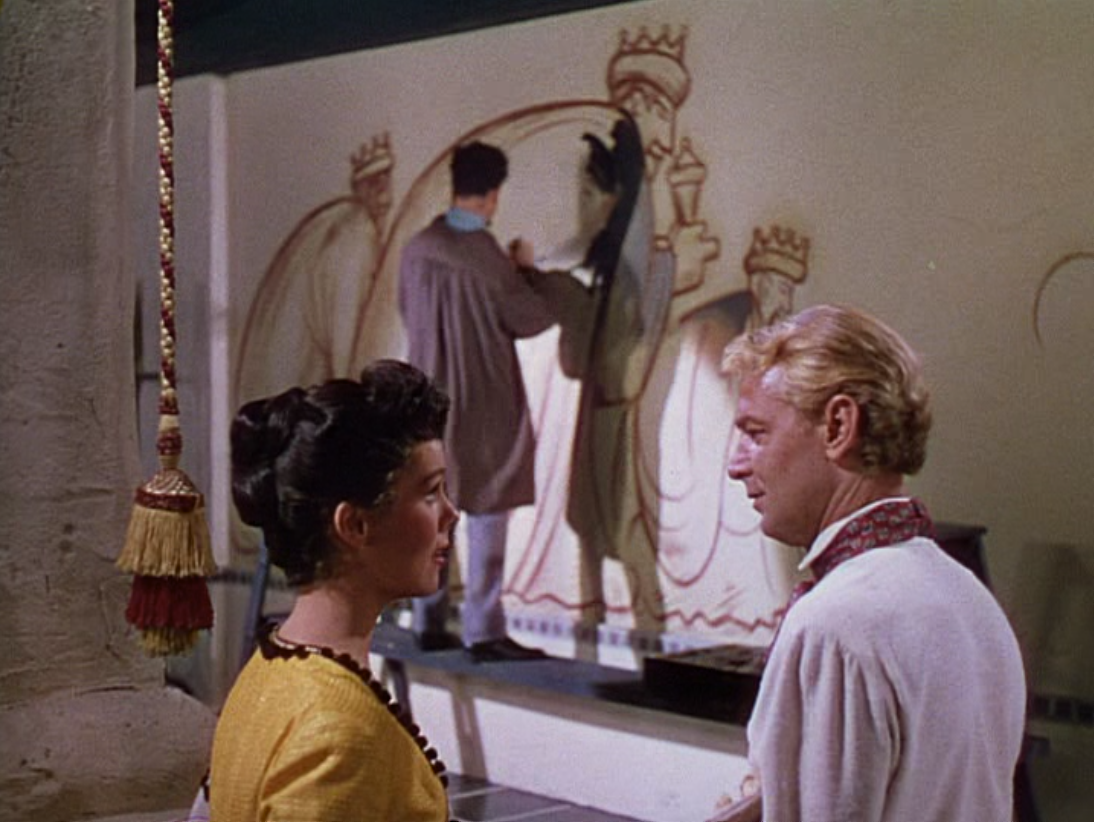

It turns out Ursula's father is the Governor of Texas.  She clearly would like to get together with Jim Bowie, but he is still obsessed with Judalon.  He leaves Texas, saying he's going to wrap up his business affairs in New Orleans, but Ursula can see it's really so he can have one final chance to find and woo Judalon.


Bowie encounters Judalon and her husband Phillipe (Alf Kjellin) on a riverboat.  Phillipe is a terrible gambler and desperate for money.  When he loses a huge sum of money to some card sharps, Jim saves the day by exposing the cheaters and getting Phillipe's money back.  Judalon tells her husband she's leaving him for Jim.  Phillipe decides to ambush Jim in his cabin on the boat.  There's another guy called Black Jack Sturdevant (Anthony Caruso) aboard the boat and planning to kill Jim too because of reasons.  (I kind of left out his whole part of the plot, but he's been after Jim Bowie for a while now -- and he stole Jim's knife.)  


Now, we all know that Jim Bowie died during the siege of the Alamo, not on a riverboat, so obviously, he survives the ambush.  And he finally realizes that Judalon has never and will never love him, that she's a scheming opportunist and liar.  He is through with her at last, and heads back to Texas to marry Ursula (also historically accurate!) and start a new life there.  And he tosses his special knife in the river on his way out for symbolic emphasis.


While the main plot of this whole movie is made up (everything involving Judalon, basically), it does at least hit some facts here and there.  It's one of those "well, this COULD have happened" sorts of movies.  And it's a good time -- lots of knife fights and duels and brawls, Alan Ladd looks gorgeous throughout, and he even gets to do some stunts.  The two things that you would think most likely to stretch your credulity -- that fight where he kills a guy while he's got a sword is sticking out of his chest, and the fact that he married the governor of Texas's daughter --  are totally true.  


Is this movie family friendly?  Basically.  There's a lot of hand-to-hand violence and some gunplay, but it's all very '50s-style and non-gory, non-scary stuff.  Judalon clearly is untrue to her husband, and even kisses Jim after she's married to Phillipe, but it's very tastefully handled and could even be a good talking point for parents and children about what marital infidelity is.

You can easily find The Iron Mistress on DVD, but I don't know that it's streaming anywhere.

Thursday, July 14, 2022

My Ten Favorite Biopics

I love movies based on the lives of real people.  Whether they're a little fantastical or strictly factual, I find them fascinating.  Of course, there are many movies based on real people that aren't biopics -- they focus on one event or short period in the person's life.  I think it only counts as a biopic if it either covers most of their life or a big part of their career.  Anyway, that's how I narrowed down my list for this post ;-)


Titles are linked to my reviews where applicable.

1. 42 (2013)

Jackie Robinson (Chadwick Boseman) is hired by Branch Rickey (Harrison Ford) to play for the Brooklyn Dodgers, breaking the "color barrier" by being the first black player on a white team.  It's a masterful, respectful, beautiful film.


2. Luther (2003)

Martin Luther (Joseph Fiennes) wrestles with his conscience, Scripture, and the Roman Catholic Church as he slowly comes to terms with the fact that the church needs to be reformed.  A moving portrayal of an ordinary man used by God to do extraordinary things.


3. Beyond the Sea (2004)

Bobby Darin (Kevin Spacey) reflects on his life and career in this mythic musical that tells his story through song and dance.  It's so bouncy and joyful!  Even in the low points.


4. Amazing Grace (2006)

William Wilberforce (Ioan Gruffudd) fights and fights and fights to end England's slave trade.  And he finally succeeds.  A beautiful movie in so many ways.


5. Evita (1996)

Eva Peron (Madonna) climbs Argentina's social ladder any way necessary, eventually becoming its first lady.  This music might get stuck in your head, but that's not really a bad thing.


6. Walk the Line (2005)

Johnny Cash (Joaquin Phoenix) turns anger and frustration into music, falls in love with June Carter (Reese Witherspoon), and finally learns to walk the line.  Masterful performances from both Phoenix and Witherspoon.


7. The Glenn Miller Story (1954)

Glenn Miller (James Stewart) makes music wherever he goes, bolstering the spirits of his family, his friends, and the entire nation.  Mostly a feel-good movie, but not entirely.


8. The Unsinkable Molly Brown (1964)

Molly Brown (Debbie Reynolds) goes from rags to riches multiple times, surviving gold rushes, bankruptcy, and even the sinking of the Titanic!  This is an irrepressibly fun movie.


9. The Wings of Eagles (1957)

Navy flier Frank "Spig" Wead (John Wayne) is paralyzed in an accident, but with the help of his wife Min (Maureen O'Hara) and many friends, he battles his way back to being able to stand on his own two feet.  So inspiring!


10. Miss Potter (2006)

Beatrix Potter (Renee Zellweger) falls in love, writes stories, paints cute pictures, publishes books, and refuses to let anyone stop her from doing any of those things.  It's a sweet, fun mix of cuteness and determination.

Wednesday, January 01, 2020

My Ten Favorite New-to-Me Movies of 2019

Happy New Year!!!

In 2019, I watched 102 movies.  Not 102 separate titles, as I am a major re-watcher, but I sat down and watched a movie 102 times. T'was a happy year.  As always, I'm here with a retrospective in the form of a list of the 10 new-to-me movies I liked best this past year.  Titles are linked to my reviews where applicable.


1. Midway (2019).  Faithful, dazzling, elegant presentation of the early Pacific Theater of Operations during WWII, from the attack on Pearl Harbor on December 7, 1941, through the Battle of Midway June 4-7, 1942.  I love this movie so much, I've put it at #14 on my list of my 100 favorite movies.  I've seen it in the theater four times now, and I'm aching to see it again.

2. Captain Marvel (2019).  This movie is just plain, unadulterated fun.  A woman (Brie Larson) learns the truth about her identity and sets about undoing all manner of injustices she was an unwitting part of.  Yes, it's a superhero movie, but it speaks to the universal longing for self-knowledge and finding your true place and purpose.

3. Avengers: Endgame (2019).  I'm okay now.  I was not okay after Avengers: Infinity War (2018), but I am okay now.  The Avengers have triumphed.  The saga is basically complete, and I will tentatively be interested in the MCU going forward, but I might be okay just letting the story be done here for me.  We'll see.

4. Captain Carey, USA (1949).  An OSS agent (Alan Ladd) gets betrayed to the Nazis while on a mission in Italy.  When the war is over, he goes back to seek vengeance for the death of the woman he loved, only to discover that much of what he thought he knew about that fateful night was a lie.  Ladd is the best part of this movie, but it's still a solid watch even if you're not his fan.

5. The Man Who Invented Christmas (2017).  Charles Dickens (Dan Stevens) needs money.  And he needs his career to stop fizzling.  And he needs these grumpy characters in his head (especially Scrooge, played by Christopher Plummer) to cooperate.  And he needs people to stop pestering him so he can just write his next book.  I was WAY more charmed by this movie than I expected to be!

6. Up (2009).  Cute kid and grumpy old guy and funny dog have an adventure.  This movie made me cry a lot.  Pixar does that well.

7. 17 Again (2009).  Middle-aged guy (Matthew Perry) thinks his life would have been so much better if he'd only fulfilled his potential as a basketball player after high school.  Then he gets turned back into his 17-yr-old self (Zac Efron) and sees his life in a whole new light.  I thought this movie would be dumb, but wound up totally digging it.

8. Dodge City (1939).  A cowpuncher (Errol Flynn) becomes a lawman so he can bring law and order to Dodge City.  And also to gain the respect of a woman (Olivia de Havilland).  My first Errol Flynn western!  Won't be the last, I assure you.

9. The Thin Man Goes Home (1944).  Nick (William Powell) and Nora (Myrna Loy) visit Nick's hometown, where he gets no respect, no respect at all.  But he does get to solve a mystery.

10. How to Train Your Dragon: The Hidden World (2019).  Every story has a ending, including Hiccup and Toothless's.  This movie also makes me cry, but I like it anyway.  So do my daughters.  My son hates it.

Special Mention: They Shall Not Grow Old (2018).  Peter Jackson's haunting presentation of WWI that transcends the documentary genre.

What wonderful movies did you discover this year?  Did you see any of these?

If you want to see my lists from 2014 through 2018, there are links to them at the bottom of my "Ten Favorites Lists" page.

Here's to a new year of watching movies!

Wednesday, November 13, 2019

"Harriet" (2019) -- Initial Thoughts

Biopics are always tricky to balance.  You've got to remain fairly faithful to a the real events of the person's life, because if they're famous enough to have a movie made about them, they're famous enough that a LOT of people know a LOT about them.  They will be quick to point out your errors if you deviate too far from fact, or if you spin a story to suit an agenda that the person in question was not a part of.

But you also have to make the story of a real person's life interesting.  And real life has a lot of boring parts.  Even the real life of a famous, courageous, heroic person.  You need to tell a cohesive story with a beginning, a middle, and an end, and some central message or point to your story.  Real life often lacks cohesion, messages, and points.  But a biopic is not a documentary -- it promises good storytelling, not a recitation of facts.  So you need to find a way to portray a person's life within the framework of a story.

Also, you need to be telling the audience something new, something that makes your movie worth seeing for those who are familiar with the story of your subject's life.

So much to balance.  So tricky.

So few biopics manage to balance all of that successfully.

I went to see Harriet (2019) this weekend.  Now, most of what I know about Harriet Tubman, I learned by reading my copy of Freedom Train (by Dorothy Sterling) over and over as a child.  I'm going to remedy that shortly -- I've put several books about her on hold at the library, but none of them are in yet.

Anyway.  I re-read Freedom Train today so I could refresh my memory as to the actual facts of Harriet Tubman's life.  It's a biography for kids, told like a story, but I trust it more than I do a movie, to be honest.  I'll review it on my book blog soon, on its own.  But if you're looking for a quick way to introduce yourself or a kid to Harriet Tubman's life, it's an excellent resource.

Okay, so the basic facts as presented by the movie were correct.  Harriet Tubman was born a slave in Maryland, escaped as a young woman, then became a conductor on the Underground Railroad and went back into the slave states to bring out her siblings and parents, plus many more.

But you know movie makers.  They love to spice things up.  I don't mean that in a sexual way, in this case, but in a "let's add something weird to make this movie more interesting."  As if the story of this brave, stubborn, intelligent woman wasn't actually interesting enough.  They took the fact that Harriet Tubman suffered a head injury that made her randomly fall asleep and they twisted that, giving her visions from God that aided and guided her.  They made her seem like a mystical, possibly delusional woman, and other characters dismiss her as crazy or brain-damaged or imagining things.

HOW IS THIS BETTER than the truth, that Harriet Tubman was a woman of indomitable courage and solid faith in God?  I think they were trying to make her seem "special" and "gifted," but to me, it does the opposite.  It makes it look like it's God, not Harriet Tubman, who's leading people to freedom.  They robbed her of her dignity and free will and turned her into a sort of sideshow curiosity.  In my opinion.  I was not a fan of this choice.

[EDIT: According to the book She Came to Slay by Erica Armstrong Dunbar, Harriet Tubman did say she experienced visions when she was unconscious, which she believed came from God and often served as warnings about bad things about to happen.  So there is some basis in her life story for how they portray this in the film.  However, that book didn't say she ever invited the visions the way they show in the film, and they used these visions FAR too often as a sort of Deus ex machina to suddenly avert disasters, so I still say it's weak storytelling/writing.]

Now, the film on a whole is really good.  There are some amazing chase scenes, there's overall a lot of excellent acting, the music is great, and the pacing was very good indeed.  Cynthia Erivo portrays Harriet as fierce and yet frightened, and I was fully invested in her portrayal, with the exception of the mystical visions from God, which I blame the screenwriters and so on for, not her.

Is this movie family friendly?  Wellllllllllllllllll... there's no nudity, and most violence is implied... but there's some pretty bad language (including the F-word), there are a lot of very tense chase scenes, some discussion of white masters having slave children who look like them, mention of young girls being raped, talk of spending money on whores, and several instances of seeing people's scars from whipping, burning, or other violence.  So I'd say it's not for children or younger teens.

Saturday, December 23, 2017

"The Greatest Showman" (2017) -- Initial Thoughts

If I had to sum up this movie in one word, it would be celebration.  Not that it's a movie filled only with sunshine and rainbows, because it's not -- there's some genuine darkness here and there.  But that only serves to make you appreciate the light more.

For centuries, actors and actresses and other showbiz folk were viewed with suspicion because so often they were "different."  Sometimes that was because they were a different race, from a different country or region, had strange abilities, even were physically unusual.  Sometimes it was because they were so transient, moving around from place to place in order to find an audience.  Theatre people have been viewed as everything from amoral to immoral to downright dangerous. 

I mean, think about what happens in Hamlet when the troupe of actors arrives.  Polonius, though he has acted in the past himself, treats them with disdain.  Prince Hamlet insists they be treated with dignity and spends quite a few words on how important they actually are.  He's clearly in the minority with his views in Elsinore, though.

But the theatre world has also long been the place where misfits are welcome.  Weirness, quirkiness, oddness, even freakishness is welcome there.  Embraced, even.  Being different can be an asset in theatre, not a handicap.

It probably won't surprise any of you to learn that when I was in college, I was considered weird.  (I didn't go to high school, but if I had, I'm sure I'd have been weird there too.)  I was homeschooled, I enjoyed studying, I liked old movies and old music and old books.  I didn't smoke, didn't party, didn't cuss, didn't skip chapel unless I was sick, didn't drink alcohol until I turned 21, and didn't like sports.  Total freak, in other words.

And I hung out with the weird people too.  The girl with the black lipstick and all the black clothes and the staggering collection of Metallica CDs.  The guy with the tattoos and dyed hair.  The girl who wore pants under her skirts and quoted Arlo Guthrie songs.  People who were weird, who were unusual, who were different. 

I wasn't quite in the theatre crowd in college.  I lurked on the fringes of it.  I painted scenery.  I sang and frolicked in the chorus for three musicals.  And I was friends with some of the theatre people, and went to every play they put on.  Even at a tiny, Lutheran college in the Midwest, the theatre crowd was where the weird people got to be embraced and included.  Didn't matter if you were tall or short, skinny or fat, black or white, talented or just enthusiastic -- you were welcome there, and something you did well would be found, fostered, put to use.

And that is what The Greatest Showman celebrates. 


P. T. Barnum (Hugh Jackman) starts life poor.  Mistreated, malnourished, eventually orphaned, he takes a job with the railroad and goes west, coming back to New York City a respectable adult.  He marries his childhood sweetheart, Charity (Michelle Williams), who comes from a rich family but leaves them to live in a tenement with him while he works one job after another.  They have two sweet daughters, and although they're barely scraping by, they're happy.

Barnum loses his job, cons a bank into loaning him a lot of money, and opens a sort of museum of oddities, kind of like one of those Ripley's Believe it or Not places you find in tourist traps.  But it doesn't succeed until he takes his daughters' advice and hires performers and outcasts.  To the little man who would become known as Tom Thumb (Sam Humphrey), Barnum says, "They're laughing at you anyway -- why not get paid for it?"  He didn't try to convince the people he hired that they were normal, he helped them find ways to use their differentness to earn a living.  And by doing that, he gave them a chance for acceptance.  Not acceptance by the audiences who came to gawk at them, but acceptance from each other.

In the literary and theatre crowd at my college, we knew we were the weirdos.  We knew that the popular people laughed at us.  But we accepted and respected each other.  And that came to matter more to me, at least, than whether or not other people called me "the smart girl with really long hair" instead of my name.

There's a point in The Greatest Showman where Barnum stops accepting and including his performers.  He shuts him out of a fancy gala.  He turns his back on them and seeks after fame by a different route, escorting famous singer Jenny Lind (Rebecca Ferguson) across the country and promoting her concerts.  He abandons his family, his performers, everyone who counts on him.  And eventually, he realizes that by leaving them behind, he's left behind the people who accept him for himself as well.  Lind wants him to be her consort, not her manager, and when he refuses her advances, she breaks her contract and bankrupts him.  She even tries to rob him of his family by causing a scandal. 

Lind shows that even in the world of the theatre, which the movie mostly peoples with kind, generous, helpful people, there are selfish and mean-spirited people as well.  There were in my college's theatre world too -- because people are people no matter where they are, all sinners everywhere.  The lesson here isn't that theatre people are perfect and everyone else are losers.  It's that accepting people despite their imperfections, embracing their weirdness, and not trying to make them be what they aren't is a good and honorable way to live your life.


You may have guessed that I loved this movie.  I've had to recalibrate my list of favorite movies I saw in 2017 so I can fit this on it.  Hugh Jackman is one of my absolute favorite actors, and he shines so brightly here, obviously enjoying his every moment in the role.  Even the unhappy ones.  His scenes with his protege and later partner, Phillip Carlyle (Zac Efron), are particularly excellent.  They share a boisterous dance that I can't wait to see again.

Was this movie family friendly?  Remarkably so!  One song has the word 'd--n' in it, I think.  I don't recall any other bad language, though I may have forgotten something.  There are a few scanty costumes, some kissing.  A fire scene that would probably scare small children.  I would recommended it for maybe 8 and up.  I plan to let my kids watch it when it comes to DVD, with me to fast-forward through the fire scene.  There's also a non-gory brawl and the suggestion that Barnum's wife thinks he's been unfaithful, though as far as the movie shows, he was not.  They never say that out loud, it's all implied.

I have other thoughts about this movie too, but this is long and gushy already.  I may write another review when I've seen it again, though that might not be until DVD since I need to see Star Wars: The Last Jedi in the theater yet, so I might not have a chance to go see this again.  I would like to, though, because it is an awesome spectacle on the big screen.


Sunday, April 21, 2013

"42" (2013) -- Initial Thoughts

Go see this movie.  Just go see it.  I'm serious.  Even if you don't usually go to the movies, go.  Even if you don't like baseball movies, go.  If, for some extremely legitimate reason (lack of money, lack of a diver's license, or lack of a theater within 100 miles that's playing it) you can't see it in the theater, rent/stream/buy it as soon as it comes out.

I don't know that I've ever said that about a movie before.  I mean, I like a pretty crazy mix of movies, and I know everyone has their own tastes, so I don't usually tell people to go see a movie just cuz I like it.  But I really, truly think most people should see this movie.  (Due to strong language, racial slurs, and a little mild innuendo, it's PG-13.)

Okay, in case you didn't know, 42 is the story of how Jackie Robinson (Chadwick Boseman) became the first African-American player in Major League Baseball.  It begins with Branch Rickey (Harrison Ford), the Brooklyn Dodgers' General Manager, announcing he wants to add a black baseball player to the team, and selecting Jackie Robinson as the one he think can handle the job.  It's the mid-1940s.  World War Two is over, but segregation and Jim Crow laws are not over.  Rickey needs a man who can stand up under all the torment and abuse that will be coming at him, and he believes Robinson has the courage needed.  Robinson isn't so sure, but he can't resist the challenge, so he signs on.  Then promptly calls his girlfriend back in California and proposes to her.

The rest of the movie is about how he proves himself as a ballplayer and human being, gradually winning over  white fans and teammates alike.  I clapped, I bounced with joy, I cried, I clapped some more.  I can't wait to buy this and see it again.  It's the best baseball movie I've seen since The Natural (1984).

But this is so much more than a baseball movie.  It's a movie about Americans, some choosing to do what is right, some choosing to do what is accepted.  And some changing their minds and learning to follow their hearts and consciences.  It's a movie about how we became a better nation.  (Not that we don't still have room for improvement, of course.)

Speaking of The Natural, I read on imdb.com that Robert Redford was the first choice to play Branch Rickey in this.  I'm so glad that didn't work out, and not just because Harrison Ford is my second-favorite actor ever.  I think Robert Redford would have been too sweet, too kindly.  Not that Harrison Ford wasn't kind, because he was.  But he had this underlying steel that made me sure he would never back down no matter how much heat got turned on.  Not to mention, this movie has some of the finest acting I have ever seen Harrison Ford do.  He wasn't a grouchy old guy.  He wasn't an angry, vengeful action hero.  He was a proud, determined baseball lover.


Ford's Branch Rickey has a growly facade, with a phlegmy voice and stooped shoulders, a shuffling walk that makes you think he's harmless, just a nice old guy who means well.  But over the course of the movie, you come to see that this isn't just a schtick on Ford's part -- it's Branch Rickey the character bamboozling the world.  In a very pivotal scene where Rickey finally explains his decision to Robinson, his shoulders gradually straighten.  His voice clears and rings deep and true.  And after he's explained himself, the mask slips back on, and he's back to being the forward-thinking old coot.  It's masterful.  I want him to get an Oscar for this, I really do.


Okay, enough rhapsodizing about Harrison Ford -- I need to talk a bit about Chadwick Boseman's performance.  First, I think he's a lovely match for Robinson, physically.  They both have boyish faces, a bit of a mischievous twinkle in their eyes, a contagious smile.  He's got a lovely voice, and a very natural, engaging, thoughtful style.  He's got an athletic build and that controlled grace that comes from all your muscles working together (something I lack and envy).

Jackie Robinson
Chadwick Boseman

Nicole Beharie played Rachel Robinson.  A relative newcomer, like Boseman, she exuded confidence and love.  It was obvious from her first scene why the dynamic Jackie fell for her.  I hope to see her in more things!


And finally, I'm going to mention Alan Tudyk.  He plays the closest thing to a Bad Guy that this film has -- Ben Chapman, the vitriolic, bigoted, loud-mothed manager of a rival team who insults and heckles Robinson and his teammates, leading to a moment where Jackie thinks he might just have to quit this whole idea.  I love Alan Tudyk, I really do -- he's phenomenal and memorable in everything, even if he's just voicing a robot like in I, Robot (2004).  Here, he's despicable and disgusting... and indispensable.


Okay, time to talk costumes!  They were unobtrusive, and by that I mean, I didn't really think of them as costumes.  I thought of them as clothes, real clothes worn by real people, and I don't think there can be any higher praise than that for the wardrobe department on a biopic.  The men wore suits and ties (or bowties, in Branch Rickey's case), and there were lots of suspenders, which I loved.  The women wore dresses or skirt ensembles.  The baseball players wore baseball uniforms.

Extras... only some of which are alive...

Is this movie family-friendly?  Like I said at the beginning of this review, not necessarily.  But what is there is there for a reason, to make a point, not just to add shock or raunch to the movie.  There's no nudity, no sex, no real violence other than a bunch of guys trying to get in a fist fight a few times.

Wednesday, June 15, 2005

"Beyond the Sea" (2004) -- Initial Thoughts

It's no secret that I love the music of Bobby Darin. Maybe 'love' is too mild and common a word. 'Adore' doesn't quite work either. 'Worship' seems a bit... blasphemous. Maybe I'll settle for 'delight in'. I delight in the music of Bobby Darin. I revel in it. I let it tickle my toes and wash through my fingers. I absorb it; I breathe it in like incense; I soak in it with greatest bliss. 

I just saw Beyond the Sea tonight. Yeah, the semi-biopic about Bobby Darin that stars Kevin Spacey, Kate Bosworth, and John Goodman. They got Spacey to look quite a bit like Bobby, and he moves so much like him it's scary. Spacey does his own singing, which I was a little worried about. But he's brilliant! He perfectly mimics Bobby's unique timing and signature vocal quirks. He even nails that little husky purr that always melts me. His voice is pleasant, but not magical like Bobby's. 

I cried at the end of the movie. I didn't think I would; obviously, I know how it's gonna end, right? Bobby Darin died. Fact. But when the audience at the Flamingo started grooving to his song, I choked up. When they hit their feet, I was a goner. And then when he launched into "The Curtain Falls"...trust me, they were tears of pure, unsullied joy. Joy that this movie fulfilled and surpassed all my hopes and expectations. 

Now, please understand that this movie is not a strict portrayal of the life of Bobby Darin. No no no. It's rather a celebration of the music and magic that Bobby gave to us. But it's not a total fictionalization, like Hans Christian Anderson. It's kind of a romantic retelling of his magnificent tale of triumph. 

I've delighted in Bobby Darin's music since the first time I heard his version of "Mack the Knife" on the radio on July 7, 1997. The following day, I bought a cassette tape of his music; during my first hearing of those 8 or 10 songs, I felt certain this voice, this music would consume me. 

Twenty cds, several movies, and three original vinyl LP records later, my delight has not abated.