Showing posts with label Inklings. Show all posts

Monday, March 29, 2021

That Droopy Look -- March 2021 Inklings

I'm squeaking in at the last moment (or, nearly) to join in this month's Inklings link-up hosted by Heidi at Along the Brandywine.  You may remember this series from a few years ago, and Heidi has recently revived it!  The idea is that she gives us a prompt, and we post something relating to it during the month.  She collects up all the entries and shares them the next month when she posts the new prompt.  I've been participating on my book blog so far this year, but today, I'm taking the action over here because I want to share a scene from a movie instead of a book.

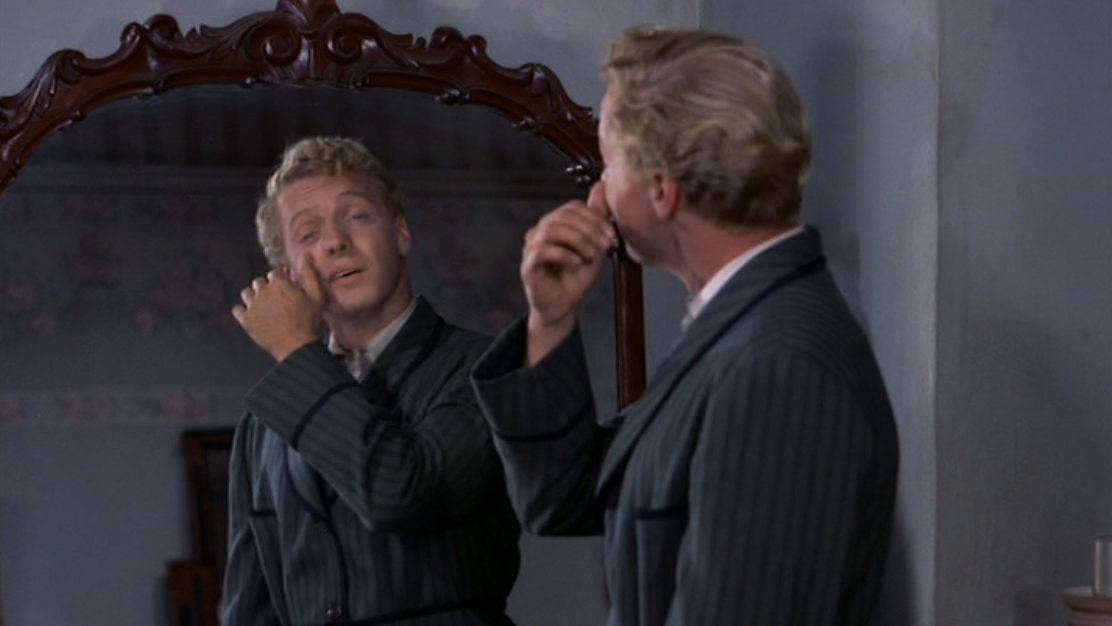
This month, the prompt is: A scene involving a mirror in book or film.  And the first one that popped into my mind was a scene in the film We're No Angels (1955).  It's such a funny scene, and my husband loves to quote it.

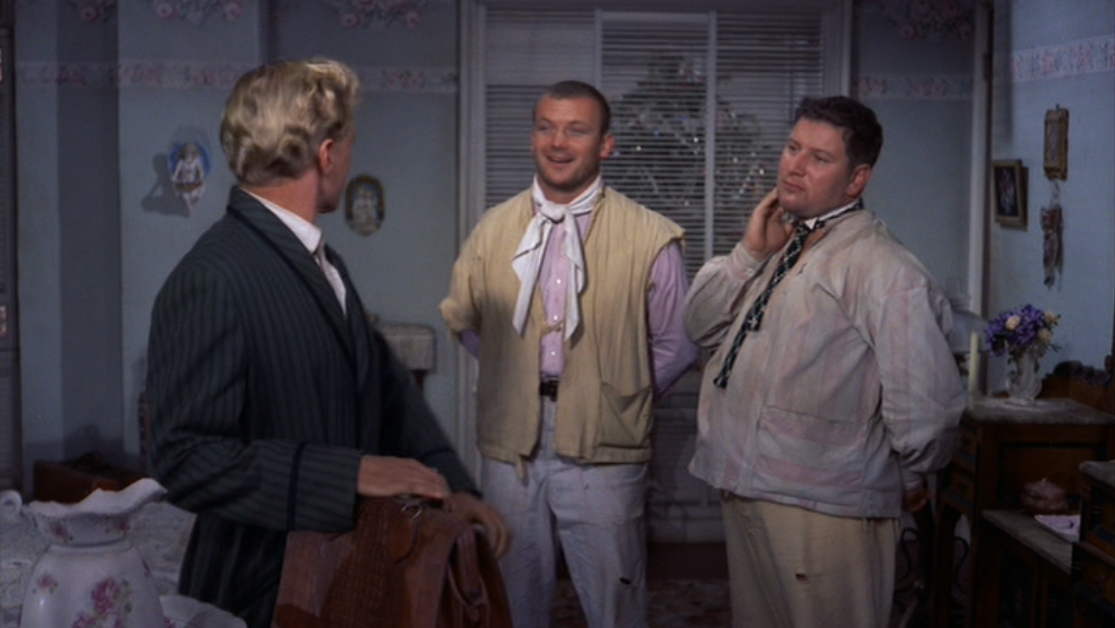
It all begins when Paul Trochard (John Baer) discovers that his uncle Andre (Basil Rathbone) is dead.  He retires to his room to collect himself.  He's followed by two convicts, Jules (Peter Ustinov) and Albert (Aldo Ray).  They arrive in time to see Paul making melancholy faces in the mirror.


He wipes imaginary tears from his cheeks.


And then he bursts out laughing because he can't wait to inherit his miserly uncle's fortune.


Albert and Jules watch and smirk until Paul realizes ::gasp!:: that he's not alone.


Jules congratulates him my saying, "That droopy look of yours -- very effective.  It'll look wonderful at the graveside."

Paul says, "Leave me alone!  Can't you see how upset I am by my uncle's death?"

Albert agrees, "I can hardly keep from laughing, myself."


It's just a tiny little snippet of a scene, but there's so much good character-enriching stuff, and it really is very funny, though I'm sure the humor doesn't come across as effectively in a blog post.

Interestingly enough, the last time I did an Inklings link-up post on this blog was in March of 2016.  Do you know what movie I chose to highlight five years ago?  We're No Angels.  Only the prompt was about letters that time, and you can read that post here.  When I chose this scene, I didn't realize I'd used this same movie for this link-up, much less that it was the last one I did back then, or that it was five years ago this month, but I love this symmetry!

If you like dark comedy, definitely find and watch We're No Angels.  Technically, it's a Christmas movie, but I watch it any time of year!

Tuesday, March 22, 2016

The Deadly Paragraph -- Inkling Explorations for March, 2016


Time for me to quick post my Inkling Explorations selection before March is over!  This month's topic is "A scene involving a letter, package, or post office in film."  You can read more about the series on Heidi Peterson's writing blog, Sharing the Journey.

I'm going to share part of the wonderful Christmastime comedy We're No Angels (1955), which I have reviewed here.

Joseph (Humphrey Bogart), Jules (Peter Ustinov), and Albert (Aldo Ray) are convicts on Devil's Island who have escaped the prison and taken refuge in a mercantile, where they've persuaded the proprieters to let them do a few odd jobs.  While up on the roof, supposedly fixing it, they watch the family through various windows and learn all about their troubles.


While they're watching, the daughter, Isabelle (Gloria Talbott) accepts a letter for her father and opens it.


She reads part of it, then faints.


The three men scurry down from the roof to assist her and her mother, Amelie (Joan Bennett).


They then give the letter to the girl's parents, telling her, "It's there, on the second page, the deadly paragraph."  The letter contains the news that the owner of the store and his nephew were coming to see for themselves why the business is failing.  Poor Isabelle has convinced herself she's in love with said nephew, and the letter also contains the news of his engagement to someone else, hence all the fainting.

By the end of the movie, the three convicts have solved all the family's problems, including Isabelle's infatuation, and although they may not be angels, they earn halos just the same.


If you've never seen We're No Angels, I urge you to find it and watch it -- you can buy it on DVD quite inexpensively right now, and it is delightful.

Friday, December 18, 2015

Two Merry(?) Little Christmases: December Inkling Explorations Link-Up


This month's Inkling Explorations subject is "A Christmastide Movie Scene."  As soon as I read that, I knew I wanted to share a scene from The Monuments Men (2014).  You can watch the whole scene here on YouTube, but I'm going to describe it for you here for those who don't want to watch it without having seen the movie, or who have small children in the room (part of it involves some blood).

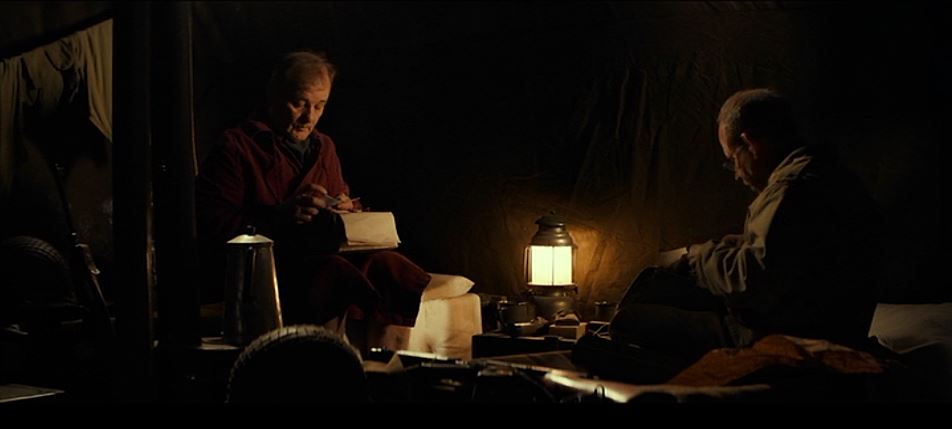
So The Monuments Men is about a bunch of Allies who try to recover all kinds of artwork that the Nazis have been stealing and hoarding, which is based on something that actually happened during WWII.  Throughout the first half of the film, Campbell (Bill Murray) and Savitz (Bob Balaban) have been very antagonistic toward each other.  Savitz thinks Campbell is an uncultured swine, and Campbell thinks Savitz is a pretentious snob.  But they have to share a tent in camp, and they keep getting sent out on assignments together even though everyone knows they dislike each other.


In this scene, Campbell and Savitz have gotten Christmas packages from their families.


Campbell's is full of snapshots and little homemade gifts.


Savitz has received tasty treats that he clearly has no intention of sharing.


Campbell also gets a record, a message his family has sent him that presumably holds Christmas greetings.  (I'm instantly reminded of one of my favorite Combat! episodes, "Just for the Record," which involves Sgt. Saunders [Vic Morrow] receiving a similar record and risking his life to hear it.)

Campbell makes a joke about having to confiscate a phonograph so he can hear it, sets the record aside, and leaves to take a shower.


And while he's in the shower, over the loudspeaker comes the voice of his daughter.  Campbell looks up in wonder as he hears his daughter and grandchildren wish him a merry Christmas.  He turns off the shower and just stands there, listening.


(By this point in the movie, I have tears running down my cheeks.  I'm actually crying right now as I type this up.)  He's got no idea how this miracle has come about.


But we, the audience, know.  Savitz has taken the record of this man he professes to dislike, commandeered the camp loudspeaker system, and is playing the record so that Campbell will get to hear these messages from home.


And then Campbell's daughter begins to sing "Have Yourself a Merry Little Christmas."


This scene has been intercutting with the interior of an aid station, where two other characters bring a wounded soldier they found by the road.


The song continues as a doctor examines the soldier, realizes he's dying, and orders morphine for him to ease his final moments.


Nobody here is having a merry Christmas.  And yet, Christmas goes on whether people are merry or not, doesn't it?  Because in the end, Christmas isn't about merriment.  It's about the pain of childbirth, the miraculous incarnation of God as a tiny child, and the wonder of an undeserved gift not for one person, but for all mankind.

Now, I said in my title that this is about TWO merry (or actually not-so-merry) Christmases.  Because the song "Have Yourself a Merry Little Christmas" debuted in the movie Meet Me in St. Louis (1944), where big sister Esther (Judy Garland) sang it to her littlest sister Tootie (Margaret O'Brien) to try to cheer her up.  You see, their father has decreed that the family will be moving to New York City after Christmas, and the whole family is very sad and upset about this.  So although Esther is singing about light hearts, their troubles are definitely not out of sight.  She says that "through the years, we all will be together," but she's contemplating staying behind in St. Louis, so she knows that much of what she sings in this song might not come true.  It's also a very sad scene, and I'm going to share it here.


Meet Me in St. Louis is one of my daughters' favorite movies, and we watch it regularly.  (And yes, we nicknamed my littlest mouse "Tootie" after Margaret O'Brien's character).  If you haven't seen it, I can wholeheartedly recommend it as a family-friendly delight.  The Monuments Men is also one of my personal favorites, but it's not for younger viewers.  You can read my full review of it here.

Despite the melancholy of these two scenes I've shared here, both of these movies are actually very uplifting and end happily!  And despite the fact that I've chosen to share two Christmas scenes that make me cry, I actually love Christmas and am generally in a happy, bouncy mood from Thanksgiving on.  Honest!

Don't forget to visit Sharing the Journey to read other entries to this month's link-up!  Most of them probably don't involve a blogger crying while she types...

Saturday, October 10, 2015

Gypsies, Tramps, and Thieves: October's Inkling Explorations Linkup

This month, the Heidi's topic for Inkling Explorations is gypsies.  Go here to read her post and other people's entries.


I am going to focus on my favorite film adaptation of my favorite novel:  Jane Eyre by Charlotte Bronte.  I love the 1983 BBC version starring Zelah Clarke and Timothy Dalton, and the "gypsy scene" in it never fails to delight me -- it's got just the right mix of mystery and humor.

This post is going to be spoilage-laden, for anyone who doesn't know the story of Jane Eyre.  Not just know the basics, but have actually read or seen it.  Just so you know!


So Mr. Rochester is having a big house party, and by "house party" I mean he has like a dozen people staying with him, neighbors and acquaintances and so on.  Including the beautiful Miss Blanche Ingram, whom he is rumored to be courting.  One day, while Mr. Rochester is out on business and his guests are all terribly bored, a gypsy woman comes to call.  She insists on seeing all the ladies in the house to tell them their fortunes.  They're bored, so off they go, though many of the ladies don't seem very pleased with her uncannily accurate predictions.  Miss Ingram in particular is quite annoyed when she returns to the group.

The gypsy insists on seeing all the ladies, including the young governess, Jane Eyre.  Jane agrees to go because she thinks it could be interesting.  Into the library she goes to confront the old woman.

Now, the book says the gypsy "had on a red cloak and a black bonnet: or rather, a broad-brimmed gipsy hat, tied down with a striped handkerchief under her chin."  They kept to the color scheme in this version at least, showing a red kerchief under a black hood of some sort.


The book also says the gypsy "drew out a short black pipe, and lighting it began to smoke," which they adhere to in this version as well.


The gypsy starts to tell Jane Eyre things about herself and her habits that make Jane suspect she's been speaking with the servants to learn things about the household.  The gypsy avers it's not so, then tries to draw out Jane's thoughts and feelings about her employer, Mr. Rochester.


Jane doesn't like this at all.  She's growing pretty attached to Mr. Rochester, but she doesn't really want to admit it to herself, much less a weird old gypsy.


But hey, guess what?  It's not actually an old gypsy lady at all!  It's actually Rochester in disguise!  Hahahaha!  What a good joke!


Well, he thinks it's a good joke, anyway.  Jane is not at all amused because he was trying to draw her out and get her to admit she likes him.  But I love how gleeful Rochester is here -- Timothy Dalton exudes boyish delight in this scene, which is what makes me love it.  He doesn't expect Jane to be so awfully angry with him, as you can see.


Then, of course, she tells him a certain Mr. Mason is waiting, and all the fun is over.  And this is what makes this scene so pivotal.  Having learned Jane does care for him at least a bit, a deeply distressed Rochester asks if she would stand by him if all the world were against him.  She says she would do so for any friend, and here I think she begins to suspect that he might return her regard, for why else would he ask her such a thing?  And why else was he trying to find out how she felt about him in the first place?


If you haven't seen this version, but like the story or just like BBC period dramas in general, do yourself a favor and find it!  The characterizations are first-rate, and while the filming has that '80s BBC we're-using-videotape-because-it's-cheaper thing going on, it's still very enjoyable.

Thursday, July 16, 2015

Courage and Sacrifice: the Inkling Explorations Link-Up for July


Time for this month's Inkling Explorations, the monthly link-up hosted by Heidi Peterson at Sharing the Journey.  This month's topic is "A well-crafted animated film climax," and I'm choosing to talk about the classic 1973 Disney film, Robin Hood.  This is my favorite animated movie, and happily, all three of my kids love it too, so I get to watch it fairly often.

Part of the reason I love Robin Hood is how he time and again risks his own safety to help others.  The climax for this movie version is no different.  Friar Tuck is in prison, along with most of the other residents of Nottingham.  But unlike the others, Friar Tuck has been condemned to die for attacking the Sheriff of Nottingham.  So of course, Robin Hood and Little John undertake to rescue him.  In the dark of the night, they scale the castle wall.


They look down on a pretty scary sight.


Archers patroll the tops of the walls.


Soldiers guard the entrance.


Robin is not daunted.  He disguises himself as one of the Sheriff's sidekick vultures, steals the keys to the dungeon, and sends Little John to rescue the prisoners.


So far, everything's going pretty easily.  Little John finds Friar Tuck's cell.  Though do you see that creepy skull to the right?  I never ever saw that skull before I screencapped this.  Kinda freaky.  I mean, it's a happy, smiley skull, but still.  Tension is starting to build, thanks to little touches like that.


Poor Friar Tuck was not being treated well.  I mean, they have him a book to read, but how's he gonna read it without his hands to turn the pages?  More like they're taunting him.  "Hey, here's a book -- too bad you can't read it."  A subtle form a torture, mayhap?


Little John and the freed Friar Tuck proceed to the debtor's prison, where they find all their friends.  Even the baby bunnies have been locked up!  That mean, naughty, low-down Prince John.


Meanwhile, Robin has decided to drop in on the royal treasury.  He scales the walls in the darkness undetected.


Prince John has decided to keep all his gold well-guarded, as you can see.


Robin sets up a rope pulley system with Little John, who's still in the dungeons, and they tie all the bags of gold to the rope and transfer them to the prisoners.  Everything is going peachy keen until Robin gets a little too greedy and takes the bag that Prince John is using as a teddy bear.  Prince John sounds the alarm, and Robin finds himself facing grim archers and few escape routes.


He swings out along the rope leading to the dungeon, narrowly escaping getting shot by various arrows along the way.  He's getting pretty worried about this, which makes us in the audience worried as well.  But so far, Robin's just saving his own skin.  Yes, it's courageous to go steal gold and give it to the prisoners your buddy is freeing, but not exactly heroic.


Little John leads the prisoners out of the dungeon, all laden with Prince John's gold, which of course he took from them in the first place.


They flee across the castle courtyard, unhindered until...


...angry rhino guards give chase.  You only see these guys for a second on the screen, so they're not horribly scary, but when you stop them like this and look at them more closely -- yikes!!!  These guys are mean and out for blood.


Robin and little Skippy stay behind the others to hold off their pursuers.  I love this shot -- look at how Skippy is totally freaking out by the fact that he's about to be killed in any number of horrible ways, but he's still standing his ground, with his hero at his side.  And where is Robin looking?  Not at the approaching enemies.  He's focused on Skippy, checking to see if he's okay.


Their brave stand gives Little John and Friar Tuck time to load everyone into a convenient hay wagon and hustle out over the drawbridge.  The escape worked!


Except that the Mama Rabbit suddenly realizes that her youngest bunny has been left behind somehow.  Look at the terror in poor Mama's face.  Anguish and heartbreak -- her baby will be trampled by rhinos or chained up by Prince John, or maybe just lost forever inside the castle.  Or possibly eaten by the Sheriff of Nottingham, since he's a wolf, after all.


Poor baby bunny is terrified too, toddling along yelling, "Mama!  Mama!  Wait for me!"


Robin Hood hears the baby's cry for help.  And here's where the courage really comes into play.  He stops running, turns around, and goes back into the castle.  He was free, he was out in the forest on the other side of the moat already, but he goes all the way back into the castle to rescue a lost and helpless child.


Baby bunny is clearly grateful.


Robin's almost to safety when a the portcullis comes crashing down, trapping him inside the castle.  (Baby bunny looks distinctly grumpy here -- I suspect Robin Hood may have squeezed it unintentionally.


What does Robin do?  Why, he passes that baby bunny through the portcullis to Little John, and orders Little John to get everyone to safety, rather than rescue him.  Now it's just Robin against a whole castle full of angry guards.  He's sealed his fate, exchanged his life for that of a baby bunny he barely knows.  And he's done it unhesitatingly.  And that, my friends, is why this movie's climax hits home for me.  Not because it's exciting, but because Robin chooses to lay down his life for another.


He doesn't give up without a fight, though.  He scrambles up that portcullis, and on up the castle walls.


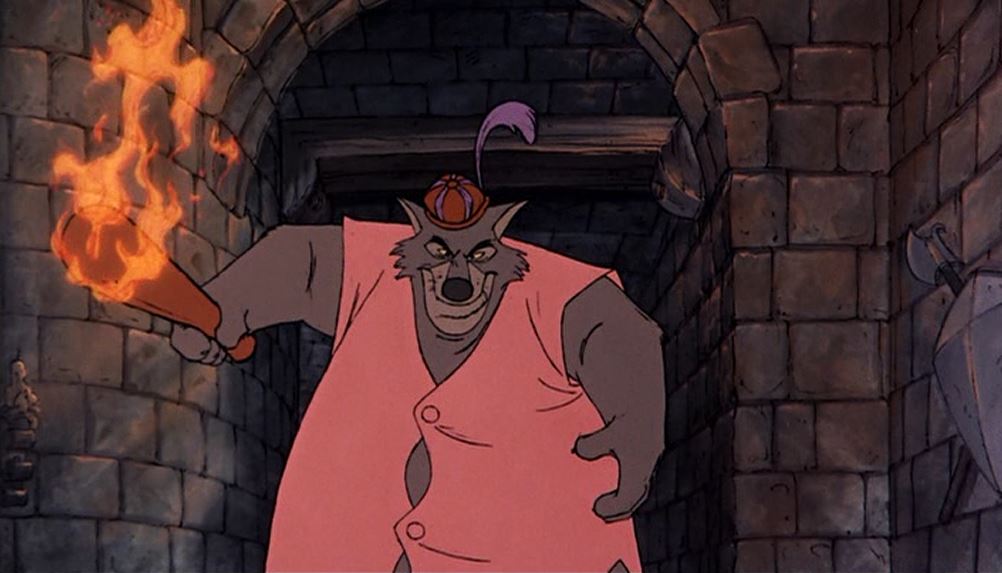
But when he ducks inside the castle, he's confronted by a very angry Sheriff brandishing a torch.


The Sheriff sets fire to everything in the room as he wildly swings his torch, trying to smash our hero to bits.


Robin flees up the stairs, flames licking at his heels.  (And aren't these flames spectacularly drawn?)


But at the top of the tower, there's nowhere to go.  He's completely trapped.


He bolts out the window, climbs onto the roof, and clings there in desperation.


On the other side of the moat, Little John and Skippy watch from the bushes as their friend and hero faces certain immolation. 


Poor, poor Robin Hood.


Of course, he jumps into the moat.


He survives the fall, but the archers above rain arrows down on him.


Little John and Skippy root for him to make it, but there's no way they can help him without getting shot themselves.


Robin goes under, and only his hat surfaces, with an arrow through it.


Prince John rejoices.


But look at Skippy's face.  He's slowly realizing that his hero has given his life to save Skippy's baby sister/brother.


This picture here?  It's making me tear up as I write this.  Oh, that poor little Skippy.


But what's this?  Why, it's a reminder that this is a Disney movie, not film noir.  It's a reed swimming around in the moat by itself.


Robin's using it to breathe through, and when he's out of range of the archers, he pops up out of the water.  Skippy prepares to give him a giant bunny hug.


His hero is safe!  My hero is safe!  Huzzah!


"A pox on the phony king of England!  Oodalolly!"


Cry all you want, Prince John.  Robin Hood has triumphed.  Good has trumped evil, and moral balance is restored to the universe.


So, there you have it.  My choice of a well-crafted animated film climax, one that showcases the hero's courage and willingness to sacrifice himself for others.  Be sure to check out the list here on Heidi's blog so you can find other people's entries to this month's link-up... and maybe add your own?